Darya Anichkina, formerly a fashion editor at Jalouse and Harper’s Bazaar, and a fashion director for Elle and Tatler, shared memories with the Russian Fashion Archive about working in one of the most underground glossy magazines and about the fashion industry of the 2000s.


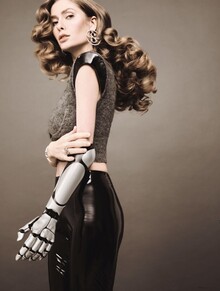
Jalouse, March 2006 The clothing worn in the shoot belongs to Denis Simachev, Alena Akhmadullina, Nina Donis, Max Chernitsov, Oleg Biryukov, and Alexandr Arngoldt. Photo: Slava Filippov; Styling: Daria Anichkina
Lyudmila Alyabyeva (hereafter—Lyudmila): Daria, is the entry into fashion somehow connected to your educational background?
Daria Anichkina (hereafter—Daria): Was there even a single person in glossy magazines who came in because of their education? Well, there was—Alena Isaeva; she graduated from the Textile Academy and seems to have trained as a fashion designer. I remember that even in Bazaar, where she was my boss, Alena gave us lectures on seams, epaulets, and other costume elements.
Generally, there are few such people. Personally, I am a magazine «nepo-baby» and graduated from the Philological Faculty at Moscow State University [Editor’s Note: Nepo baby, an abbreviation for nepotism baby, is a term referring to a person whose career mirrors or is connected to that of their parents]; my family—my mother, my father, my stepfather—all worked in magazines or newspapers their entire lives. Even my grandmother worked for the magazine «America» until her death, and my mother was a photo correspondent for TASS.
During the Perestroika era, things became uncertain: joint ventures emerged, and Dirk Sauer [Editor’s Note: media mogul, publisher, founder, and owner of the Independent Media holding] arrived in Russia, deciding to establish his presence here.
His first magazine, as far as I recall, was «Megapolis"—something akin to an urban chronicle. The paper was glossy, but not in the modern sense of glossiness.
Daria: Cosmopolitan was the first real glossy magazine, followed by Elle [Editor’s Note: Cosmopolitan began publishing in Russia in 1994, and Elle in 1996.].
When the publishing house Parlan launched a new project, Jalouse, I was working at the Condé Nast reception desk while completing my thesis in my fifth year of university. I was invited to become a fashion editor, even though I had no prior experience besides an assistant role. They told me, «You dress well and you love fashion—why not give it a try?» I agreed and started working!
Svetlana Salnikova (hereafter Svetlana): So this is one of those stories where you start at the reception desk or as an intern and then become an editor?
Daria: Yes, a fashion editor coming from the reception desk [smiles]. Usually, everyone at Condé Nast was quickly «moved up»: within three to four months, everyone was transferred to other publications—GQ, AD, Vogue.


Black Widow Jalouse, October 2005 Wardrobe used in the shoot: Nina Donis Photo: Olga Lavrenkova; Style: Daria Anichkina; Model: Ksenia Semenova
Darya: I interviewed for the Fashion Features department at Vogue [Note: Feature story/feature article refers to a journalistic piece that tells a story about a news event or personality from an unconventional perspective], but I didn’t want to write review pieces—I’ve never been passionate about that, so I declined and ended up waiting at the reception desk longer than anyone else—for almost six months.
So, my path into Condé Nast didn’t work out the first time. They diverted me to Jalouse [Note: The magazine was published from 2001 by Les Editions Jalou, which also published L’Officiel. In Russia, it was published by the «Parlan» Publishing House and Evgeny Zmievets], and it was a lot of fun: the magazine was made almost from scratch on a shoestring budget. The budget for an entire issue was about the cost of a single Vogue photoshoot. I worked there as the Fashion Editor from its inception until it closed—for six years.
Lyudmila: How were you managing to produce an issue with such a limited budget?
Darya: Everything relied on friendship: we negotiated with everyone for free. Half of the photoshoots were done with us ourselves. The Photo Editor, Sasha Levandovskaya, and the Deputy Art Director, Natasha Blumenthal—both were slender beauties.
So we filmed them, then cut their heads off, stuffed them, and sort of assembled them. Our motto was: «Golf is clever with invention.» We were friends with young designers who were interested in collaborating.
Lyudmila: Have you collaborated with Russian designers from the very beginning?
Darya: Yes, mostly with Russian ones. I just reviewed old issues—probably only Nina Donis, Tegin, and Inshade remain on the market. Terekhov might have shown up somewhere, but I don’t remember for sure. I no longer see the other names.
Lyudmila: And where did you find them?
Darya: Honestly, everywhere. Many came to us themselves, some were friends of friends, and so on; just at certain parties, in clubs, through acquaintances, everywhere.
Lyudmila: So, there was no guideline against featuring Russian designers?
Darya: On the contrary, our policy was to primarily feature them. We couldn’t afford major fashion shoots on the level of serious glossy magazines. That’s why it was so much fun with Russian designers; every issue definitely featured some new designer, some new name. And with him—an interview, at least for a column [Editor’s Note: This refers to the «[LAB]Talent» section].
Sometimes people would bring pieces they had cobbled together the day before, often recycled items. We didn’t know what it was called then, but we used them actively.


Designer Interviews: Tatiana Sudaryannto, Maxim Chernitsov, Dmitry Uvarov, Gosha Ostretsov, Sergey Ishbulatov, Tatiana Miskevich in Jalouse, March 2003
Darya: We were a magazine that was completely outside the market’s understanding; back then, L’Officiel, Elle, Vogue, Harper’s Bazaar—all the major glossies—were out there. Ours was easy, fun, leaning toward avant-garde, art, and provocation. But people accept that when you don’t have the means to produce super high-quality, expensive shoots with major photographers. Nobody expected that from us.
Svetlana: So, it was 2001, right? Did you feel like you were creating something new—a new era, a new culture? You had unconventional shoots, designers, and content that was alternative yet glossy.
Darya: You know, we weren’t thinking about that back then; we had a very cohesive editorial team, especially in the early years. There was this feeling of «us against the world.» We felt alienated from the mainstream market. The publisher constantly criticized us: he demanded more advertiser support, more digestible content, but we did things our own way.
We used to have nude men on our covers, and I shot the jewelry in fish entrails and on grandmothers. Everything looked provocative, and for that, we were constantly threatened with losing our advertising spots.
Lyudmila: But you worked like that for six years? That’s surprising, isn’t it?
Daria: Yes, six years. We were under pressure, and maybe that was what united us. We even traveled for breaks together, the entire editorial team. We barely separated; the staff hardly changed. Only the freelance writers changed, but the core team remained the same.
Lyudmila: So, there was no turnover?
Daria: No. But who would want to work for a pittance under constant pressure? Of course, we all did side jobs—I shot for other magazines and advertisements just to get by.
Lyudmila: And was the tone and presentation of Jalouse different from Vogue or Bazaar?
Daria: Jalouse was something completely different. Vogue is a huge international machine with a hundred-year history. Bazaar is even older—it was probably around 140 years old by then. But Jalouse [at the time] had just launched in France [Editor’s Note: in 1997], and the Russian Jalouse was second in the world. The French approach was like this: light discussions, recipes, horoscopes, superficial things. Here’s a great photoshoot, here’s a little horoscope, here’s a recipe.


Jalouse, May 2004 Clothing worn in the shoot by Denis Simachev Photo: Elena Daruze; Style: Daria Anichkina
Daria: Everything was different for us. We couldn’t do anything like this here. We took a logo and made our own magazine; we only syndicated the big shoots with them—it’s incomparable. Looking back now, I think our voice was super avant-garde. It was an alternative magazine that aimed to tell everything; we tried to be unlike anything else and feature the smallest new names, even if they disappeared after two days. We collaborated with many famous art figures: Volodya Fridkes, Ira Korina, Stas Shuripa, well-known graffiti artists, and so on. Why would we do something different? Major publishing houses already existed with mainstream gloss and top models… Our niche emerged organically.
Lyudmila: That’s astonishing. My colleagues and I discussed how, in the 2000s, when major advertisers came in, pressure started, and freedom ended. Magazines turned into advertising catalogs. Vogue, for instance, in the mid-2000s (at the same time Jalouse was publishing with small budgets), was half advertisements. Jalouse is a unique story, it seems.
Daria: In a way, yes.
I recently listened to a podcast where they discussed how advertisers, perhaps unintentionally, ruined the industry. Glossy magazines wanted these advertisers, but the advertisers essentially enslaved them, turning the magazines into glorified ad catalogs.
Daria: I agree with this theory [Note for ARMS: it is likely referring to the «Why Glossy Empires Collapse» episode of the «Pino, Arno, and Domino» podcast].
But perhaps the industry itself was heading nowhere from the start. Nobody invests money in a project that doesn’t generate revenue. Nobody figured out how to earn money in a different way. It was an unsolvable problem: the glossy magazine couldn’t exist without advertisers, but that’s precisely what they destroyed.
I remember that towards the end, we were required to shoot only total looks—we couldn’t even feature shoes from a different brand [Note for ARMS: Total look (from English total look) is an outfit composed entirely of one brand’s clothing, in this context, the advertiser’s brand]. The Russian market isn’t like Karin Rotfeldt, who could say, «I want this and that, please, and quickly» [Note for ARMS: French stylist, former editor-in-chief of the French version of Vogue from 2001 to 2011, now editor-in-chief of CR Fashion Book]. You shoot what you are given.


Jalousie, March 2003 Photo: Andrey Bronnikov; Style: Galya Smirnskaya
Daria: So here you are, thinking: what am I supposed to do with this Saint Laurent and this Prada in the same story? Here it’s sex, and here it’s intellectual fashion. Plus, there were those required jewelry sponsors that we also had to somehow «support»…
Svetlana: But didn’t Russian designers have similar issues? They weren’t sponsors. Or did someone start advertising?
Daria: We barely had sponsors, you understand? Maybe only Mercury—that was the main lifeline for the market in its early days. I remember shooting something with seashells and Mikimoto pearls [Note from the editor: a Japanese jewelry brand]—it sent everyone into turmoil.
I have to give credit to the editorial team: Alla never scolded me, and we all supported each other [Note from the editor: Alla Belyakova—Editor-in-Chief of Jalouse]. Everyone just left things as they were.
Everyone understood: we weren’t making money, and we never would, even with such a format—the magazine was sold only in St. Petersburg and Moscow.
Lyudmila: Who was your audience—who was reading your work?
Darya: I remember attending meetings with advertisers and our advertising department, where the latter would try to convince major brands, for example, that we had an audience suitable for their advertising. We would say things like: «Young people, fashionable, progressive, interested in art, music, photography…» But those are just clichés. In reality, it could be anyone—you could never be sure. That was important back then, but now, I don’t think it’s relevant anymore. We claimed an audience under 35, but I never really solidified that image. I think we were read by people who were interested in something other than mainstream glossy fashion.
Lyudmila: For our project, we are discussing how fashion is gradually institutionalizing. The 1990s were a very spontaneous process, heavily influenced by club culture, parties, and performance art. But then, in the 2000s, the system started professionalizing with fashion weeks and other industry formats. How did you fit into that? Did you attend runway shows, for instance?
Darya: Of course. Right after the magazine launched, Alla Belyakova and I started going to shows in Paris.


1:00 am Jalouse, July–August 2005 The clothing worn in the shoot was by Nina Donis Photo: Maxim Shapovalov & Slava Schoot; Style: Daria Anichkina; Model: Tatyana Terekhova
Daria: We were strange characters to everyone. Naturally, we didn’t have proper invitations or real support from the French editorial team. If we interacted with them, it was purely out of necessity. But somehow, we managed to break through—we went everywhere…
Lyudmila: But why wasn’t there support?
Daria: It’s hard to say… I encountered this in every magazine where I worked, maybe with the exception of Elle (at one point, at the peak of its popularity, Russian Elle was genuinely integrated into the international context).
Despite the competition, the Russian magazine market was very supportive. We all helped each other out, especially at fashion shows. I remember Alena Isaeva (who was the fashion director for Harper’s Bazaar at the time) was essentially the main coordinator for getting people to the shows. She could stand somewhere near the fence, pass invitations through the gate, and we could get in. That’s how we got into Saint Laurent, Chanel, and other major runway events—Alena ensured all the emerging editors saw it, and for that, she deserves huge thanks.
I was lucky enough to attend incredible fashion shows; for instance, I saw the famous Hussein Chalayan Spring/Summer 2007 show featuring transformable dresses controlled by remote controls, Viktor & Rolf, and the magnificent shows by Alexander McQueen—we often cried just from the beauty of what was happening—it was fantastic.
I stared with my mouth agape, even though I had never been a fan of fashion in the classic sense, but I understood that this was normal—this is how runway shows should look. Over time, of course, once everything turned into a more mechanical process («they came out, walked, left»), the initial impression faded, but back then, it was incredible.
Svetlana: Did you attend any Russian shows?
Darya: Firstly, I always went to shows with friends, for instance, all of Andrey Artemov’s shows (Walk of Shame). I worked with him for several years, styling his collections. It was at the beginning of our careers—everything was done on a friendly basis back then; it was fun and easy. I think a lot of things were done that way; I went to shows by Nina Donis, Alena Akhmadullina, Tegin, and so on.
Lyudmila: Or did you go based on friendships?
Darya: Of course. We went to shows by Yudashkin, Chapurin, Sasha Terekhov, and others.
Svetlana: Why is that natural?
Darya: Well, they were our heavy hitters. Major designers—we always watched Yudashkina in Paris.
Valentin Yudashkin in the «[METR]» section Jalouse, March 2005
Lyudmila: You mentioned you worked as a stylist on the side?
Darya: Yes, I had several pseudonyms, for example, Zoya Jones. Sometimes I filmed for other publications under that name, even for Bazaar.
Svetlana: Tell us about 2000s Moscow. Were there any places everyone went to? What replaced the clubs of the '90s?
Darya: I was closely connected to the club culture—in fact, I left it and met many people who were like me, with whom I later worked. The same directors I filmed music videos with later also came from «Ptuyach.» I remember at 15, I demanded my parents drive me to an after-party at the club at 5 AM. Later, when I grew up, I started sneaking there myself.
I even participated in club shows as a model. I think it was at Masha Cigal’s show, or just at a show in «Ptuyach.» Back then, we thought it was incredibly fun and interesting.
As I remember it, low-rise fur pants were fashionable—it was probably 1995. I had some with a cow print, and we went to clubs like «Ermitage,» «Penthouse,» and «Aerodance"—that was in the '90s. Then everything evolved into some more respectable places, like «Galerie.»
We were friends with DJs, we followed them to various clubs, and many makeup artists and photographers went there too.