Project Description
My objective in this module was to learn how to apply artificial intelligence to promote my own work across various platforms.
As the piece I promoted, I selected a project from last year which I also completed as part of a course: a rebranding project for a fictional service using neural networks. In this project, I developed a new visual identity for a fictional service called MIG, which assists with emigration, utilizing artificial intelligence.
In my view, this project addresses a timely topic—the use of neural networks in design—which made me particularly interested in promoting it. To boost my work, I created SEO-optimized articles for the platforms vc.ru and dtf.ru, as well as short vertical videos for Pinterest and VK Clips.


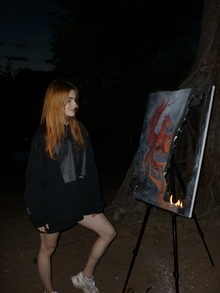
Works from the promoted project: old and new designs of service advertising posters
Marketing Analytics

Analyzing the view counts allows for several conclusions. First, articles garnered more views than videos. I believe this may be connected to the subject matter of my project and the specific nature of the platforms themselves. The rebranding process is simpler to illustrate through a long-form article than through a short video. However, for video content about my project to contribute to promotion in the future, I would focus on analyzing similar content. In my competitive analysis, I did not sufficiently study the platform selection or the approach to crafting a compelling narrative.
Second, it can be observed that despite a significant difference in publication time, the article on dtf.ru spread faster and wider than the same text previously published on vc.ru. This suggests that reach on the dtf.ru platform performs better. Engagement analysis also supports this: it is 0,50% higher on dtf.ru. On that platform, the post accumulated four comments within the first 10 minutes, whereas the project received only one save across its entire run on vc.ru.

However, it is important to note that the click-through rate (CTR) is higher on the vc.ru platform. This suggests that the audience on this platform is more engaged and attentive to the content. On dtf.ru, users skim the content, likely focusing only on the headline—this is a conclusion I reached after analyzing the comments on my article. One user even frankly admitted they hadn’t read the text but still felt compelled to leave a biting comment.
Returning to the engagement analysis across the platforms, it is noticeable that the video uploaded to VK Clips leads in this metric. Because it achieved one repost despite a relatively small reach, its engagement percentage became higher. There were no interactions on Pinterest, meaning that even with a reach nearly equal to VK Clips, the platform’s engagement was zero.
In conclusion of the analysis, it can be concluded that promoting the project through an article was quite successful. I drew conclusions about the characteristics of the two platforms, and in the future, when publishing on dtf.ru, I will try to pay closer attention to the headline and introductory text to capture the audience’s attention and increase the click-through rate. However, when working with video content in the future, I should also consider different platforms for promotion and more closely study the content of competitors to understand the narrative features of viral videos.
Case Study: Using AI in Promotion
In creating this project, I utilized various neural networks primarily for two purposes: analyzing and generating new ideas and materials.
I began my work by conducting an interview with myself using Qwen3: I needed to understand what I wanted to promote and why.
Prompt: Hello. I am planning to write an article about my project, and for this, I need you to conduct an interview with me that will result in formulating: what the project is about, why it is important to me and others, what the results and plans are.
The neural network asked me 10 questions, analyzed my answers, and based on them, composed a coherent text about me and my project.
Text generated by AI:
How I Redesigned My Project Using an AI: A Design Student’s Experience My name is [Your Name], and I am a student at the Higher School of Economics studying Design. One of my recent projects became more than just an academic assignment—it was a personal experiment with new technologies. I decided to rebrand a fictional immigration assistance service, MIG, using generative AI.
What is this project? MIG is a fictional service that helps people move to and successfully adapt to another country easily and safely. As part of this project, I created a complete new brand identity for the company: the logo, promotional posters, office mockups, and product line visuals.
The key element was that all the visual content was generated using generative AI, such as Midjourney and DALL·E. This allowed me to test these new technologies within a real design process and compare the outcomes to what I could have achieved manually.
Why did I choose this topic? The idea originated as part of a course assignment, but I decided to approach it creatively—transforming it into a full case study. I was curious to see how well modern AI tools could handle graphic design tasks. I wanted to understand: can an AI replace a designer? Or at least serve as an assistant?
It turned into an investigation into the future of the profession—both its possibilities and its limitations given new technologies.
Why is this personally significant to me? Working on the project brought me face-to-face with a crucial question: where does AI assistance end, and where does genuine, authorial vision begin?
Although the AI accelerated certain stages, the quality of the final images was often disappointing—they frequently came out distorted, low-quality, or simply visually «off.» Ultimately, I had to manually refine most of the results, and sometimes rebuild them entirely.
This experience demonstrated to me that, for now, technology is not capable of replacing the subtlety of the human eye or a designer’s professional intuition.
Why might this be relevant to others? This project became more than just a portfolio piece for me; it became an example of how neural networks can be utilized in design. It demonstrates: • My proficiency with emerging technologies; • The ability to approach automation with a critical eye; • A professional standard of hand illustration and branding. Furthermore, it could be beneficial for students, faculty, and emerging designers who want to understand how to properly integrate AI into the creative process—without sacrificing quality or style.
Outcomes and Feedback The project is currently presented as a presentation in my portfolio. Several students and faculty members have already reviewed it, sparking a lively discussion about the role of AI in design. The feedback helped me better understand which concepts succeeded and which require further refinement.
Future Plans I aim to continue developing as an illustrator while actively experimenting with neural networks. My goal is to find a balance between meticulous hand-finishing and the potential of automation—using AI as a supporting tool, not a replacement for the creative process. In the future, I plan to create more case studies where technology and human vision work in tandem—and perhaps return to the MIG project with new ideas.
Conclusion: Can a neural network replace a designer? If I could say something to those following my project—it would be this: ask yourself, can a neural network truly replace a designer? I believe that my original design, created by hand, achieved greater coherence, stylistic consistency, and emotional depth. Neural networks generate interesting ideas, but quality and harmony ultimately depend on human involvement. My project is not simply a brand refresh; it is an exploration of the boundaries between artificial intelligence and human creativity. And if you are also exploring new technologies—remember: no neural network can replace the eye of a true designer just yet.
In this instance, the neural network served as a tool to analyze my thoughts. I found this incredibly convenient because the artificial intelligence preserved my ideas and reflections, structuring them into a logical and coherent text.
Writing an article
Then, I gathered the most popular articles on topics similar to my project and used NotebookLM to analyze my competitors' work. I wanted to identify successful storytelling techniques to integrate them into my own article later on.
Prompt: What storytelling techniques are used in articles?
After analyzing the articles, I went back to Qwen3: I needed to create a prompt that incorporated the analyzed techniques for writing the article.
While creating the prompt, I also specified additional parameters (such as keywords) and mentioned the platform where I plan to publish the article.
I selected keywords for the article using the Yandex Wordstat service.
After receiving detailed instructions, I asked the neural network to write the article. Finally, I requested further minor revisions to the resulting text.
The neural network generated a very detailed prompt with 15 points, according to my request.
It also added an extra instruction for the AI writing the article:
Write an article on the specified topic («How I Rebranded the Fictional Service MIG Using AI: A Student Case Study»), strictly following the provided outline and all the aforementioned requirements. Analyze the provided search query data (keywords and intents) to accurately determine what user problems the article must solve. Pay close attention to the natural use of keywords, alignment with the target audience (students, young designers, recruiters), personal experience, and analytical approach. Use the specified style and tone (first-person narrative, expert yet accessible), include all specific details (brand comparisons, trends, portfolio link). Ensure proper internal linking and a call to action at the end. The article must meet the specified criteria and formatting requirements. Upon completion, conduct a self-assessment regarding the completeness of the topic coverage and ensure that all key user intents are adequately addressed. The final text must be unique, informative, and achieve its goal—to inspire, demonstrate the practical application of AI, and attract recruiter attention through a high-quality student case study.
Creating promotional videos
When creating the video about my project, I also utilized Qwen3: based on an existing interview about the project, we discussed potential script ideas and analyzed competitor videos.
Next, I selected the most relevant videos and used Notebook LM to analyze competitor content.
Using Perplexity and the database provided by the instructor, I identified key search terms for promoting the project on Pinterest and drafted the profile description.
Then, Qwen3 helped me polish a successful script based on the analysis conducted. Subsequently, the neural network generated song lyrics for the video and a description incorporating keywords (pulled from Yandex Wordstat).
A soundtrack was created using Suno. I then used Ideogram to generate images for subsequent animation (the project cover was also created with this neural network).
Kling, Hedra, and Runway were used for image animation. I found the videos produced in Kling to be the most effective.
Prompt for Qwen3 Description Generation: I need to come up with a title and description for a video. It must be optimized for SEO promotion; please help me select keywords and use them to compose the text and the title.
Keywords for Pin Titles: These must be catchy and striking, attention-grabbing, and under 50 characters: Startup logo design ideas How to create a unique brand identity Modern corporate style 2025 Color palettes for your brand Memorable logos Brand design: best practices
Keywords for Description: Brand identity Brand identity development Branding for business Logo creation Corporate style Logo design Identity and corporate style Logo and identity Unique brand design Identity ideas
Examples of prompts for Ideogram:
«An abstract soft gradient of pastel colors»
«A cardboard box with a cute face flying up in the sky. Cute minimalistic illustration in soft colors»
Conclusions on Working with AI:
Neural networks were extremely helpful in analyzing existing content. They streamlined my work by highlighting key aspects, structuring vast amounts of information, and adapting content for easier comprehension. I found the skills for applying artificial intelligence to text exceptionally useful. However, I concluded that when creating new content, neural networks still fall short of human capability. Using AI to create truly compelling visual products is difficult right now, as these works often feel somewhat lifeless.
In summary, I can say that during this module project, I significantly developed my skills in working with artificial intelligence: I expanded my knowledge of neural network platforms, learned how to combine their use, and understood how to write better prompts. I also learned a great deal about SEO and plan to apply this knowledge in promoting my projects on other platforms in the future. Information analysis tools, such as NotebookLM and Perplexity, proved particularly valuable to me—I plan to use them more often for academic projects, as this can substantially ease my workload.
Project Visualization and Materials
350 reach 58 views 0 likes 0 comments 1 save