The second module is dedicated to the movement of the night sky and object recognition based on their behavior.
Why does this map keep changing?If you return to the same point several hours or several days later, the familiar constellations will already be in a different position. Some objects will rise above the horizon, while others will disappear. Among the fixed stars, points may appear that move, twinkle, or vanish.

Block Result
After this module, the participant will be able to:
— explain the daily motion of the stars; — understand why familiar constellations appear in different locations; — distinguish between changes in the sky during the night and seasonal changes; — observe the movement of a specific patch of sky over time; — analyze a luminous point based on its motion, twinkling, and duration of appearance; — create a third layer for their own atlas—the change of the map over time.
LESSON 2.1
WHY DOES THE SKY MOVE?
Lesson Topic.
If the Earth is moving at an immense speed, why does it seem like the sky is moving while we remain stationary?
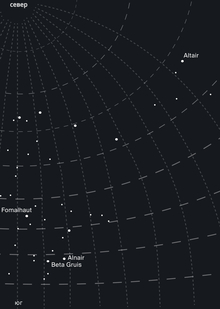
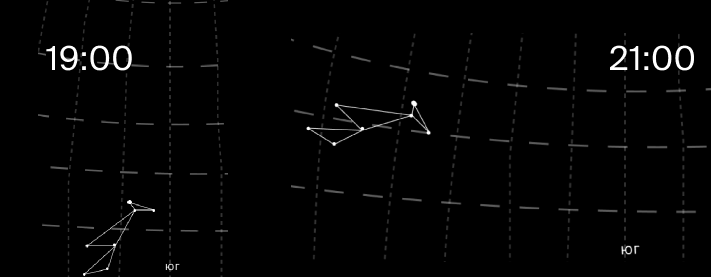
One point of observation. One day. The difference is several hours.
On the first map, the constellation is above the horizon. On the second, it has visibly shifted.
The main reason for diurnal motion is the Earth’s rotation.
The Earth completes one full rotation on its axis in approximately 24 hours.
It rotates from west to east.
Therefore, to an observer on the surface, the Sun, Moon, and most stars appear to move in the opposite direction—from east to west.
NASA explains this apparent motion as a result of the Earth’s rotation: because the planet is spinning toward the east, celestial objects appear to move across the sky in a westward direction.
Why don’t we feel the Earth’s rotation?
The reason is that almost everything around us moves along with the Earth:
— the surface; — buildings; — the atmosphere; — the observer itself.
We are very good at sensing changes in speed—that is, acceleration.
Constant movement without sharp changes is felt much less intensely.
A simple analogy can help:
In an airplane flying straight and level, you can calmly place a glass on the table. Movement is felt most strongly during takeoff, landing, or turbulence.
This helps explain why the Earth’s constant rotation is not perceived by us as the daily movement of the surface beneath our feet.
How fast are we moving?
At the equator, the Earth’s surface moves due to rotation at a speed of approximately 1670 km/h.The closer you get to the poles, the slower the linear speed.
In space, motion always depends on the chosen frame of reference. Relative to the Earth’s surface, we can stand still. Relative to the Earth’s axis, we rotate. Relative to the Sun, we travel along Earth’s orbit.
Why doesn’t the polar move?
In the first block, the Pole Star was used as a reference point. The Pole Star is located very close to the direction of the celestial north pole—an extension of the Earth’s axis of rotation into the sky.
Therefore, the other stars appear to trace circles around it, while the Pole Star itself moves very little throughout the night.
NASA notes that this is precisely why it remains in roughly the same part of the sky, serving as a reliable indicator of north.
Why are star trails circular?Because the observer is rotating along with the Earth around its axis.
Do all the stars rise and set?
No.For an observer at certain latitudes, some stars may never dip below the horizon. These stars and constellations are called circumpolar. They trace visible circles around the celestial pole, remaining above the horizon.Other stars: rise → cross the sky → set.Which specific stars will be circumpolar depends on the observer’s latitude. That is, geography influences not only which constellations we see but also the nature of their movement.
Are the stars moving?
In reality, stars are also in motion.
They move within the Galaxy and have their own velocities.
However, they are so distant that for human observation over one night, one month, or even several years, the relative positions of most bright stars hardly change.
NASA notes that stars do have real proper motion, but for most bright stars, it is too small to detect with normal observation over a short period.
Main takeaway: When we see an entire constellation move across the sky overnight, we are primarily observing the Earth’s rotation, not the actual movement of those stars across vast distances in just a few hours.
CLOCK $\to$ Earth’s rotation
MONTHS $\to$ Earth’s orbit
PRACTICE: ONE SKY TWICE
The participant selects a patch of sky that they are already using for their own atlas.
Task: Conduct a second observation on a different evening, at a different time.
It is important to preserve: — Location; — Direction; — Approximate map scale.
After the second observation, the images are overlaid on each other.
The participant notes: what maintained its shape; what changed position; what appeared; what disappeared below the horizon.
LESSON 2.1 RESULT
After the lesson, the participant will understand:
— why the stars appear to move across the sky; — the direction of their daily apparent motion; — why the North Star remains almost stationary; — why some stars never set below the horizon; — how the daily change in the sky differs from the seasonal change; — how to observe the movement independently.