Essay
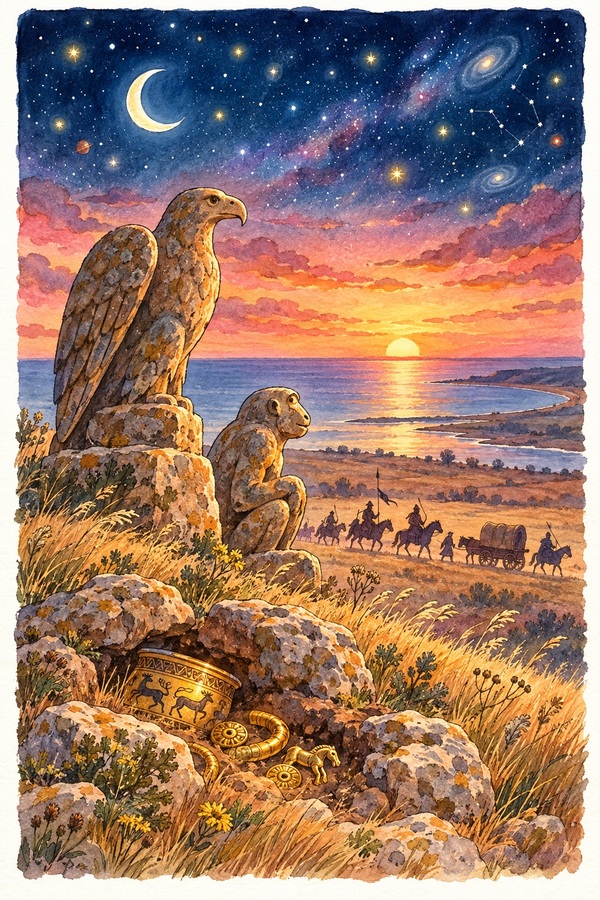
On the grounds of the «Mayak» Creative Center in Berdyansk, visitors are greeted by a sculpture of an eagle with outstretched wings. It symbolizes creative ascent and new opportunities. A model of the Potemkin Lighthouse is also situated in front of the center, serving as a reminder of the city’s maritime history. These objects belong to the modern «Mayak,» while the coast itself holds the memory of the peoples who lived here long before us.More than two thousand years ago, the shores of the Sea of Azov looked different. Steppes stretched across this area, traversed by various nomadic peoples. Among them were the Scythians—skilled riders and warriors known from the accounts of ancient authors. Along the eastern and southeastern coast of the sea lived the Maeotians—a union of several tribes. Their lives were intrinsically linked to the steppe, the rivers, and the sea.During their raids, the Scythians would seize spoils: weapons, jewelry, pottery, and precious metals. Such items indicated the wealth and status of their owners. However, gold is difficult to preserve when rapid departures are necessary. According to legend, part of the treasure was hidden in secret places—buried in the earth or left in secluded shelters. Over time, these traces vanished: the coastline changed, paths grew overgrown, and those who knew the secret to the hiding spot might not have managed to pass it on to their descendants.Thus, tales were born of gold that seems to still lie somewhere in the Priazov lands. Could the treasure be hidden very close—under a hill, among the stones, or right at the water’s edge? It is easy to imagine someone noticing a glint of metal in the ground and starting to dig, hoping to find traces of ancient warriors. But a story about treasure and a proven discovery are not the same thing. Legends ignite the imagination, whereas archaeological research helps confirm the past.
The museum collections of Berdyansk and Melitopol offer a glimpse into the region’s past. These artifacts allow us to envision how people adorned themselves, what weapons they used, and what they considered valuable. Gold ornamentation speaks to the jeweler’s skill, weaponry speaks to military traditions, and pottery reflects daily life. Behind every object is a person who once held it and deemed it important enough to preserve.The eagle sculpture at the entrance to «Mayak» evokes freedom and the desire to rise above the familiar horizon. The model of the Potemkin Lighthouse alludes to Berdyansk’s maritime history. While these objects do not prove the existence of a Scythian hoard, they illustrate how different eras coexist in one place—modern life continues where ancient paths once traveled.Perhaps Scythian gold still lies buried beneath the earth. Perhaps the most captivating stories exist only in legend. No one knows how many ancient treasures the Priazov land still conceals. But the value of these narratives is not simply the hope of striking it rich. They compel us to look closer at a familiar shore and to remember a past that remains incompletely studied.Today, there is no ancient convoy or open treasure cache here. There is the sea, the steppe, and stories passed down through generations. And as long as no one can definitively say where the truth ends and the legend begins, everyone has the opportunity to gaze upon the shore and pose a question to the past.
Legend
After the overnight storm, the coast of the Azov Sea had changed. The waves had washed away some sand, exposed the roots of old pines, and turned heavy stones up from the earth. In the morning, the younger of the two brothers, Egor, noticed a round object among the clay. He called his older brother, Anton, and together they began to uncover the find. «Look how big it is!» Egor brushed the dirt off the darkened surface. «Maybe it’s that treasure?» Anton sat down beside him. He had long dreamed of getting rich. After their father’s death, the brothers inherited an old workshop, but they lacked the money for repairs—the roof was leaking, and customers avoided them. Anton believed a lucky discovery could change everything. «If there’s gold in there, we won’t work for others anymore, ” he said. „We’ll buy a new workshop and forget about this wreck.“ Egor smiled. He also wanted to escape his ordinary life, but it wasn’t about money. In his family, he was always considered the younger one, someone who couldn’t be trusted with anything serious. Even Anton, who cared for his brother, rarely listened to him. Now, Egor had found the vessel first and wanted to prove he was capable of more than people expected of him. Since childhood, they had heard stories about Scythian gold. Their grandfather used to tell them that cavalry units once traversed the Azov steppes, accompanied by carts laden with plunder. In times of danger, warriors would bury their valuables in the ground, hoping to return for them after the war. But not everyone returned. Some died in campaigns, others left their hometowns for good, and the caches remained under hills and coastal bluffs. Grandpa always added one strange phrase: „Not all gold belonged to the king. Sometimes people buried things they couldn’t live without.“ Back then, the brothers would laugh. What else could possibly be more valuable than gold? Now, an old vessel lay before them, and no one knew what was inside. Anton brought a collapsible tool from the car. Egor carefully cleared the earth around the find. The vessel was buried deep, nestled between two large stones. When the brothers finally pulled it out, a crust of clay broke away from the surface. Beneath it, dark metal was revealed.
«Let’s open it,» Anton urged. «Wait. It might fall apart.» «You’ve spent your whole life suggesting we wait. If I listened to you, we’d still be sitting at grandpa’s workshop.» Egor stayed silent. He held the vessel with both hands while his brother carefully removed the lid. Something quietly tinkled inside. On the bottom lay a gold bracelet, several small pendants, and a thin chain. Nestled among them was a tiny figurine of a horse, carved from light bone. It had darkened with age, and one ear was chipped. Anton even whistled. «Wow! Do you have any idea what they’ll pay for this?» He was already imagining telling his friends about the find, paying off his debts, and buying equipment for the workshop. Egor also looked at the gold, but his attention was caught by the figurine. It was extremely small, no bigger than two fingers. There were uneven scratches visible on its side, as if someone had tried to carve a design with a knife. «Look,» he said. «The little horse is a toy.» «So what?» «Why put a toy with gold?» Anton shrugged. «Maybe it was the owner’s favorite item. What difference does it make? The main thing is we found treasure.» «What if these are someone’s belongings?» «Egor, this is a Scythian hoard. It has lain in the earth for thousands of years. Who is going to come for it now?»
The brothers started arguing. Anton wanted to take the vessel and find a buyer. Yegor insisted that the find needed to be shown to specialists. He had heard about ancient burial mounds and jewelry in the museums of Berdyansk and Melitopol. He knew that even a small object could tell people more than an entire legend. «Are you trying to give away what we found with our own hands again?» Anton snapped. «No one will thank us for that.» «What if the only evidence of someone’s life disappears because of us?» «We can’t even afford to live!» Anton got up and put the vessel in his bag. Yegor blocked his path. «Grandpa said that treasures shouldn’t be sought for the sake of gold.» «Grandpa said a lot of things. But he won’t pay our debts.» Anton stepped toward the car. At that moment, the edge of the cliff crumbled beneath their feet. First, small stones rained down, then a large slab of earth collapsed with a dull roar. His brother recoiled, stumbled, and slid down the wet slope. The bag slipped from his grasp. «Yegor!» Anton hung over the rocky depression, clinging with his fingers to a protruding root. Water rushed beneath him, and loose earth continued to fall. Yegor rushed to him and grabbed his wrist. «Hold on!» «The bag…» Anton gasped. It lay lower down, almost at the water’s edge. Gold flashed from the unzipped opening. Anton strained toward it. «Leave it!» Yegor shouted. «Give me your arm!» For a moment, the older brother froze. Just recently, he had been willing to give up everything for that treasure. Now, there was no solid ground beneath him, his fingers were numb from the tension, and his younger brother held him with all his might. Anton extended his free hand. Yegor pulled him toward himself, bracing his knees against the rocks. Their hands slipped, the root creaked, but he didn’t let go. Finally, Anton managed to reach a safe spot. Both collapsed onto the ground, breathing heavily. The wave took the bag. For a while, the brothers remained silent. Anton stared at the water, where their find had vanished. He felt as though with it, the last chance to change their lives had been lost. «I’m sorry, ” he finally said. „I almost left you for a handful of gold.“ Yegor wiped the dirt from his cheek with his palm. „You didn’t leave. You just wanted to get out of here too badly.“
They remained on the shore for a long time. When the tide receded, Anton noticed a small object among the stones. It was a bone horse, fallen from a vessel. He picked it up and handed it to his brother.
The figurine now seemed even smaller. Anton traced his finger over the uneven scratches.
«A child probably carved it, ” Egor said quietly.
The brothers remembered their grandfather’s words again. What if the vessel did not belong to a tsar or a celebrated warrior? What if someone hid family jewelry during the invasion, took a children’s toy with them, and hoped to return? Perhaps the owners never found their way home. Perhaps the gold was the last thing connecting them to their former life.
They would never know for sure.
The next day, the brothers returned to the shore. They reported the find to specialists and showed them the bone figurine. At first, Anton did not want to part with it. But as he passed the horse along, he suddenly realized that it no longer belonged to him alone. Its story began long before their family was born and was meant to outlast them.
The brothers returned to the workshop without the gold. The roof still needed repair; orders did not appear on their own, and their debts had not vanished. But Anton no longer mocked Egor’s caution. For the first time, he saw in his younger brother a person worth trusting with the most important things.
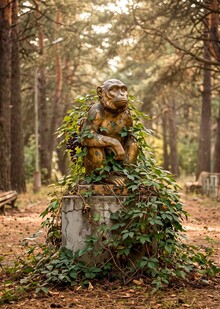
Later, people repeatedly searched for Scythian treasures near the Sea of Azov. Some hoped to become wealthy; others wanted to connect with ancient history. And each time, as they passed the monkey sculpture on the grounds of Mayak, someone recalled the story of a hoard that could not be carried away.
They say the stone monkey is not looking at the shore by chance. It seems to be waiting for someone who can see in an old object not its worth, but its memory.
The brothers never found the tsar’s gold. But they understood that sometimes the most valuable thing in a hoard is not what shines in the sun, but what makes a person stop, look back, and remember why they set out searching in the first place.