Research
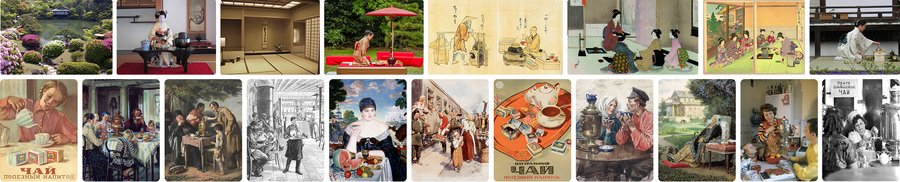
In Russia, there is no tea ceremony—there is a tradition of drinking tea.The Japanese ceremony is a codified ritual with its own schools, rules, and masters.Russia. Tea was first brought to Russia in 1638 by ambassador Vasily Starkov: a gift from the Mongol Khan Altin Khan to Tsar Michael Fyodorovich. Tea was widely imported through Kyakhta on the border with China—this was the caravan route of the 18th–19th centuries. The samovar appeared in Tula in the late 18th century. By the 19th century, drinking tea had become a social practice across all classes: from nobility to merchants and peasants. Japan. Tea arrived from China along with Zen Buddhism. The canon of the ceremony was established by master Sen no Rikyū in the 16th century. His aesthetic is wabi: simplicity, modesty, the beauty of imperfection. Four principles govern it: wa (harmony), kei (respect), sei (purity), and jaku (tranquility).
Chabako (Japan). These are lidded boxes used to store the tea bowl, kettle, spoon, and other utensils; the Rikyū model has an interior shelf. During the ceremony, each item is taken out of the box and returned at the end. This is important: the arrangement inside is part of the ritual script. There are also woven versions: an antique bamboo chabako measuring approximately 15×15×20 cm once held the tea bowl, water vessel, spoon, whisk, kettle, and several other basic items. A luxurious example comes from the Hikone Castle Museum: inside, there was a whisk with a holder, a napkin case, a tray, a spoon, a natsume kettle, a sweet box, a tea bowl, and a feather duster, while the exterior was lacquered with motifs inspired by waka poetry.

Casket (Russia). It was common in Europe and Russia starting in the mid-18th century as a road carrying case; there were tea, toiletry, and wine caskets made of vine, wood, leather, and even silver. The Museum of the History of St. Petersburg holds a late 19th-century casket: made of wood, leather, fabric, and metal, measuring approximately 46 × 40 × 25 cm, containing 27 items, including a samovar, a tray, a cup holder, a tea set, and napkins. The casket is mentioned by Pushkin in «The Captain’s Daughter» and by Tolstoy in «War and Peace.» In 1887, Muscovite merchants gifted Tchaikovsky a custom-made casket from a silver factory.

The market is divided into two poles. Pole 1: inexpensive sets in a soft bag. A typical gongfu set includes a kettle, four cups, a dripper, a strainer, a teapot, tongs, a tray, a mat, and a travel bag. It is functional, but uninspired. Pole 2: the premium case. The benchmark is the Zens × BMW set with Red Dot. Four cups, two kettles, and a tray are fitted into a compact case with custom-molded inserts. This is exactly the «detective’s trunk» you want to move away from. A good anti-reference for a defense. The industry’s general logic. A travel set is described as a miniature tea room, where instead of the complexity of a traditional set, there is an embedded structure: the kettle, cups, and strainer fit into each other. In China, there is a specific word for a soft case: a tightly quilted pouch for tableware is called cha dai.
Concept
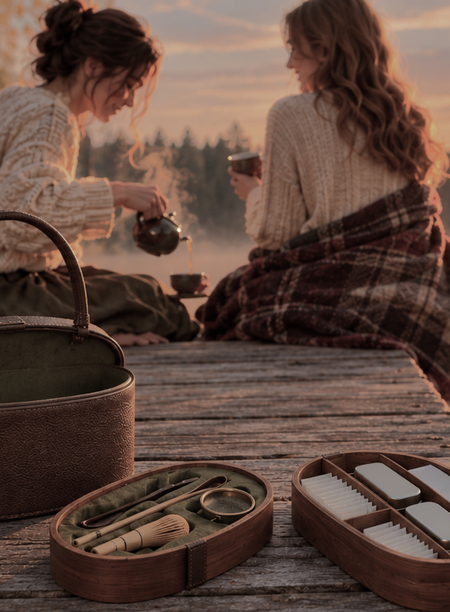
A tea ceremony requires a space: a surface, order, and silence. On the road, this space does not exist. The project is a small chest that carries this space with it. The objective is for it to feel natural in the hand—like a beautiful bag, not a toolbox. Therefore, we eschewed rigid plastic, metal latches, and foam inserts. Instead, we utilized natural tactile materials, a soft exterior, and a concealed internal structure. Each element serves two functions: it protects during transit and it participates in the ritual. The way objects are retrieved and returned establishes the ceremony’s narrative. Our inspirations are the Japanese chabako, the tiered tsubako boxes, and the Russian travel pantry. Asian aesthetics are adopted as a guiding logic.
Thin aluminum for the body and lid, but the thickness must be at least 2 mm to prevent dents.Enamel for accent inserts, decorative elements, or other pieces.Natural wood for spoons, coasters, interior dividers, and other small accessories.Stone or ceramic for the main components: the teapot and cups.
Visualization