Communication Theory: Terminal Type Foundry
Terminal Type Foundry is the type design division of the branding agency Terminal Design.
Focus: designing display typefaces, both custom-made and retail fonts (with a stronger emphasis on custom work).
[1] Communication Theory in Design and Contemporary Visual Culture
In contemporary design practice, communication is no longer understood as a linear transmission of information from sender to receiver. Instead, it is approached as a complex, multilayered process in which meaning is constructed, negotiated, and interpreted within specific cultural, visual, and media environments. This understanding aligns with Robert T. Craig’s view of communication theory as a field composed of multiple traditions, each framing communication as a form of social practice rather than a purely technical process.
Design, and particularly graphic and typographic design, operates within this paradigm as a system of meaning-making. Visual forms do not simply represent information; they encode values, assumptions, and cultural references that are actively decoded by audiences. Stuart Hall’s theory of encoding and decoding is especially relevant in this context, as it emphasizes that meaning is not fixed within a message but emerges through interpretation shaped by social and professional frameworks.
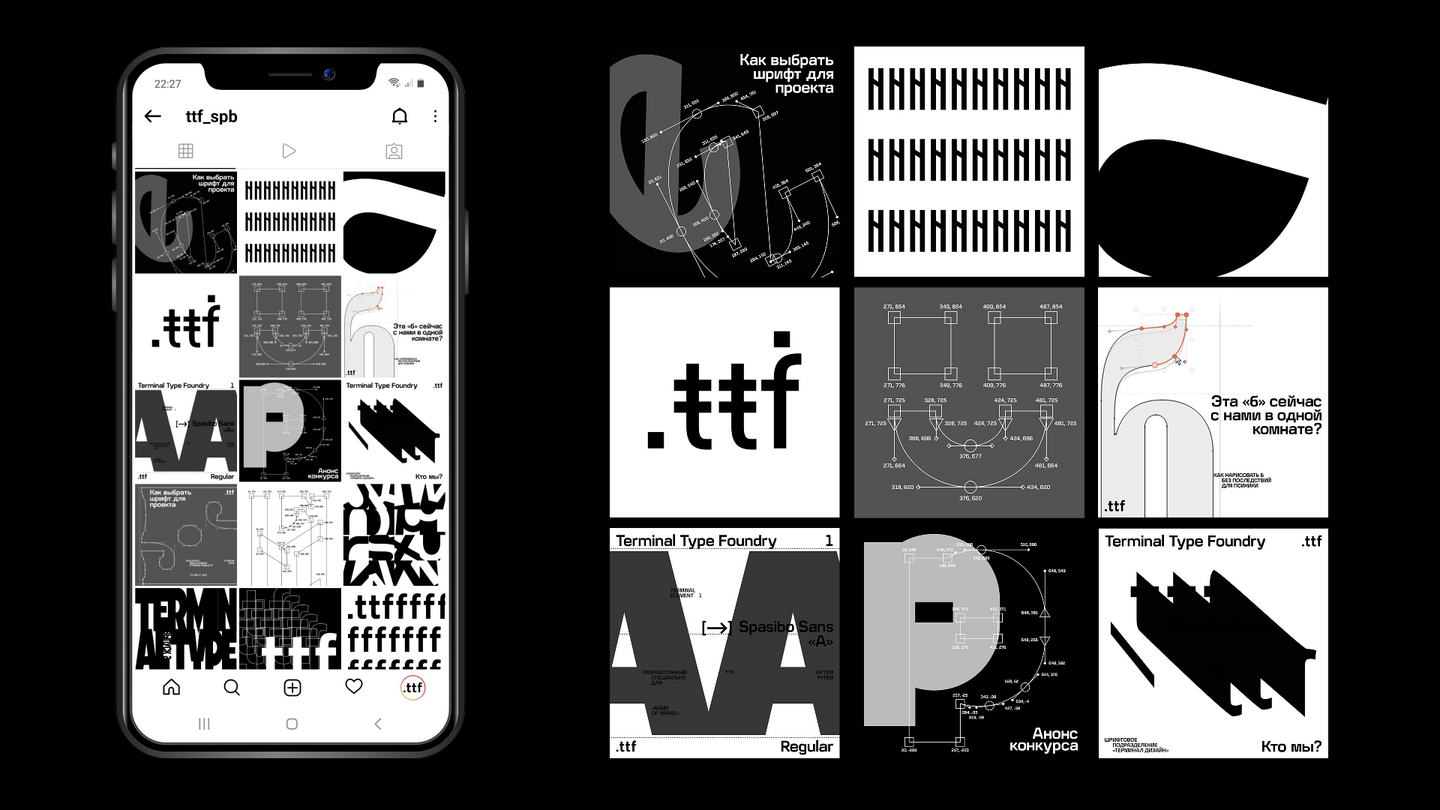
Design of brand social networks
Typography occupies a unique position within contemporary communication systems. Letters, glyphs, and typographic structures function simultaneously as linguistic signs and visual forms. As such, typography exists at the intersection of verbal and visual communication, where form, structure, and rhythm participate directly in persuasion and interpretation. From the perspective of rhetorical communication theory, typographic choices can be understood as rhetorical strategies that influence how messages are perceived, trusted, or emotionally engaged with.
Terminal Type Foundry (TTF) emerges precisely at this intersection of communication theory and design practice. As a type design division within a branding agency, TTF approaches typography not as a neutral tool, but as a communicative system shaped by cultural memory, technical precision, and visual experimentation. The concept of the «terminal element» — the smallest meaningful unit within a system — becomes a central metaphor for both typography and communication. Just as a glyph functions as the terminal unit of a typeface, communication itself is constructed from minimal elements that acquire meaning only through structure, context, and interpretation.
By foregrounding the construction of the glyph — its skeleton, proportions, and internal logic — TTF makes the communicative process visible. Rather than concealing the mechanics of design, the project exposes the system behind the message. This approach resonates with reflexive models of communication theory, which stress awareness of the communication environment and the active role of the audience in meaning-making. In this sense, TTF does not merely apply communication theory to design; it visualizes communication as an ongoing process of construction, interpretation, and negotiation.
[2] Terminal Type Foundry: Brand Presentation for a General Audience (clients who turn to Terminal Design for identity)
Who are we?
Terminal Type Foundry is a type design studio focused on creating expressive and carefully crafted typefaces. We work with brands, cultural institutions, and creative teams who understand that typography is not just a technical necessity, but a powerful means of communicating identity, values, and emotion.
The custom «Linedot» font created specifically for Terminal Type Foundry
At TTF, every typeface begins with close attention to detail. We explore how each letter is constructed, how it behaves in motion, and how it functions within a broader visual system. Our aim is to create type that reflects the character of a brand — its tone of voice, cultural position, and emotional resonance.
— We believe that typography can be both precise and playful.
Our visual language combines strict systems and structural clarity with experimentation and movement. Through digital animations and typographic compositions, we demonstrate that the process of designing a typeface can be as expressive and engaging as its final form.
Shoppers: personalized merchandise for employees, clients, and collaboration participants
A central focus of TTF is Cyrillic typography. Preserving and developing the Cyrillic typographic tradition is a key part of our mission. By creating original typefaces rooted in this tradition, we contribute to a more diverse and culturally grounded visual landscape.
Terminal Type Foundry communicates primarily through digital communication environments, where typography can move, transform, and interact with viewers. This allows us to share not only finished typefaces, but also the ideas, structures, and experiments behind them, inviting audiences to perceive typography as a living and evolving form of communication.
[3] Terminal Type Foundry: Brand Presentation for a Professional Audience (other design studios or designers)
Terminal Type Foundry is a specialized type design unit within a branding agency, focused on custom and experimental typographic solutions. Our practice is based on the understanding that typography is a foundational element of visual identity and should be developed as an integral part of a brand system rather than as an auxiliary component.
The conceptual core of TTF is the notion of the terminal element. In typographic terms, the glyph functions as the final structural unit of a typeface, while remaining open to variation, interpretation, and contextual application. By placing the glyph at the center of the brand identity, we emphasize construction, process, and system-based thinking. This approach allows typography to operate both analytically and expressively.
Designing stories for brand social media
The visual identity of TTF is intentionally restrained in its palette — black, white, and shades of gray — in order to foreground form, structure, and movement. The logotype «ttf.», set in an original custom typeface, reinforces the studio’s commitment to authorship and typographic integrity. Using an in-house typeface within the branding of a type foundry is both a conceptual and ethical decision.
TTF actively collaborates with branding agencies, independent studios, and designers on complex visual projects. We remain open to experimentation while maintaining a high level of technical precision in type design. Our work includes custom commissions, retail typefaces, digital animations, typographic templates, and visual systems for online communication environments.
Templates for demonstrating typefaces digitally
By combining rigorous typographic construction with playful visual exploration, Terminal Type Foundry positions itself as a studio that values both structure and curiosity, understanding typography as a communicative system shaped by cultural context, professional discourse, and contemporary media environments.
[4] Communication Theory as the Foundation of the Brand
The communication strategy of Terminal Type Foundry is directly informed by theories presented in the online course on communication theory. Central to the project is the understanding of communication as a process of encoding and decoding rather than a one-directional transmission of meaning.
The face of the second issue of the brand newspaper
Encoding / Decoding Theory (Stuart Hall)
The communication strategy of Terminal Type Foundry is directly informed by theories presented in the online course on communication theory. Central to the project is the understanding of communication as a process of encoding and decoding rather than a one-directional transmission of meaning.
Within TTF, the same visual system encodes different meanings for different audiences. For a general audience, typographic animations and simplified narratives emphasize creativity, craftsmanship, and visual pleasure. For a professional audience, these same elements are decoded as signals of methodological rigor, system-based thinking, and typographic authorship. This distinction reflects Hall’s encoding/decoding model, which highlights the interpretative agency of audiences.
Rhetorical Tradition and Visual Rhetoric
Rhetorical approaches to communication further inform the project. Typography functions here as visual rhetoric: structure, contrast, rhythm, and motion operate as persuasive elements. Rather than relying solely on verbal explanation, TTF allows design itself to function as an argument.
Narrative Paradigm (Walter Fisher)
The narrative paradigm also plays a significant role in the brand’s communication logic. By consistently returning to the concept of the glyph as a terminal element, TTF constructs a coherent narrative across platforms and formats. This narrative frames typography not as a static product, but as an ongoing practice of research, experimentation, and cultural engagement.
Designing a template for showcasing fonts on social media
Narrative Paradigm (Walter Fisher)
The narrative paradigm also plays a significant role in the brand’s communication logic. By consistently returning to the concept of the glyph as a terminal element, TTF constructs a coherent narrative across platforms and formats. This narrative frames typography not as a static product, but as an ongoing practice of research, experimentation, and cultural engagement.
Media Ecology Theory (Marshall McLuhan)
Together, these theoretical perspectives demonstrate how communication theory can serve as a practical foundation for branding and design. In the case of Terminal Type Foundry, theory directly informs visual decisions, audience differentiation, and the overall communicative logic of the brand.
[5] List of sourses
Communication Theory as a Field — Craig — 1999 — Communication Theory — Wiley Online Library [Электронный ресурс]. URL: https://onlinelibrary.wiley.com/doi/abs/10.1111/j.1468-2885.1999.tb00355.x (дата обращения: 13.12.2025).
McLuhan M. Understanding Media [Электронный ресурс]. URL: https://designopendata.wordpress.com/wp-content/uploads/2014/05/understanding-media-mcluhan.pdf (дата обращения: 13.12.2025).
McLuhan M. Understanding Media [Электронный ресурс]. URL: https://designopendata.wordpress.com/wp-content/uploads/2014/05/understanding-media-mcluhan.pdf (дата обращения: 13.12.2025).
Wiley Online Library: статья по теории коммуникации — 1985 [Электронный ресурс]. URL: https://onlinelibrary.wiley.com/doi/abs/10.1111/j.1460-2466.1985.tb02974.x (дата обращения: 13.12.2025).
Вышка Digital | Smart LMS: Учебный курс [Электронный ресурс]. URL: https://edu.hse.ru/course/view.php?id=133853 (дата обращения: 13.12.2025).
Student project «Terminal Type Foundry identity project», author: Ekaterina Shilova. URL: https://hsedesign.ru/project/61a4078070504895a1ab2d7da8a5d6f8