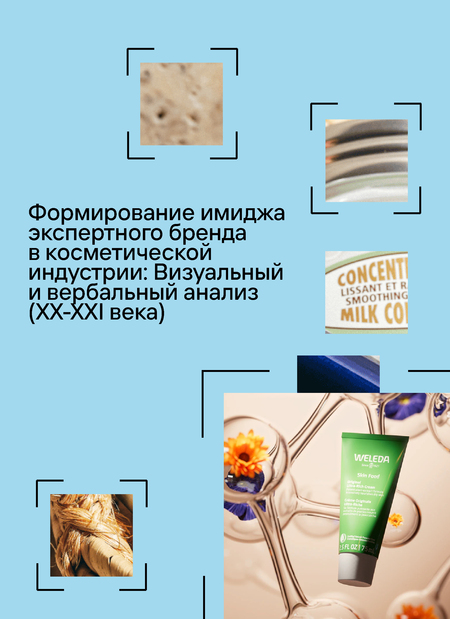
TITLE
Forming the Image of an Expert Brand in the Cosmetic Industry: Visual and Verbal Analysis (20th–21st Centuries)
INDEX
I
- INTRODUCTION
CONCEPT
0.1 Topic Relevance
0.2 Research Problem
0.3 Research Hypothesis
0.1 Topic Relevance 0.2 Research Problem 0.3 Research Hypothesis
II
- CHAPTER 1
THEORETICAL FOUNDATIONS OF FORMING AN EXPERT BRAND IMAGE
1.1 Expertise: Definition and Trust-Building Factors
1.2 Typology of Expertise in the Cosmetics Industry
1.1 Expertise: Definition and Trust-Building Factors 1.2 Typology of Expertise in the Cosmetics Industry
- CHAPTER 2
ANALYSIS OF VISUAL AND VERBAL STRATEGIES FOR FORMING AN EXPERT IMAGE
2.1 Communicating Expertise Through Product Composition
2.2 Communicating Expertise Through Manufacturing Process
2.3 Communicating Expertise Through Positioning
2.4 Communicating Expertise Through Influence
2.1 Communicating Expertise Through Product Composition 2.2 Communicating Expertise Through Manufacturing Process 2.3 Communicating Expertise Through Positioning 2.4 Communicating Expertise Through Influence
- CHAPTER 3
KEY VISUAL AND VERBAL TRENDS
3.1 General Trends in Visual Communications
3.2 General Trends in Verbal Communications
3.1 General Trends in Visual Communications 3.2 General Trends in Verbal Communications
III
- CONCLUSION
FINDINGS
4.1 General Trends
4.1 General Trends
I
INTRODUCTION
CONCEPT
0.1 The Relevance of the Topic
The cosmetics industry is one of the most competitive sectors in the global market. Brands are forced to develop diverse design solutions and marketing strategies to stand out among numerous offerings. I chose this topic because I want to investigate the tools that allow cosmetic brands to convey their expertise. This will help me understand what makes a company successful and respected in the market, and it will serve as the starting point for formulating a unique positioning for a future cosmetic brand (the design of which is my final qualification project).
Since my goal is to develop my own expert private label for mid-range skincare cosmetics for the «Zolotoye Yabloko» perfume and cosmetics store chain, this visual research is directly related to the topic of my thesis.
Building a strong expert brand requires a deep understanding of how visual and verbal elements influence consumer perception. This visual research will not only help me structure existing approaches to conveying expertise but also identify the unique elements and principles inherent to different types of expertise—which will form the foundation for creating my own private label capable of winning consumer trust.
0.2 Research Problem
The research problem lies in the fact that consumer choice in the oversaturated cosmetics market is complicated by intense competition and the visual and verbal similarity among many brands. This creates a dilemma: how can a brand stand out among numerous offerings and persuade the consumer to choose it specifically? A key factor in this choice is trust in the brand’s expertise, but it remains insufficiently researched what specific tools—visual and verbal—used in different historical periods (20th–21st centuries) build this trust and help a brand effectively differentiate itself from competitors.
The study is grounded in the theoretical foundations of expertise image formation in marketing and communications, drawn from academic literature. These theoretical tenets serve as the basis for developing a typology and preparing the analytical framework.
To address this problem, a comprehensive research methodology has been selected, combining qualitative and comparative analytical methods:
In the first phase, a typology of cosmetic brands will be developed based on their declared expertise. This approach will allow for the structuring of existing positioning directions and will create a foundation for further analysis by organizing the diversity of brands according to key characteristics of their expert image.
Subsequently, a comparative analysis will be conducted. This analysis will allow for a comparison of the current designs and advertising materials of the brands and will identify common trends across historical and modern advertising. This approach was chosen to isolate specific tools that convey expertise, allowing us to trace whether these tools have changed over time.
During the source analysis and the development of this topic, the following stages will be completed:
Preliminary Review of Cosmetic Companies:
An overview of a wide range of cosmetic companies and their strategies will be conducted to compile a preliminary brand typology.
Theoretical Conceptualization:
The theoretical foundations of expertise image formation will be studied, including works related to marketing, branding, and consumer behavior.
Systematic Source Analysis:
A systematic analysis of companies’ official websites, social media, and advertising campaigns (including historical archives, where feasible) will be performed to identify and classify the visual and verbal tools used to communicate expertise.
The research material will be structured into three logically connected parts:
I Introduction
This section will establish the research problem, justify its relevance, define the goals and objectives, formulate the hypothesis, and describe the methodology. This part will set the framework for the study and orient the reader within the subject matter.
II Analytical Review
This section will be the core of the work, presenting an in-depth analysis of both the theoretical and practical aspects of the topic. Here, a typology of brands will be developed, a detailed comparative analysis of the visual and verbal tools used to convey expertise across different historical periods will be conducted, and specific brand examples will be examined.
III Conclusion
This section will summarize the findings of the research, formulate the main conclusions, and either confirm or refute the hypothesis.
0.3 Research Hypothesis
I have formulated the hypothesis that, to build a compelling and durable image for an expert cosmetic brand amid the informational noise of the 21st century, the most effective strategy will be hyper-specialization—concentrating visual and verbal communications on one dominant type of expertise.
The research will identify key visual trends, such as the use of specific color palettes, typeface solutions, imagery (celebrities, experts, regular consumers), and graphic design elements that communicate a specific type of expertise. The tools for conveying expertise will be analyzed in detail, and the role of brand ambassadors in shaping the brand image will be considered. These observations and findings will be presented in the thesis project, enabling the formulation of a unique positioning and the creation of a truly expert brand that will succeed in the cosmetics market.
II
CHAPTER 1
THEORETICAL FOUNDATIONS OF FORMING EXPERT BRAND IDENTITY
In today’s competitive landscape, where the consumer audience is becoming increasingly informed and demanding, establishing an expert brand image is a key factor in achieving long-term success. Brand expertise is not merely a claim of high quality or professionalism; rather, it is a complex, multifaceted perception formed by the combination of visual and verbal signals a consumer receives throughout their entire interaction with the brand. This is trust, built upon the conviction in the brand’s competence, reliability, and deep understanding of its product or service.
1.1 Expertise: Definition and Factors in Building Trust
A brand’s expertise can be defined as the perceived competence and authority of a brand within its industry, substantiated by convincing evidence of its knowledge, skills, and achievements. This is not a static attribute, but rather a dynamically formed perception that a consumer constructs based on their experience, gathered information, and associations. Consumers turn to an expert brand when they need a solution to a complex problem, are seeking a guaranteed outcome, or desire a product that exceeds standard expectations.
In her research, «Brand Personality Aspects, ” Jennifer Aaker identified five key dimensions of brand characteristics that consumers use to describe brands. One of these dimensions is Competence, which correlates closely with the concept of expertise. According to her study, competence can be understood as reliability, responsibility, effectiveness, intelligence, and success. Therefore, when applied to the cosmetics industry, one can investigate exactly how these traits are reflected in brands and gain a deeper understanding of the specific characteristics that shape a consumer’s perception of expertise in this field.
Consumer trust in a brand as an expert is shaped by numerous factors. This study will examine those manifested through visual and verbal communications—specifically through packaging, advertising, storefronts, and social media. These channels serve as the primary bridge between the brand and the consumer, forming the initial impression and sustaining long-term relationships. Visual elements, such as typeface selection, color palette, graphic symbols, and imagery used, instantly convey specific values and associations. For instance, minimalist design and clean lines may suggest a scientific approach and precision, whereas the use of natural textures and nature imagery might indicate expertise in natural cosmetics. Verbal communications, including copy on packaging, advertising slogans, brand narratives, and social media content, play an equally critical role by explaining product benefits, disclosing its scientific foundation, or emphasizing the unique experience the brand offers. Collectively, these elements create a holistic perception that the consumer interprets as evidence of the brand’s competence and reliability, thereby cultivating trust—which is the foundation for long-term relationships and establishing a sustainable expert image in the market.
1.2 Typology of Expertise in the Cosmetic Industry
To systematize the diverse approaches to building an expert image in the cosmetics industry, I decided to create an original typology. In developing this typology, I based my analysis on how companies use visual and verbal strategies to convey their competence and authority—focusing on key aspects of their operations, ranging from product formulation and manufacturing methods to historical heritage, core values, and consumer engagement strategies. This approach aims to reveal common patterns, individual approaches, and the evolution of expert image-building strategies within the cosmetics industry.
Conveying Expertise Through Product Composition
Expertise Based on Natural/Organic Ingredients:
Brands whose core strategy involves using naturally sourced, minimally processed ingredients. In this case, expertise is communicated through a deep understanding of nature, its resources, and its capacity to safely interact with the skin. The emphasis is placed on the ecological aspects of the raw materials used. These brands position themselves as connoisseurs of natural recipes and their efficacy.
Expertise Based on Innovative/Scientifically-Backed Composition:
Companies whose expertise stems from unique scientific discoveries, the development of advanced formulations, and the use of active ingredients with proven efficacy. Here, knowledge of chemistry, biochemistry, and dermatology is communicated, as well as the ability to translate scientific breakthroughs into tangible, effective products. The focus is placed on scientifically validated formulas, clinical studies, and measurable results.
Translating Expertise Through Production Methods
Traditional and Artisanal Production Methods and Historical Heritage:
An analysis of brands that rely on traditional, often handcrafted production methods, historical recipes, and time-tested technologies. In these cases, expertise is underscored through deep historical knowledge, artisanal mastery, and the preservation of cultural heritage. The focus is on authenticity, proven quality, and a unique experience passed down through generations.
Innovative and Technological Production Processes:
This section examines companies whose expertise is built upon the use of modern, cutting-edge production processes, high-tech equipment, and laboratory control. These brands demonstrate their competence through their capacity for innovation, manufacturing precision, and the integration of the newest scientific and technical advancements to create high-quality and efficient products.
Translating Expertise Through Positioning
Premiumness and Prestige:
This investigates brands that consumers trust because of their high price point, exclusive status, and luxurious positioning. Expertise here is often associated with sophisticated packaging design, the use of premium ingredients, and the promise of exceptional results, creating the image of an unattainable yet guaranteed-effective product.
Ethical and Environmental Responsibility:
This analyzes companies that build their expertise through responsible production. This includes utilizing eco-friendly packaging, foregoing animal testing, and adhering to ethical principles. This approach conveys the brand’s deep understanding of its role in society and the environment, positioning it as a wise and responsible market player.
Translating Expertise Through Influence
Leveraging Celebrities, Opinion Leaders, and Experts:
This explores how incorporating actresses, entertainment industry stars, popular bloggers, or authoritative experts in a relevant field (such as dermatologists or makeup artists) into advertising campaigns conveys trust and brand competence. These figures act as a sort of «guarantee of quality» and transmitters of authority.
Personalizing the Product, Packaging, and Ancillary Services:
We examine how brands deepen their connection with consumers and demonstrate their expertise through tailored approaches. This can manifest in personalizing the product or its packaging, or by offering supplementary services (such as consultations, skin diagnostics, or customized care routines), thereby emphasizing the brand’s deep understanding of each client’s needs.
CHAPTER 2
ANALYSIS OF VISUAL AND VERBAL STRATEGIES FOR SHAPING EXPERT IMAGE
2.1 Translating Expertise through Product Composition
Natural Composition
Weleda
Weleda Logo | Weleda Naturally Clear Skin Care Product Set from the eberle-werbeagentur website, 2024
Weleda is a Swiss brand founded in 1921 that produces natural and organic cosmetics whose philosophy is deeply rooted in the connection between humanity and nature. The name «Weleda» derives from the title of wise women capable of healing, which itself underscores the brand’s natural, restorative aspect. Weleda’s expertise is evident through the consistent use of natural and organic ingredients, affirmed by strict quality standards such as the NATRUE certification, and a commitment to principles of biodynamic agriculture and ecological sustainability.
Visual Manifestations of Expertise:
Packaging:
Weleda’s packaging design is characterized by minimalism, which emphasizes the purity and simplicity of the natural components. Simultaneously, it utilizes rich, natural colors—green, red, orange—that are associated with the vitality of plants and fruits. Older packaging featured illustrations of ingredients, directly depicting the natural origins of the products. In contemporary versions of the brand, visual elements are often replaced by distinctive brand typography, lending the packaging individuality and sophistication, alongside organic symbols (international certifications) that serve as clear indicators of the components' natural origin.
Photography Style and Imagery:
In its visual communications, Weleda favors botanical backgrounds, creating a sense of closeness to nature and authenticity. Images of people, most often women, demonstrate natural beauty and effortless grace, without heavy makeup, reinforcing the idea that the brand’s cosmetics merely harmonize with one’s innate qualities. Advertising materials frequently incorporate watercolor elements, which evoke softness, picturesque quality, and organic harmony.
Store Displays and Merchandising:
At the retail level, the brand’s display continues the theme of botanical elements, reinforcing the overall perception of the brand as a source of natural beauty.
Weleda Skin Food Ultra-Light Dry Oil | Weleda Skin Food Skincare Collection
Weleda Pomegranate Firming Facial Care set with pomegranate | Weleda Hydrating Facial Mist
Weleda Pomegranate Face Cream | Weleda Lavender Relaxing Body Oil | Weleda Campaign Development by Charlotte Ferster | «You are Nature» | «Time Does Not Master You»