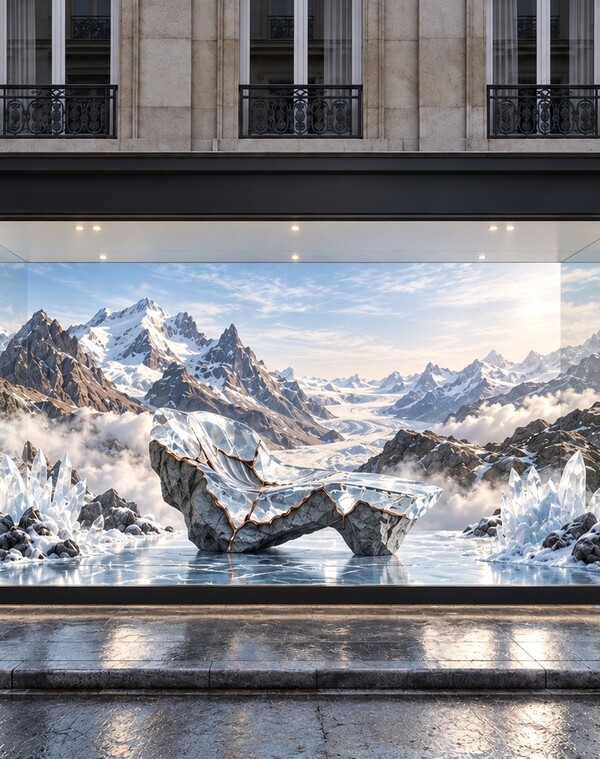
A series of six conceptual window displays inspired by natural forms and the visual language of the GORDON GU brand.
About the Project
GORDON GU — a brand of artistic furniture and interior objects operating at the intersection of design, sculpture, and art.
The brand’s pieces transcend conventional functional furniture, evolving into independent works of art. The foundation of GORDON GU’s approach lies in uniting art, culture, craftsmanship, and contemporary materials.
A special focus is placed on the dialogue between Eastern cultural heritage and modern global design.
The essence of the brand can be captured in the phrase: «Art you can live with.»
Brand DNA
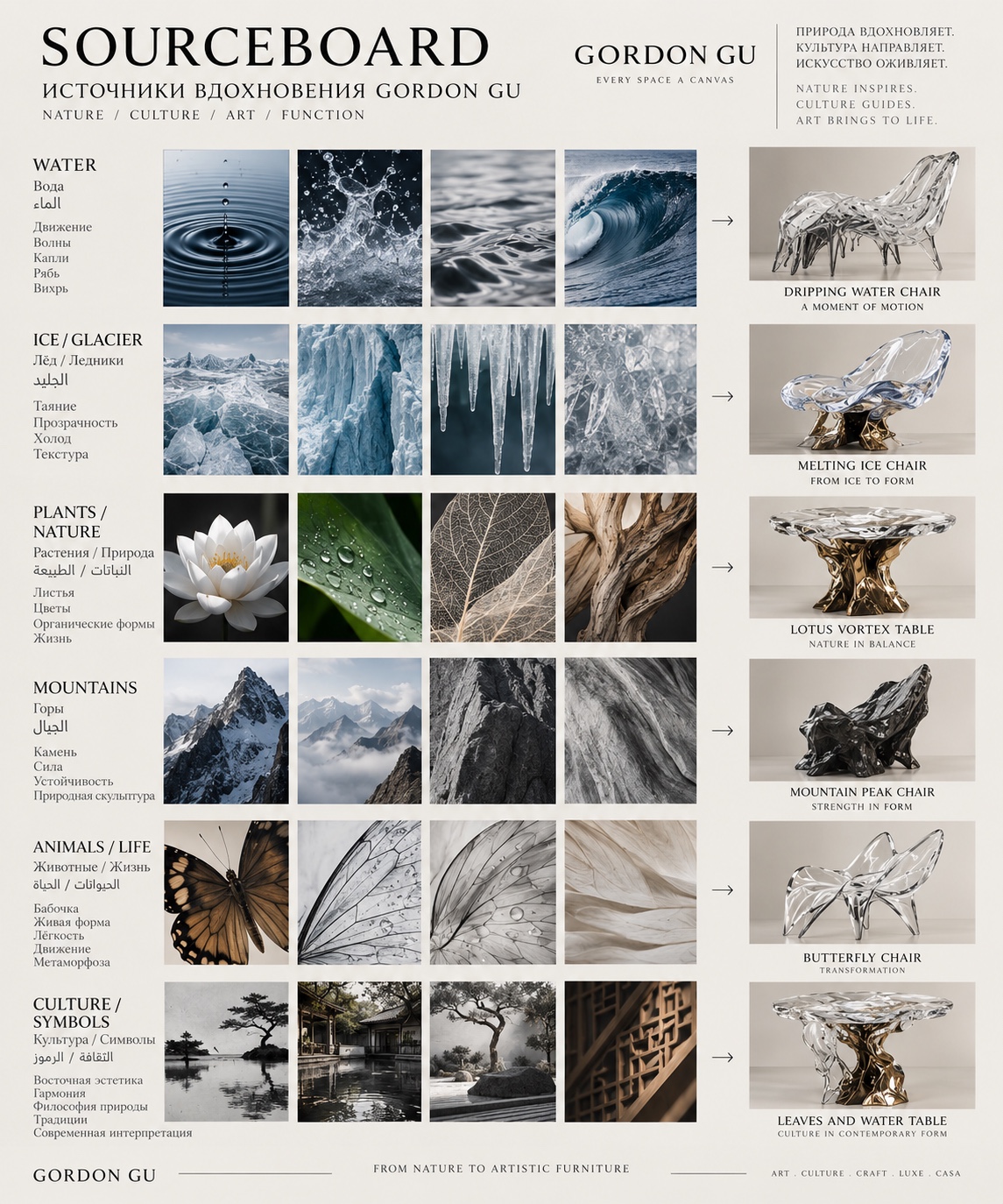
Nature is one of the important sources of inspiration for GORDON GU. The brand draws upon recognizable natural forms and states: the movement of water, the melting of ice, waves, plants, mountain terrain, and organic structures. However, these natural motifs are not necessarily reproduced literally. Their plasticity, movement, texture, and transparency become the foundation of the artwork’s form.
The brand’s visual language is particularly characterized by the juxtaposition of contrasting materials and states:
Solid $\times$ Fluid Transparent $\times$ Solid Natural $\times$ Artificial Traditional $\times$ Modern
The brand research did not reveal a single, strictly divided collection system based on the elements of nature. However, recurring thematic directions can be identified, particularly those related to water, ice, and organic forms.
SOURCEBOARD
03. Concept — «Nature as Form»
The core of my project is the concept of transforming nature into functional art objects.
I decided to build upon GORDON GU’s characteristic approach to working with natural imagery, yet to propose my own forms and methods for their visual representation.
Each display case is dedicated to a specific natural phenomenon: rock formations, marine corals, river currents, arboreal structures, clouds, or autumn leaves.
Of importance is not only the external form of the natural object but also its inherent properties—motion, growth, erosion, transparency, plasticity, and state change.
NATURE → FORM → MATERIAL → FUNCTION → ART
04. Project Visual Language
The project’s primary materials and textures include wood, stone, metal, a transparent crystal-like material, and natural elements.
Each display case is designed as a self-contained natural environment, revealing the inspiration for the item.
A unified architectural principle was developed for the entire series: panoramic glazing, a minimalist façade, mirrored side surfaces, and restrained lighting.
The mirrors visually expand the space, and the natural landscapes create a sense of continuity beyond the display case.
05. Series of Six Showcases
01 — Mountain Fracture
Rock and ice formations inspired the shape of the sculptural chair. The combination of massive stone and transparent material creates a contrast between weight and lightness, while the snow-covered mountain landscape reveals the source of inspiration.
02 — Living Wood
The timber structure and the natural curves of the wood are transformed into the form of an artistic bench. A transparent inlay seems to continue the natural lines of the wood, uniting organic texture and contemporary material.
03 — Weightlessness
The smooth lines of the sculptural table evoke natural forms shaped by the wind. The cloudy landscape and soft light create an illusion of weightlessness, contrasting the object’s materiality with the lightness of the surrounding space.
04 — River Erosion
The smooth contours of river stones, shaped by water over many years, form the foundation of the sculptural lounge chair. The transparent line within the dark form evokes the flow of water passing through the stone.
05 — Quiet Autumn
The structure of an autumn leaf forms the basis of the artistic chair’s shape. Transparent surfaces and delicate metal lines evoke the leaf’s veins, while the natural palette of the autumn forest enhances the feeling of harmony and seasonal change.
06 — Coral Structure / Coral Growth
The table’s form is inspired by the natural growth of sea coral. The branched, organic base connects to a transparent tabletop, and the sandy coastal landscape emphasizes the shape’s natural origin.
06. Conclusion
The project explores the potential of transforming natural forms and processes into contemporary works of art.
Six display cases are unified by a common concept, yet each presents its own method for interacting with the natural image, material, and function.
The series is designed for emotional perception: natural forms become unexpected artistic objects that evoke interest and the desire to examine them more closely.
Nature does not become a backdrop for furniture; it becomes the form itself.