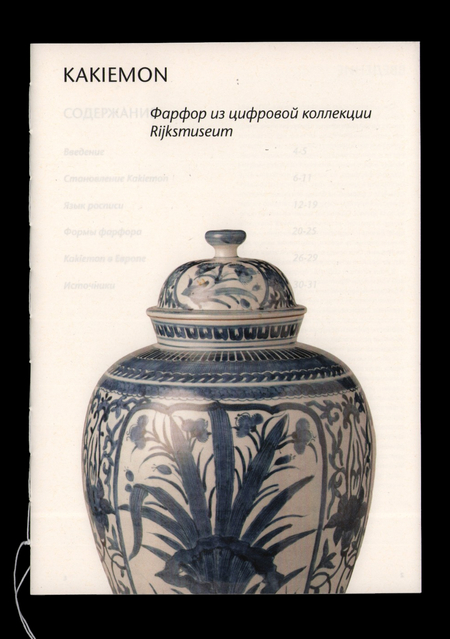
Porcelain from the 17th–18th centuries from the Rijksmuseum digital collection.
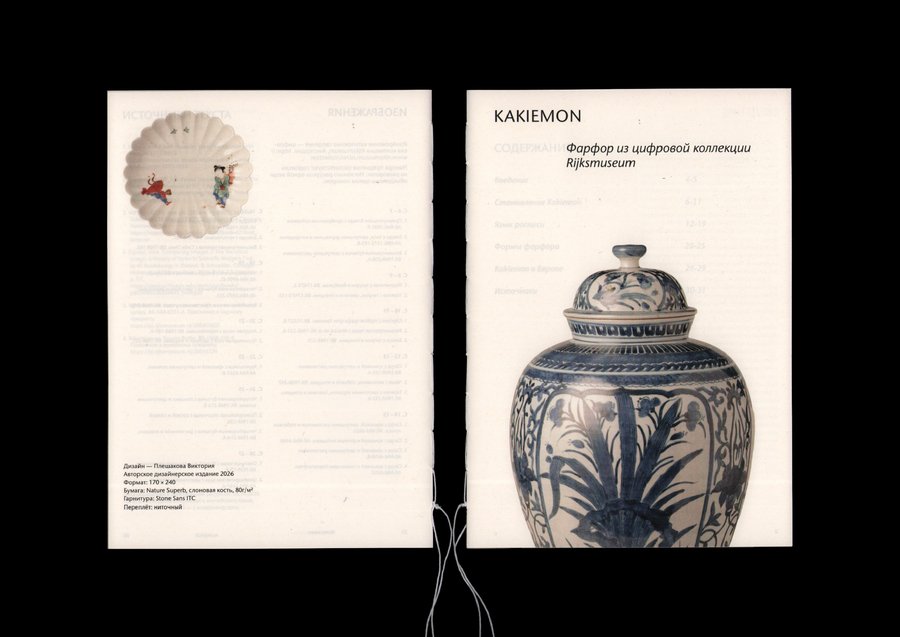
Material/Selection
For this project, I selected Kakiemon porcelain from the Rijksmuseum’s digital collection. I was interested in how the recognizable decoration transforms depending on the object’s form—how one motif unfolds differently on a flat plate, a rounded cup, and an elongated vase. The museum photographs and catalog data allow me to connect the visual comparison of the objects with narratives about their provenance.
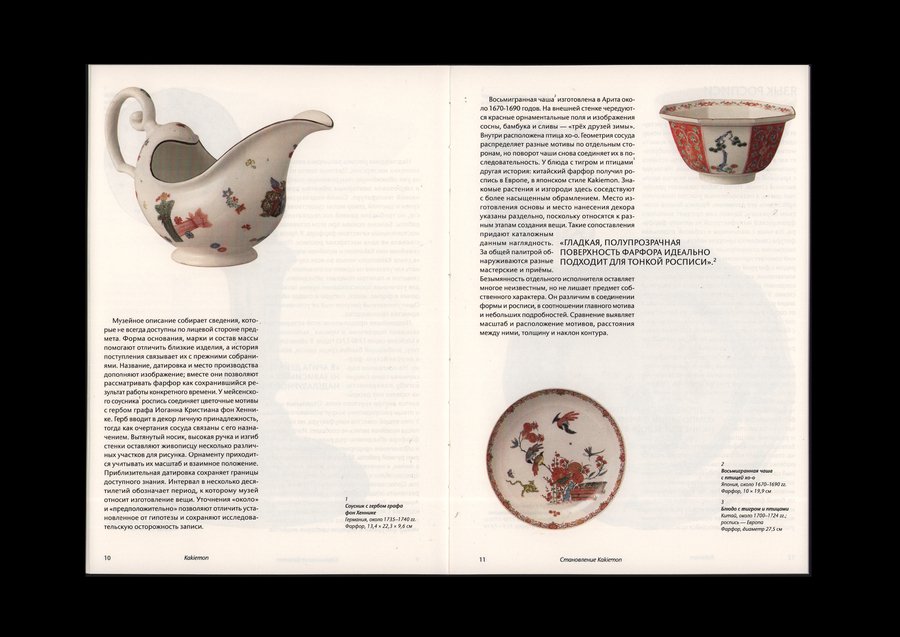
Catalog/Structure
The narrative sequentially explores several facets of Kakiemon: the evolution of its production, the characteristics of its painting style, the diversity of its forms, and European interpretations. The catalog opens with an introduction and concludes with a bibliography. Within the sections, objects are compared based on color, decoration, silhouette, and scale. Spreads featuring similar forms alternate with mixed groupings. This arrangement allows the viewer to examine each object through its similarities and differences with its neighbors.
Catalog/Concept
The concept is rooted in translating the Kakiemon compositional principle into the space of the book. Just as the painting interacts with the blank surface of the porcelain, the images interact with the page’s open field. Negative space defines the distances between objects and distributes attention. The alternation between large images, small groupings, and individual details sets the rhythm of viewing—from a general impression to the fine details of the painting.
Mockup
Format: 170 × 240 mm
Font: Stone Sans ITC
Volume: 32 tracks
Paper: Nature Superb,
ivory, 80 g/m²
For the publication, I chose stitched binding. The stitching emphasizes the material construction of the book and resonates with the craft nature of the featured objects.
Sources
The text is based on museum publications on Japanese porcelain and materials from the Rijksmuseum’s digital collection. Information regarding the names, dating, origin, and manufacturing techniques of the objects was drawn from museum records.
1) Rijksmuseum — catalog descriptions and object annotations.
2) Victoria and Albert Museum — Japan’s encounter with Europe, 1573–1853.
3) Anna Willmann, The Metropolitan Museum of Art — Edo-Period Japanese Porcelain.
4) NIPPON-KICHI–Iroe-jiki and Sakaida Kakiemon: Statements of Sakaida Kakiemon XIV.
5) Vera Dünkel — Comparing Images, from the collection The Technical Image.
Floor Plan