Research Concept
The choice of the visual research topic stems from an intrinsic impulse to seek truth and a motivation to focus on the unprecedented misfortune that befell people as a result of a policy later dubbed «War Communism.» The bearers of a sophisticated visual culture—artists of the Silver Age—were witnesses to those events. The goal of this research is to reconstruct the daily life of War Communism based on their works.
Structuring Principle
The research text is structured using the narrative collage method, which conceptually aligns with the very pulse of the era. The collage structure precludes passive reception, allowing the viewer/reader the ability to constantly reassemble meaning by juxtaposing fragments of varying scale and type. War Communism was a time of ruptures—of letters, connections, fate, and time itself. The paradox is that a unified narrative did not exist then: in one point in space, Chekhonin was painting parade plates with a sickle and hammer, while in another, Vladimirov was documenting how hungry people in the streets of Petrograd were cutting pieces of meat from a horse’s carcass. Some artists packed their bags for emigration; others entered the People’s Commissariat of Education. Collage is the only form that honestly holds this fragmentation, without smoothing it into a polished history.
Materials and Sources
Based on the concept of the narrative collage for this study, we selected works by artists who conveyed the atmosphere of the era through emotional imagery, alongside pieces that presented stark documentary evidence.
The research utilized primary sources, featuring narratives that described personal experiences during the period of War Communism and the food dictatorship. These diaries shed light on aspects such as: survival practices, methods of adapting to abrupt changes in daily life, attitudes toward Bolshevik politics, descriptions of living conditions, feelings, and thoughts.
Revolutionary Force
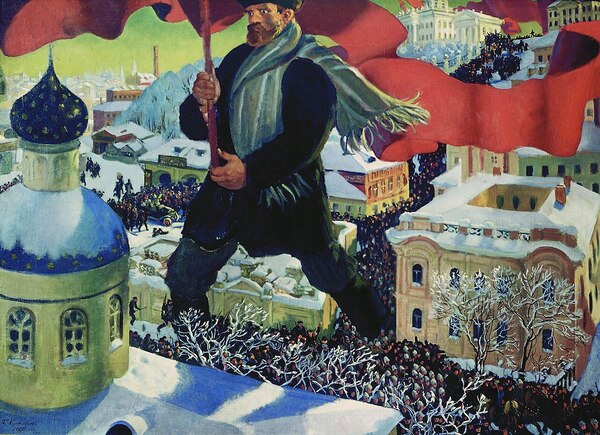
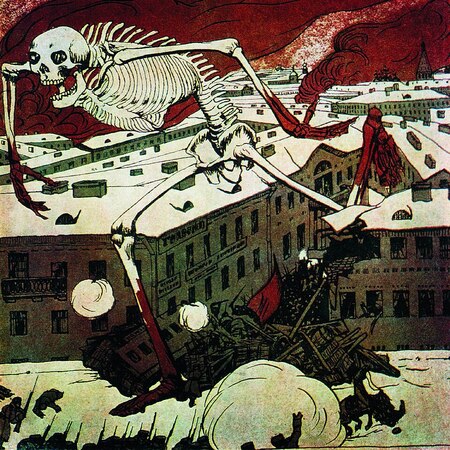
Boris Kustodiev. Bolshevik. 1920; Introduction. 1905.
Boris Kustodiev’s «Bolshevik» is a testament created directly during the era of War Communism. The painting was born from pain, fear, and an attempt to comprehend reality as it existed then. Researchers note that compositionally, «Bolshevik» mirrors Kustodiev’s early anti-government caricature for the magazine Zhupel, where a gigantic skeleton strode over the city. This echo of a frightening image surfaces through the new painting—and this cannot be accidental.
The colossal scale of the figure can be read in two ways. On one hand—the grandeur of the ascent. On the other—the frightening disproportion. The Bolshevik carries a vast red banner, moving toward some distant goal, indifferent to the people beneath him and ignoring the ground. The Bolshevik is not a character; he is a force. He is not moving toward a destination, but rather flowing through the city, like lava or a flood. In this image, one perceives Bolshevism as a power that is uncontrollable by human will and unconcerned with humanity.
The End of the Old World
Marc Chagall. Revolution. 1937
The painting «Revolution, ” in the strictest sense, cannot serve as evidence of War Communism—it was conceived and painted much later, while the artist was in emigration. However, it represents the artist’s view of his own experience of those years, viewed through the lens of time.
The composition can loosely be divided into three parts. At the center, the revolution is depicted as a farce, a circus act. Lenin is performing a handstand (a metaphor for the complete overturning of the established order). To the left, the red revolutionary force, which Lenin directs with his hand toward the bright world of Chagall, featuring his musicians, goat, and roosters.
In the corner, the artist has depicted himself with his wife, Bella, and their little daughter, Ida, lying on a rooftop. There, they are struggling together to survive the revolutionary elements. Chagall recounts how his family survived during that time in «My Life.»
Nationalization of trade is when the entire nation trades.
After coming to power, the Bolsheviks resolutely began to fight capitalism by every means their bold imagination could conceive. They confiscated bank deposits, nationalized all factories and mills, and abolished the right to private property in real estate.
Mstislav Dobuzhinsky. From Life in Petrograd. 1920
Among the Bolsheviks' absurd innovations were the ban on private trade, the nationalization of all shops, and simultaneously, the abolition of currency across the country. This allowed the new government to force the population to work for food. What was devastating to the people was that the Bolsheviks were unable to implement a centralized, rationed supply for all citizens, yet they actively used raids and the confiscation of food from the population.
The need to provide for themselves and their loved ones pushed people toward risky speculation. Every member of the intelligentsia had experience selling personal belongings—gold, bedding, tablecloths, clothing, and books.
Shagal recalls: «For little Ida, we needed to find at least some milk and butter. His wife took her jewelry to Sukharevka. But the police cordoned off the crowd and detained her. ‘Please, for God’s sake, let me go, ’ she pleaded. ‘I have a child at home. I just wanted to trade some rings for a piece of butter.’»
Alexander Vakhrameev. Tolkuchka. 1919
Work Permits and Ration Cards
Since everyone worked for food, the new state issued a work book and food coupons to every citizen. The distribution via coupons was meager and irregular.
Kuzma Petrov-Vodkin. Herring. 1918.
The painting «Sardine» is not a myth or a symbol, but a dry document of the era, written in the language of still life. Lying on a wrinkled pink tablecloth is a meager ration: two potatoes, a slice of substitute bread, and a sardine on blue paper. No dishes, no tablecloth, no comfort. Only broken light and color. In fact, it is a self-portrait of hunger, if you know the lines from the artist’s letter to his mother in that same November of 1918: «All summer the hunger was so strong that I felt like an animal—thinking only about food, and becoming wildly greedy.»
Petrov-Vodkin, like Kustodiev, remained in Petrograd and painted what he saw. But his testimony was of a different kind. He did not offer the viewer an image of a primal force; instead, he captured its consequences at the level of an individual’s daily life. This is an intimate tragedy, where the main characters are silent potatoes and a piece of herring. The artist’s gesture is not one of denunciation or pathos, but the courage to look at a meager table and see not an end, but the essence of existence.
The Utopian Paradox
Sergey Chekhonin, Vasily Timorev. Propaganda Porcelain. 1921.
The creators of agitprop porcelain dreamed that this tableware would grace the tables of workers and peasants. However, the reality of War Communism quickly turned mass-produced items into rarities. Due to its cost and the upheaval, the porcelain bearing slogans largely disappeared into the offices of commissars, international exhibitions, or the hands of collectors, becoming a luxury item.