Communication Strategy for the POLA Furniture Brand
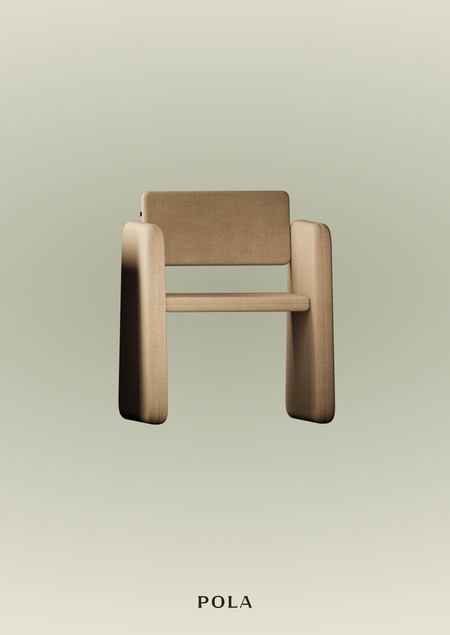
For this project, the fictional furniture brand POLA was chosen. It was created as part of a «creative entrepreneurship» course, for which a business plan was developed. This project will establish a communication strategy for this brand.

Communication Theory as the foundation of design: POLA brand
Design is not merely about creating aesthetically pleasing objects, it is a powerful and complex communication process. Every line, material choice, color palette, and functional detail is a non-verbal symbol that encodes a specific meaning intended for the receiver (the user or customer). Understanding communication theory is, therefore, crucial for a design brand to effectively convey its philosophy, build relationships, and succeed in the market.
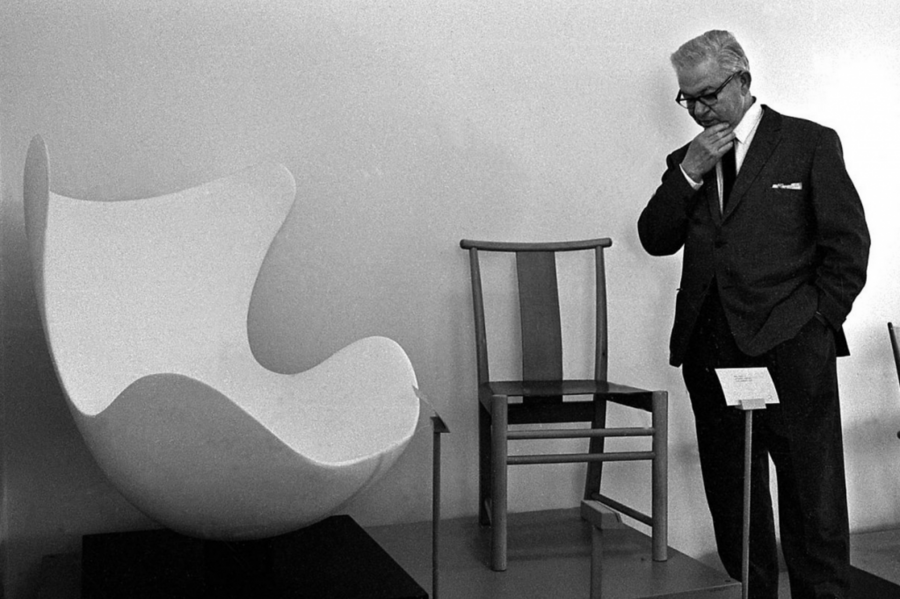
Arne Jacobsen with an armchair Egg
The communication process model is at the core of our work. POLA, as the sender, creates a message (furniture and brand identity). This message is encoded through the principles of minimalism, natural materials, and «quiet luxury». The target audience (affluent urban residents aged 30-40) decodes this message based on their own context: their taste, social environment, and desire for a status-expressing yet functional home. The feedback we receive (through purchases, social media engagement, designer collaborations) completes this transactional process, allowing us to adjust our offerings.
Two specific theories from the course have been instrumental in shaping POLA’s strategy:
1. Social Exchange Theory (SET):
We view the customer relationship as an exchange. POLA offers high rewards: not just a product, but emotional satisfaction (identity and spiritual needs — feeling of harmony, taste, tranquility), ecological values, and customization. The costs are financial. Our goal is to make the perceived outcome (Rewards — Costs) highly positive, exceeding the customer’s comparison level (CL) set by competitors like СОМО or ВОСА, and making the comparison level of alternatives (CLalt) less attractive. Our focus on premium materials and personalization directly increases the perceived rewards.2. Politeness Theory:
Our communication respects the customer’s face needs. Positive face (need to be appreciated) is addressed through flattering, exclusive design that makes the owner feel discerning. Negative face (need for autonomy) is respected by offering customization — the client is not imposed a standard solution but is a co-creator. When communicating policies (like lead times), we avoid bald-on-record FTAs and use more polite strategies to maintain a good relationship.Applying Craig’s Seven Traditions, POLA’s communication is multifaceted:
-
Semiotic Tradition:
Our minimalism, use of natural textures, and soft beige shades are signs that communicate eco-friendliness, calm, and «quiet luxury».-
Sociocultural Tradition:
We understand that our products are part of reproducing a specific social order — the lifestyle of successful, design-conscious urbanites.-
Cybernetics Tradition:
We manage communication channels (Instagram*, YouTube, Telegram, marketplaces) to deliver our message with minimal noise, ensuring the brand image remains consistent.(*Meta is recognized as an extremist organization and banned in Russia)
Thus, communication theory is not an abstract concept but a practical toolkit. It guides POLA in encoding meaningful messages into design, building beneficial relationships based on exchange and politeness, and ultimately ensuring that our brand’s values of minimalism, honesty, and comfort are successfully decoded and embraced by our audience.
Presentation for a general audience
The problem and our philosophy
In a noisy world, your space should bring peace, clarity, and joy. POLA believes in design that removes the unnecessary, focusing on honesty of materials, practicality of forms, and the calm atmosphere. We create not just furniture, but the foundation for your well-being.
What we offer?
- Eco-Friendly & Honest: We use sustainable materials because we care about your health and the planet.
- Customizable: Choose fabrics, sizes, configurations. Your POLA should be as unique as you are.
- «Quiet Luxury»: Not about obvious status, but about impeccable quality, comfort, and timeless aesthetics that you feel every day.
For whom?
POLA is for modern individuals aged 25-50 (especially aged 30-40) who have achieved a lot and understand that true luxury is harmony, comfort, and self-expression through their environment. For those who choose quality over quantity and design for life.
How to start your POLA story?
- Visit our showroom in Moscow to feel the textures
- Explore our gallery and feedbacks on Instagram* and YouTube
- Order a design consultation to plan your perfect space
(*Meta is recognized as an extremist organization and banned in Russia)
POLA. Design that speaks softly.
Presentation for a professional audience
The professional perspective
For professionals, a brand is not just a collection of products — it’s a well-thought-out system. In this analysis, we look at POLA through the lens of communication theory and show the logic behind every decision.
Design as language: semiotics in practice
According to Craig, design is a language. POLA’s clean forms, natural wood texture, and solid silhouettes are all visual signs. They communicate honesty, tranquility, and timeless quality. This unified visual code helps the brand stand out in a crowded market.
Place in culture: social context
Objects gain meaning within their social environment. POLA fills a specific niche: the new affluent urban class in Russia is looking for its own local code of «quiet luxury». The brand gives this audience both products and meaning to express their identity. This way, POLA becomes part of new cultural practices.
The logic of price: exchange and fairness
Social Exchange Theory says: clients weigh what they get against what they give. POLA offers not just function but emotion — a sense of identity and harmony. Equity Theory explains the premium price: it’s fair because behind it are expensive materials, handcrafted work, and customization options. For B2B partners (developers), fairness lies in POLA increasing the value of their properties.
Customization as dialogue: Politeness Theory
Working with demanding clients means working with their face — the self-image they want to maintain. A rigid «take it or leave it» offer threatens their autonomy. POLA’s customization is a politeness tool. It respects freedom of choice (negative politeness) and validates the client’s taste (positive politeness). This turns a sale into a partnership and builds loyalty.
Production as a channel: the cybernetic view
From a cybernetic perspective, a brand is a message transmission system. Investing in proprietary equipment (like the DW-413F planer) means controlling the main channel: production. This reduces noise — defects, delays — and ensures the promise of «impeccable quality» reaches the client undistorted. It also creates a feedback loop for continuous improvement.
Validating the strategy: two research approaches
The strategy is validated through two methods:
Quantitative:
Tracking numbers (sales, average order value), testing hypotheses («customization increases revenue»).
Qualitative:
Conducting interviews to understand what «quiet luxury» really means to clients.Together, these approaches provide both data and human understanding.
The coherent system
For professionals, POLA is a unified system. Semiotics defines the visual language. Sociocultural analysis determines market position. Exchange and politeness theories build client relationships. Cybernetics optimizes production. This theoretical framework is the brand’s operating system — ensuring coherence, sustainability, and competitive advantage.
Detailed explanation
The communication theory from the online course directly underpins the POLA presentation by framing design as a deliberate encoding-decoding process, where furniture and branding serve as non-verbal symbols to convey minimalism, natural materials, and quiet luxury to affluent urbanites aged 30-40.
Core Model Application
The presentation’s central communication process model—sender (POLA), message (furniture/identity), encoding (design principles), decoding (audience context), and feedback (purchases/engagement)—mirrors the course’s foundational depiction of communication as a systemic, transactional exchange of symbols influenced by context. Course lectures emphasize sender-receiver dynamics, verbal/non-verbal symbols, meaning creation, and feedback loops, transforming linear transmission into iterative adjustment, exactly as POLA uses sales data and social interactions to refine offerings.
Interpersonal Theories
Social Exchange Theory (SET) in the presentation, balancing rewards (harmony, ecology, customization) against costs (financial) to exceed competitors' baselines, draws from the course’s Week 2 coverage of SET as cost-reward calculations driving relationship maintenance. Politeness Theory applies course concepts of positive face (exclusive design for appreciation) and negative face (customization for autonomy), employing indirect strategies over bald-on-record impositions like fixed lead times.Craig’s Traditions
The presentation explicitly integrates three of Robert Craig’s seven traditions from Week 1 Lecture 1.5: Semiotic (minimalism/natural textures as signs of eco-friendliness/calm), Sociocultural (products reproducing urbanite lifestyles), and Cybernetic (consistent channels like Instagram/Telegram minimizing noise). These «lenses» structure POLA’s philosophy, positioning communication theory as a «practical toolkit» for encoding values that audiences decode and embrace.The Semiotic tradition helps substantiate the product design through symbols: serene form is equated with peace and tranquility, which became the foundation for audience presentations.
The Socio-cultural tradition helps adapt the message for the target audience: for the general audience, it’s emotions and benefits, while for the professional audience, it’s statistics and market data (in the case of communication with investors).
The Rhetorical tradition helps structure the narrative: thesis-argument-proof (logos in sales figures for the professional audience, pathos in the visual component for both audiences).
List of literature and sources of images
Communication Theory: Bridging Academia and Practice. Week 1-5 // HSE URL: https://edu.hse.ru/course/view.php?id=133853 (дата обращения: 10.12.2025).
[Электронный ресурс] — URL: https://design-mate.ru/read/megapolis/design-thinking/scandinavian-design-lessons-for-every-day (дата обращения: 26.11.2025).
[Электронный ресурс] — URL: https://ru.pinterest.com/pin/1055599908525695/ (дата обращения: 26.11.2025).
[Электронный ресурс] — URL: https://ru.pinterest.com/pin/3025924744408346/ (дата обращения: 26.11.2025).
[Электронный ресурс] — URL: https://ru.pinterest.com/pin/7599893116828531/ (дата обращения: 26.11.2025).