Курс 2. Текстиль в контексте современного искусства
Теоретический курс
Textile Research within Contemporary Art Practices: From «Feminine» Craft to Political Medium
What is this course about?
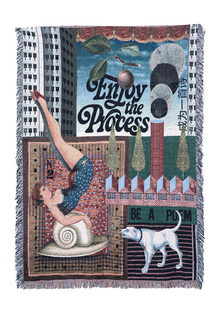
Within major institutions (such as the Art Basel fair), there is a growing trend toward popularizing applied art in the work of contemporary artists. Textile remains one of the leading mediums. The relevance of textile is increasing not only from the perspective of visual techniques but also from its conceptual applications. Today, textiles are no longer merely decorative applied art or a hobby predominantly associated with feminine pursuits, but a tool through which artists create a statement.
Through this theoretical course, students will explore the history of textiles and its application within the context of contemporary artistic expression. Drawing from scholarly research, they will learn how art theory frames the use of textiles in modern artistic practices.
Students will also discover how textile can be integrated into their own artistic practice—not only as a standalone medium but also as a complement to other art forms. The course will culminate in a study of textile application within the student’s own artistic practice, presented in the format of an essay and the development of a concept for their own textile statement. This work can be completed individually or in a group format.
Who is this course for?
Within this course, the student will expand their understanding of how to utilize textiles in their own artistic practice. This course may be beneficial for: — Students and practitioners in contemporary art who wish to broaden their perspective on textile art practices. — Students in design or fashion who wish to deepen their understanding of textiles and their application within their craft.
Program Duration: 4–6 months. The course consists of 2 modules and is offered online.
Specialized textile skills are not required. Attendees should have a foundational understanding of 20th–21st-century art history and an interest in contemporary art. Prior experience in artistic or design practice is desirable, but not mandatory.
What will students learn?
Upon completion of the course, the student will be able to: — Analyze artistic practices utilizing textile within historical, social, and institutional contexts. — Correlate theoretical approaches with artistic examples, formulate, and argue one’s own position during discussions. — Select, organize, and analyze visual material according to the chosen research problem. — Develop a concept for an art project using textiles, substantiating the choice of medium, material, form, and artistic strategy.
What practical assignments will the course participants complete?
— Seminars on Theoretical TextsThroughout the course, the student participates in four seminars. For each seminar, the student independently reads the assigned theoretical text and prepares for discussion. In the seminar, the student identifies the author’s main theses, correlates them with the course material and artistic examples, formulates questions, and articulates their own position.— Mid-Course Concept for Personal Textile ProjectMidway through the course, the student presents the initial development of their own artistic project—including the theme, the research question, the artistic problem, potential materials, techniques, and project forms.— Visual ResearchThe student conducts independent visual research on the chosen topic, selects and systematizes artistic examples, and identifies connections, differences, and recurring strategies for working with textiles (in relation to the research question outlined in the mid-course concept).— Final Concept for Personal Textile ProjectThe final concept includes the theme, artistic objective, justification for choosing textiles as a medium, proposed materials and techniques, the form and method of project exhibition, visual references, and a description of the artistic strategy.