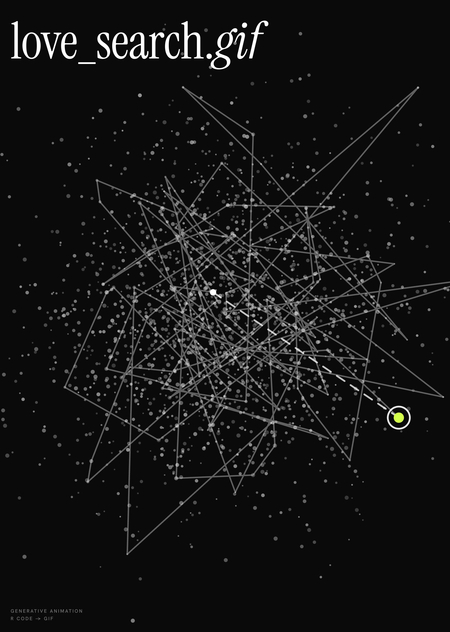
love_search — generative animation in R. Two thousand points represent eight billion people; one of them searches for «the one» amidst a gray crowd, knowing nothing ahead of time. 100 steps, randomness, and the weight of distance—and the question that remains: was the encounter luck, or a condition scripted in the code.
Two thousand points—instead of eight billion people on the planet. All are gray, except for two: the seeker and that one, far away. The seeker does not see a goal, only those nearby. A hundred steps, a hundred attempts, weighed by distance and corrected by chance. No one is visited twice: the red thread is not a memory of those met, but a measure of how long he has been searching.
In the hundredth frame, a dotted line bridges the gap, but the points do not meet. A gap remains between them—minimal, but not zero.
The simulation cannot render only one thing—love. It can only show how far a point is willing to travel for it. And at the end of the journey between the two sparks, there is not a line, but a dotted one.
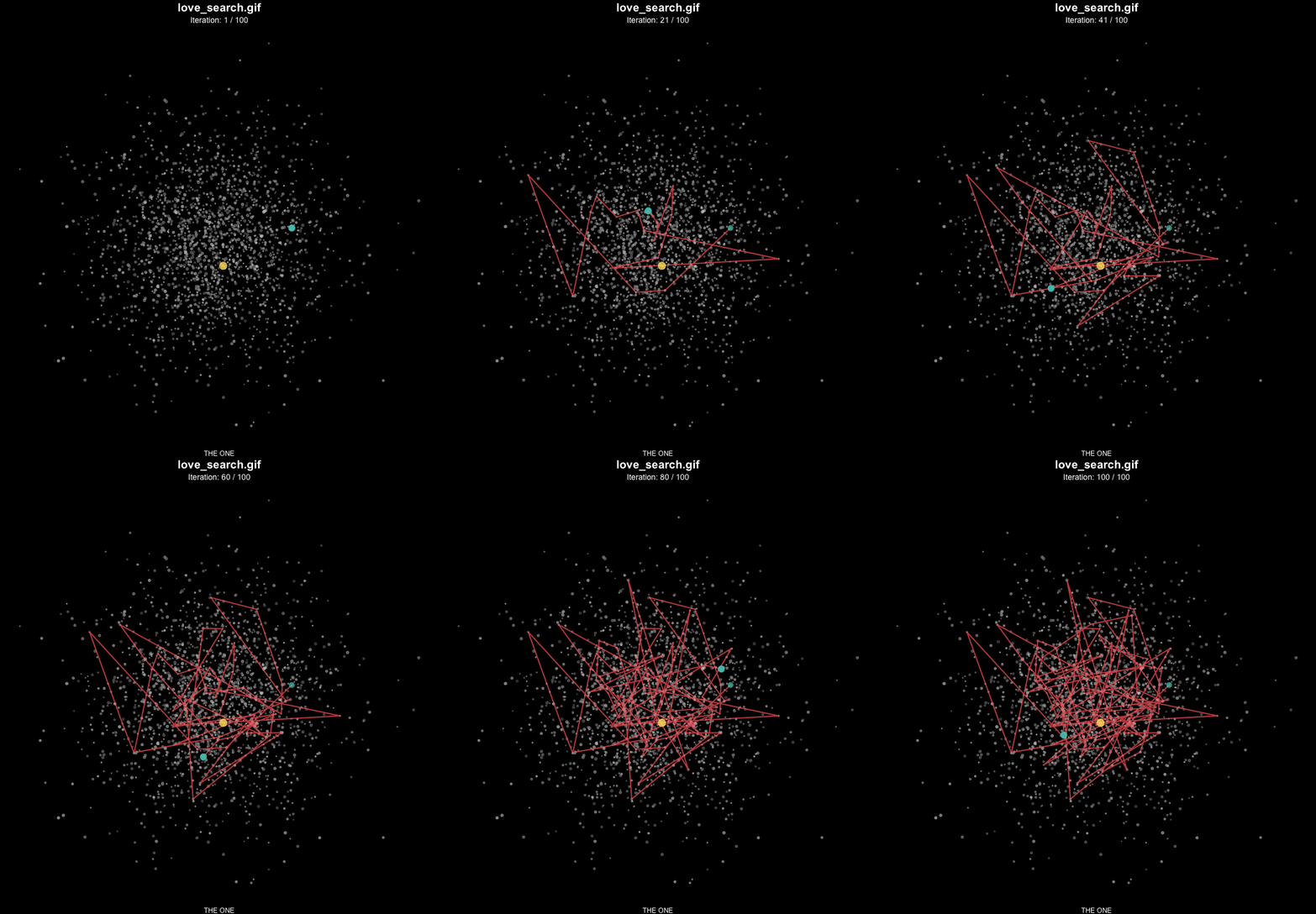
The R script generates 2,000 points—a «crowd"—with random coordinates, sizes, and brightness. There are two special entities: the seeker and «the target.» Over 100 iterations, the seeker navigates the crowd; nearby points receive greater weight (1 / (d + 1)), ±20% noise maintains randomness, and no point is visited twice. Each step generates a separate ggplot2 frame with a growing red trail; the animation package stitches them into a GIF. When the path reaches the goal, a dotted line closes the distance and the caption changes to «CONNECTION FOUND,» though this is, unfortunately, never seen.

[No text provided for translation.]
What if it’s just a bug?
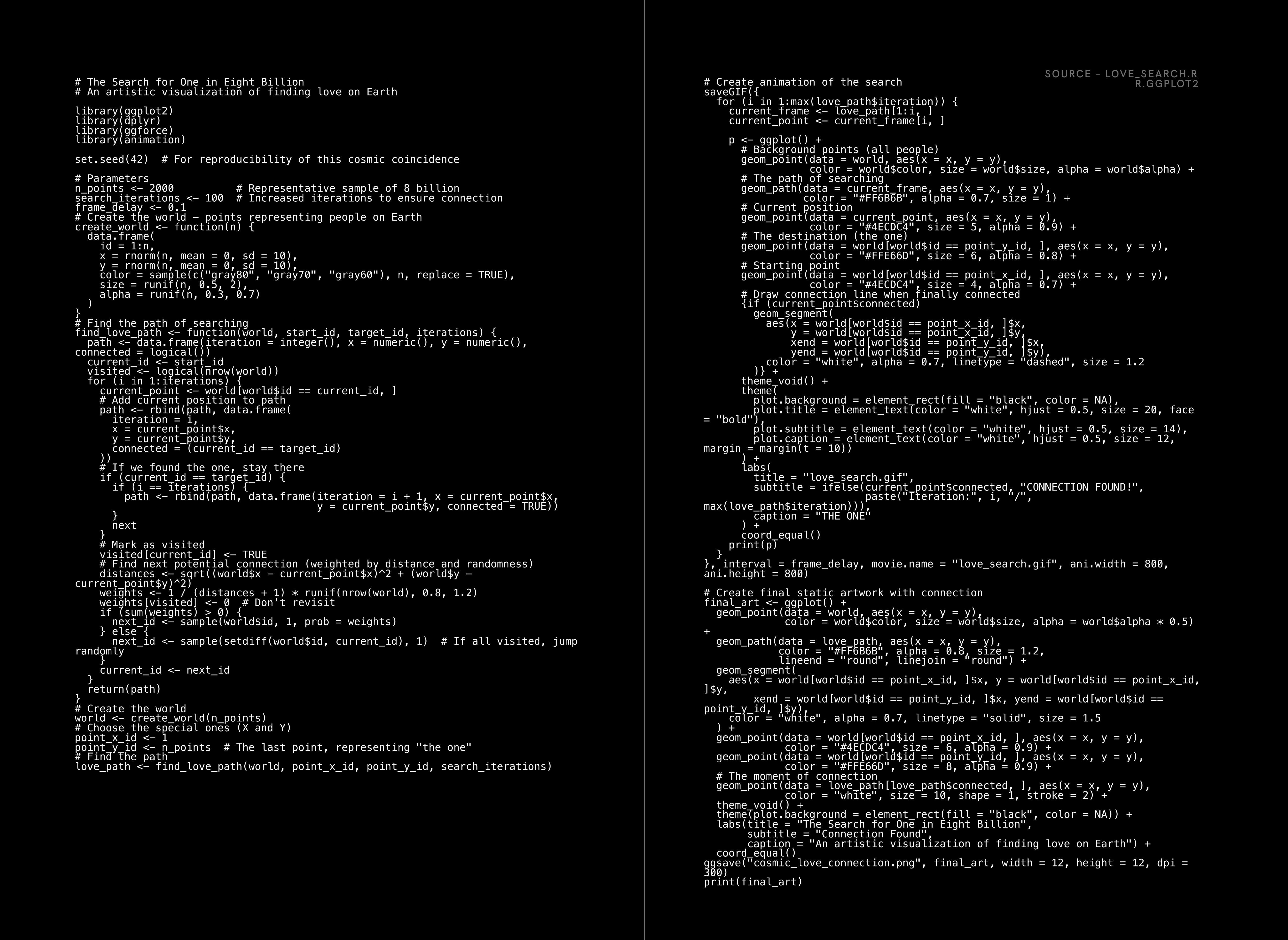
The source code contains this line:
iterations increased to ensure connection — the number of steps was increased to guarantee a meeting. The meeting here isn’t chance; it’s an invariant: no matter how much the point wanders, the code won’t let it fail to connect. Therefore, the dashed line isn’t a gap, but a draft of the line that allowed the points to connect. And pessimism is merely a misinterpretation, not a property of the world: connection found == True.
Then, the conclusion of this story may be different:
You can illustrate fate and the probability of an encounter. But only in code can you program them: by setting weights, conditions, and a threshold at which an «encounter» becomes possible.
We live the same way—by rigid parameters: who to look for, what that person must be like, and how many attempts to give yourself before giving up. We don’t notice this code until a bug occurs: a point that was supposed to orbit forever nearby suddenly ends up within reach. We call this coincidence—unwilling to admit that it is an exception to the rule that we wrote ourselves.
love_search could only exist in code—only it is capable of holding the condition that is almost never met, and the string that will eventually meet it anyway. After all, it contained the single bug for which the rest of the code and the project as a whole were worth writing.