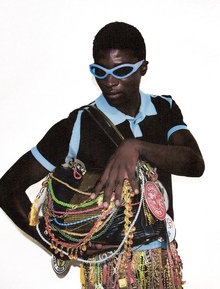
For Maor Zabar, a hat is not merely an accessory or an outfit complement. It is a standalone work of art where fashion, scenography, sculpture, and performance intersect.
The Israeli designer, artist, and costume creator has achieved international recognition for his works, which navigate a balance between high art, theatricality, and irony. His headwear transforms into architectural structures, gastronomic fantasies, and visual statements that resist easy categorization within a single genre.
From Costumes to Hats
Initially, Maor Zabar worked on costume design for theater and ballet. However, working with headwear gradually became the central part of his practice. Personal circumstances prompted this shift. Due to dietary restrictions, the designer began creating hats shaped like dishes and foods he could no longer eat. What started as a way to cope with a difficult situation eventually transformed into a recognizable artistic method and a full-fledged professional practice. Today, Zabar emphasizes that he views himself first and foremost as an artist, and the hat as one of the tools for artistic expression.Engineering, Materials, and Sense of Humor
Despite the outward eccentricity, Zabar’s works are built upon complex engineering solutions. One of the main challenges is finding a balance between visual expression and comfort. Many of his pieces look massive, yet they remain light and stable thanks to custom-designed frameworks. In his work, the designer combines traditional hat-making materials with more unexpected solutions: silk, thermoplastic, metal elements, and even real rust. He rarely uses pre-made forms, preferring to construct the base for each object himself. Humor, irony, and camp aesthetics play an important role in his creative process. Even his most intricate pieces retain an element of play and refuse to take themselves too seriously.
Theater, Gastronomy, and Personal Narratives
Maor Zabar’s practice extends far beyond the fashion industry. Gastronomy remains one of his constant sources of inspiration. The designer has created collections dedicated to desserts and culinary culture and has collaborated with chefs, including Dmitry Reshetnikov in St. Petersburg.
Theater holds an equally significant place in his work. When working on costumes for stage productions, Zabar views clothing and headwear as integral parts of the action and choreography. In these projects, he works closely with directors, set designers, and choreographers.
At times, his creative work serves as a way to process complex personal and societal experiences. This led to the «Zone of Operations» series, which was created during the conflict in Israel. Through artistic imagery, the designer attempted to reinterpret the anxieties and experiences associated with the unfolding events.
Why the Hat Remains Relevant
In addition to his own practice, Maor Zabar actively engages in educational projects and conducts masterclasses for designers worldwide.
In his view, one of today’s main goals is to bridge the gap between hat artistry and contemporary fashion.
This is achieved through photoshoots, collaborations with apparel brands, and participation in interdisciplinary projects.
The designer admits that in his signature collections, he primarily relies on his own artistic vision. However, when working with clients, he always strives to find a balance between his personal style and the specific demands of the project.
Maor Zabar’s work reminds us that fashion can exist not only as an industry or a form of self-expression but also as a complete artistic practice—one capable of telling stories, evoking emotions, and transforming an everyday object into a work of art.
This article is based on a discussion held in the Creative Hub space at HSE CREATIVE HUB.
Fashion is fundamental to the cultural self-definition of entire generations. Consequently, professionals in this field require deep and systemic knowledge.
The HSE Art and Design School offers students the opportunity to pursue any profession in the world of fashion—from fashion designers and photographers to versatile industry specialists. Education at the School is built around practical challenges and guided by leading fashion experts.