Navigator
1. ConceptI. Rationale for Topic SelectionII. Material Selection PrincipleIII. Categorization PrincipleIV. Source Selection and Analysis Principle2. Hypothesis3. Research Goal4. Objects of StudySection 1. Vases featuring direct depictions of ships and/or marine creatures.Section 2. Vases with allegorical themes referencing the sea without direct images of marine creatures or ships.5. Conclusion6. List of Sources
Concept
Maritime iconography on Attic vases from the 6th–5th centuries BCE represents not a decorative element, but a dynamic system of visual codes that transmits the idea of Athenian maritime supremacy. The work examines the evolution of this system: from direct depictions of ships and sea creatures in the 6th century BCE to allegorical and mythological narratives in the 5th century BCE, a shift driven by the political challenges of the era and the demands of ceramic export. The vase painting is analyzed as a channel of political communication operating on two levels: mythological decoration for the external viewer and an affirmation of Athenian hegemony for the Athenian citizen.
I. Rationale for Topic Selection
My interest in Greece began in childhood with a love for its coastlines. After visiting Athens, I was so captivated by the city’s beauty that I felt compelled to study the various artifacts created there centuries ago. I gravitated toward Attic painted vases because they allow for a deeper understanding of the myths and how everyday life intersected with politics. As I began to analyze the vase scenes, I noticed that the marine theme held a special significance. I wasn’t only interested in depictions of ships or dolphins, but also in how Athens’s naval supremacy was articulated through narratives involving gods from well-known myths. I am interested in how the state idea of maritime dominance was transmitted through objects that entered homes, were used in burials, or were exported. It seems important to me to demonstrate that these images were not accidental.
II. Material Selection Principles
- Chronological Period: Vases created in Athens during the 6th–5th centuries BCE.
- Presence of allegorical or symbolic marine imagery.
- Confirmed Attic provenance—red-figure or black-figure technique.
- Preference is given to vases whose imagery can be correlated with historical events from the 6th–5th centuries BCE.
III. Principle of Material Categorization
The research is presented as a text-based paper whose structure reflects my logic as I contemplated the shift from direct maritime scenes in the 6th century BCE to allegorical iconography in the 5th century BCE. The text is divided into two main sections—direct maritime themes and allegorical themes.
IV. Principle of Selecting and Analyzing Textual Sources
For this research, I am exclusively selecting scholarly literature. I work with authoritative scholars in the fields of Ancient Greek history, classical archaeology, and art history. From each work, I select only those passages that align with the established chronological period, geography, and theme. I then compare these selected fragments with one another and with my own observations of the artifacts, identifying areas of convergence and divergence before finalizing my own position.
Hypothesis
Marine iconography on Attic vases of the 6th–5th centuries BCE functioned not merely as decoration, but as an instrument of state propaganda, illustrating Athenian superiority.
Research Objective
To identify and analyze the narratives and methods through which Aegean maritime iconography on Attic vases from the 6th–5th centuries BCE conveyed the idea of Athenian naval supremacy.
Section 1. Vases with direct imagery of ships and/or marine creatures.
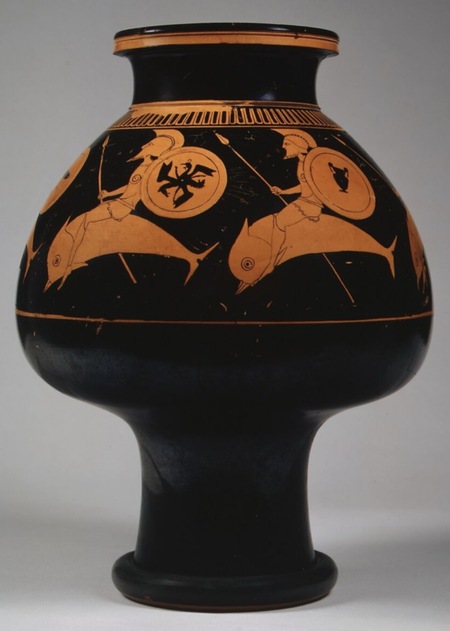
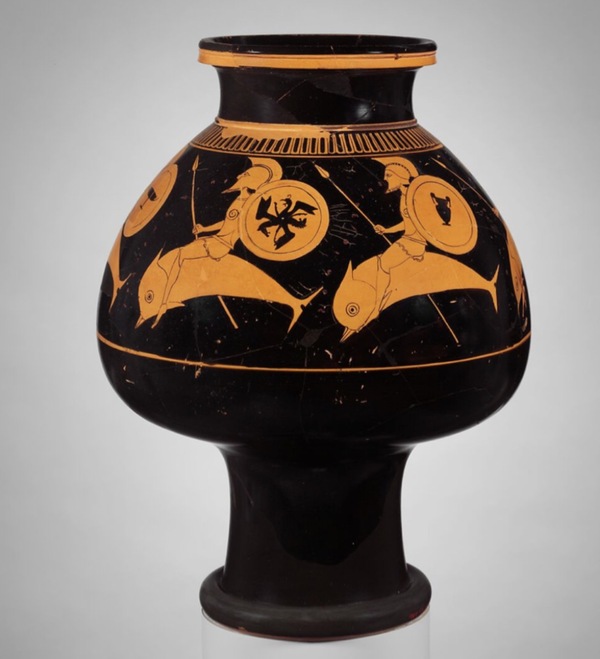
I. Terracotta Psyche. Master Altos. Approximate Date of Creation—520–510 BCE.
*The Psykter is a wine cooler.The hoplites are arranged in a circle around the body of the Psykter. Each warrior sits on a dolphin, their body oriented in profile. The spearheads of the warriors point forward, which can demonstrate a constant readiness to defend against enemies or to attack them.When the Psykter containing wine was lowered into a large basin of ice water, it created the illusion that the six dolphins were alternately diving and leaping from the water. Thus, it gave the impression that the warriors were «moving» into battle, armed with spears and shields. The shape and function of the vessel actively contributed to the creation of the maritime image.
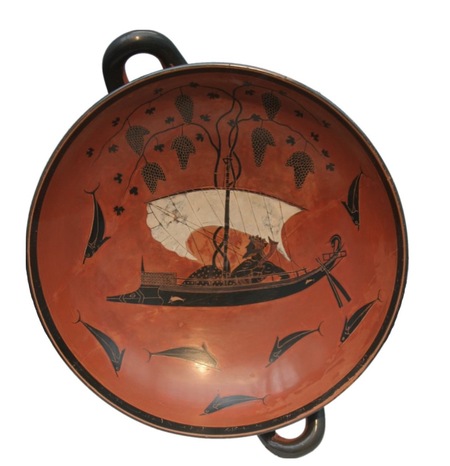
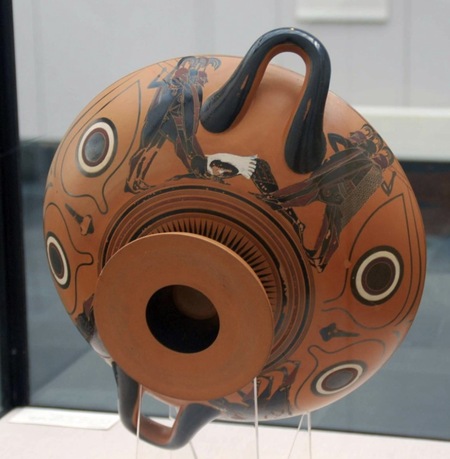
II. Kilix depicting Dionysus on a ship. Work by Exekias. Approximate creation date: 540–530 BCE.
On the exterior, there are large, stylized images of eyes on both sides. Flanking each handle are three heroes in armor. On the inside of the handle, the myth of Dionysus’s voyage is depicted. Exekias has presented the moment as Dionysus leading a ship at sea. Dolphins are shown leaping from the water around the ship.The composition that Exekias created on this vase has a quite bold concept, which is not particularly characteristic of the vase painting of that era. One large scene fills the entire circular surface of the ship’s base. The outline of the narrow ship on which Dionysus sails is in complete accordance with the contours of the dolphins surrounding it.Overall, the depiction on this vase is interpreted quite straightforwardly—it is the well-known story of how Dionysus’s power destroys pirates, turning them into dolphins. This could be symbolizing the triumph of Athenian power over piracy. It is difficult to detect any hidden subtext on this vase.
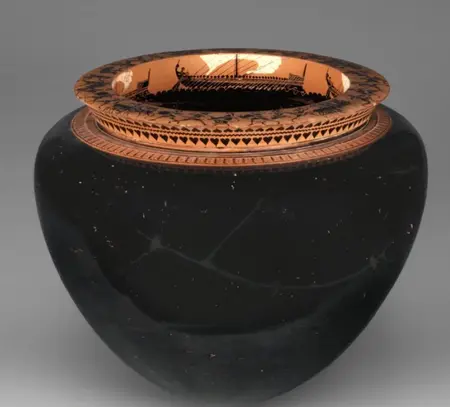
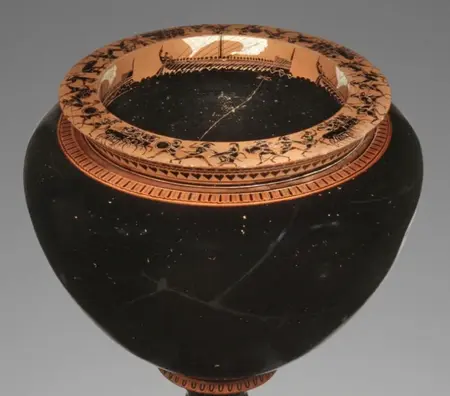
III. Dinos Exekias. Estimated date of creation—540–530 BCE.
Attic vessels, which featured ships depicted on their necks, were round bowls used for mixing wine with water and were called dinoi.
Typically, the images of Greek warships and merchant vessels were painted on the interior of the neck of these vessels, while the exterior was decorated with fine patterns.
The artists of that era did this intentionally. When the dinos was filled with wine up to the neck, it created the illusion that the ships were rocking on dark sea waves.
One can also note that the artist renders the ships and oars quite well, although the heads of the oarsmen are depicted as simple black circles, which could easily be mistaken for a pattern. Most likely, this was done so that the viewer’s eye would be drawn specifically to the powerful Greek fleet.
In the direct depictions of the ships, another special context can also be traced. The primary consumers of decorated vessels were members of the aristocratic elite. In the 6th century BCE, the construction and maintenance of warships rested on the shoulders of the wealthiest citizens. The depiction of a ship on an expensive vase flattered the elite, reminding them of their crucial role in protecting and strengthening the state.
What could have inspired the creator of this vase?
Triremes were warships, among the fastest and most maneuverable, featuring three banks of oars that were particularly heavily utilized in Ancient Greece from the 7th to the 4th century BCE.
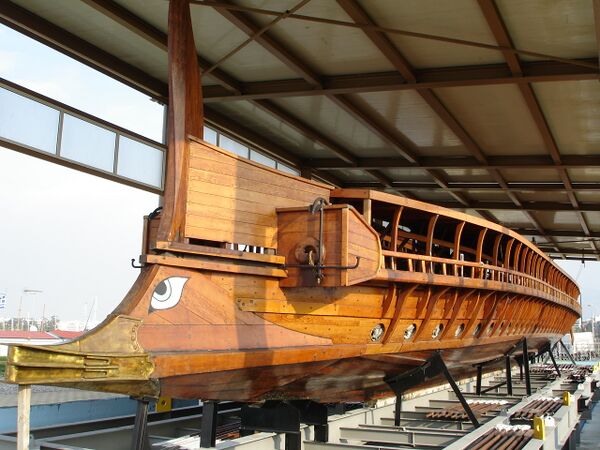
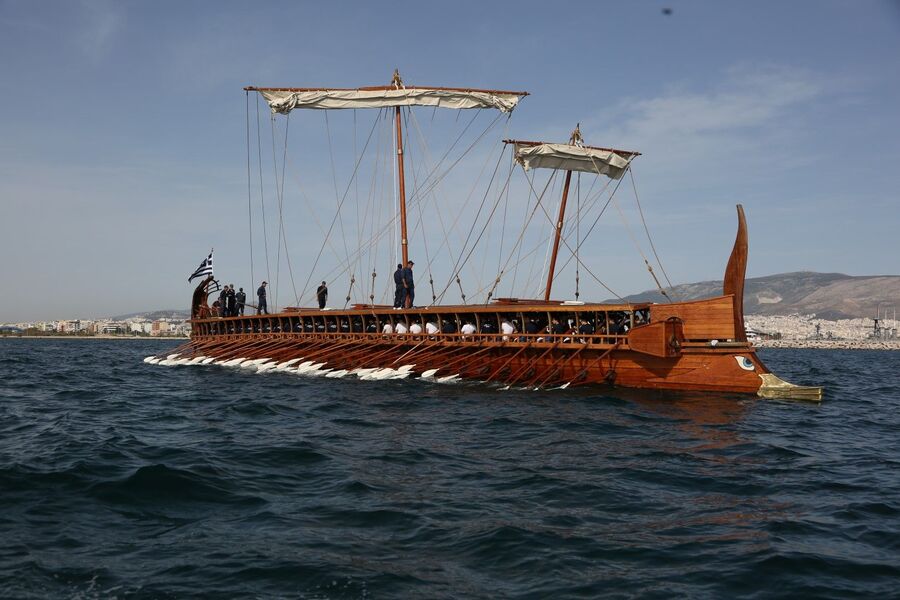
Reconstructions of the Athenian trireme «Olympia.» Built in 1987, it is approximately 37 meters long and requires 170 rowers and a ram weighing about 200 kg.
Comparing the image of the trireme on the vase with its historical reconstruction helps convey the gap between the conventional vase painting and the physical reality of the ships. The trireme was narrow, long, and extremely low to the water, and its primary weapon in reality was the ram, not a deck populated by warriors. Execky’s vase provides not a technically accurate portrait of a similar ship model, but an idealized image designed to demonstrate the power of the rowers (note that on the vase, the rowers' heads are depicted above the ship, whereas in reality, they were seated beneath the main deck). It is this very divergence that is significant: the vase painting functioned not as a documentary illustration, but as a visual formula through which the might of the fleet was recognized in ancient Greece and beyond.
Heracles—one of the most popular heroes of Ancient Greece. The feats he accomplished regularly served as a source of inspiration for masters.The vase depicts the hero’s struggle with a Triton, who embodies the turbulent marine element. On the right, one can see Poseidon, the god of the seas, and on the left, Nereus, symbolizing the calm sea.Virtually everyone knows Heracles' feats on land, but for some reason, in this scene, he invades a watery environment alien to him. Perhaps the artist is showing that the influence of Athens now extends to the sea.
It can be concluded that the direct depiction of ships and marine creatures was prioritized specifically in the 6th century BCE. However, this does not negate the existence of allegorical themes during that period. It simply means that even when depicting ancient Greek gods, images of ships or sea creatures were included.
Section 2. Vases featuring allegorical themes related to the sea, without direct depictions of marine life or ships.