The Femme Fatale Archetype in Austrian and German Symbolist Painting: A Study of Gustav Klimt and Franz von Stuck (1890s–1910s)
Concept
In my visual research, I am addressing one of the most tense and contradictory periods of European culture—the turn of the 19th and 20th centuries. The fin de siècle era in Vienna and Munich attracted me not merely as a historical segment, but as a space of global shifts in consciousness.
This was a period when the philosophy of Schopenhauer and Nietzsche was dismantling the foundations of old morality, and Freud’s psychoanalysis was unveiling the frightening depths of the subconscious. I view the art of this era as a mirror reflecting the «crisis of masculinity» and the patriarchal society’s fear of burgeoning emancipation. It was precisely this fear, in my opinion, that spawned the pervasive image of the femme fatale—the fatal woman who brings ruin.
My interest centers on moving beyond a generalized understanding of symbolism. Studying the literature and art of that period, I noticed that despite the common theme, the visual languages of the artists differ radically. To demonstrate this, I am focusing on the work of two key figures in German-Austrian Modernism: Franz von Stuck and Gustav Klimt.
My focus is on the issue of differentiating their artistic strategies. These masters are often viewed within a single current, yet I hypothesize that Klimt and von Stuck created two fundamentally different models of the female image, reflecting the polar extremes of the era’s crisis.
The objective of my research is to demonstrate through comparative visual analysis that where Stuck perceives ancient animalistic force, Klimt reveals a cool, neurotic calculation. This study is an attempt to deconstruct the myth of the fatal woman and observe behind it two distinct perspectives on the nature of human passions: one plunging into the abyss of myth, and the other reflecting the brilliance and poverty of Viennese Modernism.
While developing this theme, I grappled with several key questions that helped me develop the hypothesis stated in the concept. Primarily, I am interested in the problem of transferring a philosophical idea into the material of painting: what specific visual means do artists use to convey the idea of feminine doom? I attempted to understand why, despite a similar conceptual foundation—the fear of emancipation and the influence of Nietzsche’s philosophy—the visual outcome turned out to be so disparate.
I am concerned about the nature of this «evil»: is the femme fatale in the works of Schtuka and Klimt a creature of the same species? Or are we dealing with a fundamental division between the «natural» (in Schtuka) and the «social» (in Klimt)?
A crucial part of my analysis involved the role of space and environment: how does the absence of a background, or conversely, its transformation into an active ornament, influence the perception of the heroine’s image?
Finally, I am exploring the issue of audience reception: how artists specifically direct our gaze, making us feel simultaneously like victims of hypnosis and voyeurs peering through a keyhole.
When compiling the corpus of visual sources, I guided myself by the principle of representativeness, intentionally limiting my research to the 1890s–1910s. This was a period of the highest flourishing of Symbolism and Secession, when the topic I was interested in resonated most intensely.
I deliberately excluded graphic sketches, posters, and applied arts from my view, focusing exclusively on easel painting. This choice was motivated by the fact that chromatic strategies are most fully realized in oil painting—Climt’s use of gold and Stuck’s deep earth tones—which is critically important for my comparative analysis.
As examples, I chose the programmatic works—"Sin» and «Salome» by Franz von Stuck, as well as «Judith I» and «Water Snakes» by Gustav Klimt. My choice of these works was not arbitrary: they serve as a kind of artistic manifesto, in which the artists’ individual stylistic techniques and their interpretation of the femme fatale archetype are brought to their absolute peak, making them ideal material for a contrasting comparison.
So, Franz von Stuck: The Demonic Hypostasis and the Archetype of Eternal Evil
Drawing from the creative work of Franz von Stuck, the leader of the Munich Secession, I discovered that his artistic system deliberately strips the female figure of individual or social characteristics.
In my view, Stuk transforms women into archetypes, crafting a mythologized image of the femme fatale as the personification of primordial, metaphysical evil. Analyzing his pictorial method, I noted that his primary tools are dramatic contrast between light and shadow (chiaroscuro), emphasized materiality—almost sculptural forms—and a specific, «theatrical» staging of the gaze.
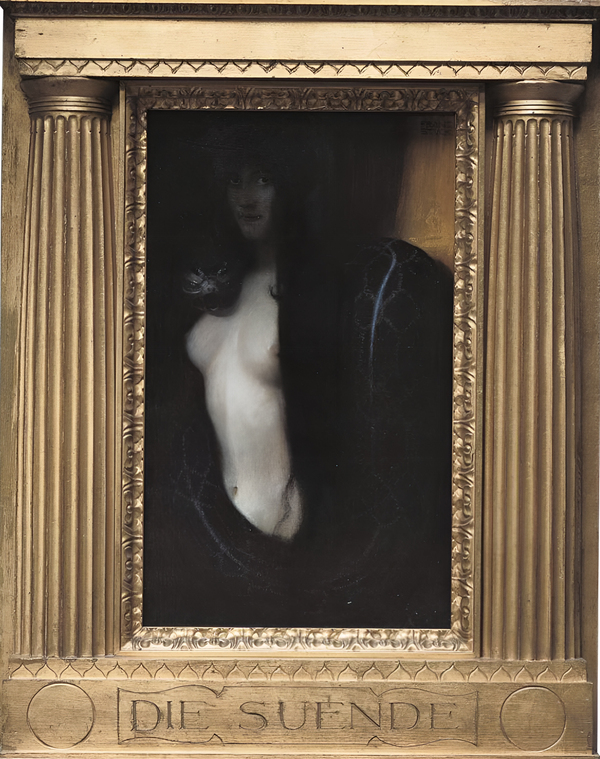
Sin / Franz von Stuck / 1893
In my view, the most striking example of this approach is his canvas, «Sin» (1893). Examining this work, I first noted how the artist places the figure in a dense, dark space, devoid of any domestic details or landscape setting. This absence of temporal coordinates seems fundamental to me: before us is not a specific woman, but an allegory of the very concept of vice.
Sin / Franz von Stuck / 1893 / Fragment
Particular attention should be paid to the visual center of the composition—the interaction between the heroine and the enormous boa constrictor. I got the impression that the snake here functions not merely as an external attribute of temptation, but as an extension of the woman’s own body: the reptile’s scaly skin and the heroine’s pale, luminous flesh are rendered with the same meticulous attention to texture, visually rhyming with one another.
Sin / Franz von Stuck / 1893 / Fragment
The heroine’s gaze, directed straight at the viewer from beneath lowered brows, lacks flirtatiousness. These dark voids, devoid of distinct pupils, create a hypnotic effect. It is as if the piece transforms into a sacred object—a dark altar, where the massive golden frame only intensifies the sense of pagan power.
Salome / Franz von Stuck / 1906
If the figure in «Sin» is static, then in the painting «Salome» (1906), Stuk approaches expressive dynamism while retaining a sense of fatal predestination. Here, I noticed an interesting compositional device: the low horizon line forces the viewer to look up at the heroine, which visually asserts her dominance.
Salome / Franz von Stuck / 1906 / Fragment
I find it important to emphasize how Stuka rejects historicism: instead of palace interiors, he depicts a deep blue, star-strewn sky, elevating the event to a cosmic level. In my view, Salome by Stuka is not the refined princess we might see in French Symbolists, but rather the embodiment of a barbaric, vital force.
Salome / Franz von Stuck / 1906 / Fragment
Her body is fractured in an ecstatic movement, and her face is contorted in a grimace of triumph. Light catching the figure from below, like a theatrical ramp, and the spectral glow from the severed head of John the Baptist create the atmosphere of a mystical thriller, where the feminine overwhelms the sacredness of the prophet.
Thus, by immersing myself in the visual world of Franz von Stuck, I concluded that his interpretation of the femme fatale is rooted in monumentality and chthonic dread. In both static and dynamic compositions, he employs a dark color palette and rigid plasticity to depict the woman not as a human being, but as an inscrutable and dangerous natural force.