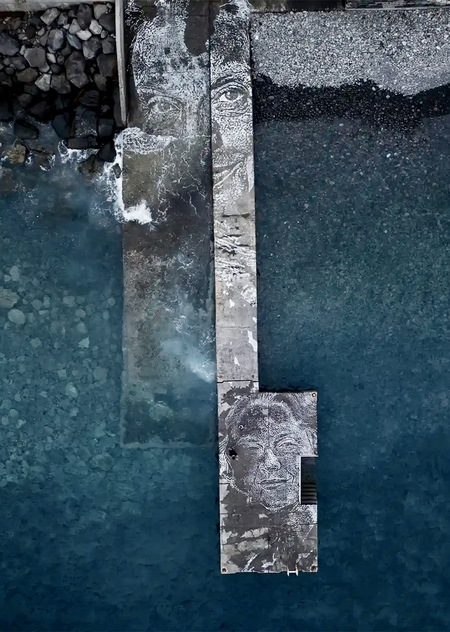
Palimpsest: Layers in Dialogue
What is a Palimpsest?
A palimpsest, in its original meaning, is a manuscript page from which text has been scraped off to make room for new writing. Yet the old text never fully disappears — it remains faintly visible beneath the surface, creating an involuntary conversation between what was and what is. This tension between erasure and persistence, between past and present, transforms the palimpsest from a simple recycled surface into a profound metaphor for how time accumulates, overlaps, and speaks to itself.
In contemporary art, the palimpsest operates not merely as a technique of layering but as a conceptual framework for understanding how artworks embody multiple temporalities simultaneously. Artists working with palimpsestic strategies create spaces where different moments refuse to remain separate — where the material, temporal, and conceptual strata enter into dialogue, making visible the conversations that occur when past, present, and potential future occupy the same surface.
This essay explores the palimpsest as a site where layers enter into dialogue. Through diverse artistic practices — from painting and sculpture to photography and performance — I examine how contemporary artists collapse linear time, making different temporalities coexist in productive tension. The palimpsest, I argue, is not about what remains or what is lost, but about the dynamic conversation that emerges when multiple layers insist on simultaneous presence.
Seeing Layers
Portuguese artist Alexandre Farto, known as Vhils, works with the city itself as a palimpsest. By carving into weathered walls, he removes layers of accumulated material — posters, paint, plaster — to reveal what lies beneath. The portraits that emerge are inseparable from their substrate: a face takes shape through fragments of old advertisements, traces of graffiti, architectural scars. This is not simply excavation, but a form of temporal choreography where past and present become mutually constitutive.
The dialogue here operates through subtraction rather than addition. Each carved line is both an act of erasure and an act of recovery — what is removed makes visible what was hidden, yet what remains is always incomplete, fragmented. The wall refuses to offer a single clear surface; instead, it presents multiple moments layered upon one another, each insisting on its presence. Vhils’s gesture acknowledges that urban surfaces are never blank — they carry histories that cannot be fully erased, only renegotiated. The palimpsest, in this sense, is less about preservation than about the impossibility of complete erasure.

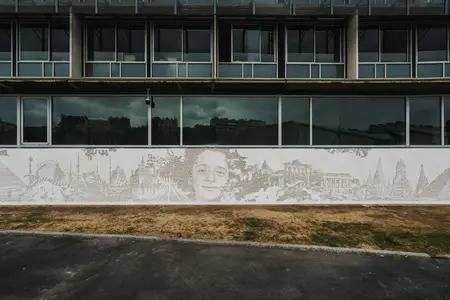
Vhils, Scratching the Surface project: 1. Ulsan University, South Korea, 2024 (photo by André Alves) 2. UNESCO, Paris, France, 2023 (photo by José Pando Lucas)
If Vhils uncovers layers through removal, Gerhard Richter’s «Overpainted Photographs» enact a different palimpsestic gesture — one of partial concealment. In this series, Richter applies gestural strokes of paint across photographic images, often family snapshots or found photographs. The paint does not fully obscure the image beneath; instead, it creates a tension between visibility and erasure, between the indexical certainty of photography and the interpretive openness of painting. We see fragments of faces, landscapes, domestic scenes — enough to recognise, never enough to fully grasp.
The dialogue between layers here is one of resistance and negotiation. The photograph, frozen in its moment of capture, represents a fixed past — mechanical, objective, already gone. The paint, applied in the present, is subjective, gestural, alive. Yet neither layer dominates completely. The paint cannot erase the photograph’s insistence on «this was», while the photograph cannot prevent the paint’s assertion of «this is now». What emerges is a conversation between two temporalities, two modes of representation, two claims on truth. The overpainted photograph becomes a site where past and present refuse to remain separate, where memory and intervention coexist in productive ambiguity.
Gerhard Ritcher, Overpainted Photographs: 1. 2.9.94, 14.8 cm x 10.1 cm, 1994 2. 16. Nov. 99, 14.8 cm x 10.1 cm, 1999 3. 4. April 05, 15 cm x 10 cm, 2005
Doris Salcedo’s «Atrabiliarios» presents a more haunting form of palimpsest — one where layers speak through absence rather than presence. The work consists of shoes belonging to victims of violence in Colombia, placed in wall niches and sealed behind translucent animal fiber membranes. The membrane allows partial visibility: we see the worn leather, the shape of a foot once present, but the image is blurred, obscured, forever just beyond full apprehension. This is a palimpsest of loss, where what is missing becomes as articulate as what remains.
The dialogue here unfolds between the material object and the absent body it once held. The shoe carries the imprint of use — creases, scuffs, the subtle deformation caused by weight and movement. These are physical traces of a life, a body, a person now gone. The membrane acts as another layer, a veil that simultaneously protects and distances, that makes visible while preventing complete access. What emerges is not a straightforward memorial but a complex negotiation between presence and absence, between the desire to remember and the impossibility of fully recovering what has been lost. The palimpsest becomes a space where the disappeared remain perpetually suspended — neither fully present nor completely erased.
Doris Salcedo, Atrabiliarios, 1992-93 Wall installation with plywood, shoes, cow bladder and surgical thread, six niches, (overall 76,2×178,4×13 cm).
Hiroshi Sugimoto’s «Theaters» series translates the palimpsest into photographic time. Using extended exposures that last the entire duration of a film screening, Sugimoto captures not a single moment but the accumulation of all moments. The movie screen, which flickers through thousands of individual frames, appears in the final photograph as a luminous white rectangle — every image collapsed into pure light. What we see is both everything and nothing: the entire film compressed into a single surface, yet no individual scene remains legible.
This is a palimpsest where all layers occupy the same temporal plane simultaneously. Unlike Richter’s paint over photograph or Vhils’s excavated walls, Sugimoto’s layering happens within the photographic act itself. Each frame of the film writes itself onto the same piece of film, each image overwriting and merging with the next. The result is neither addition nor subtraction, but a kind of temporal saturation — a surface so densely layered that it becomes blank, luminous, abstract. The dialogue here is between duration and the instant, between the cinematic experience of time unfolding and the photographic insistence on freezing it. The palimpsest reveals itself as paradox: complete accumulation produces apparent erasure.
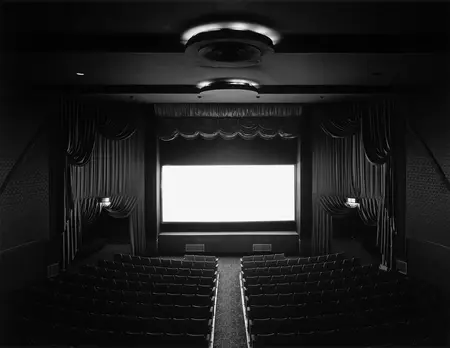
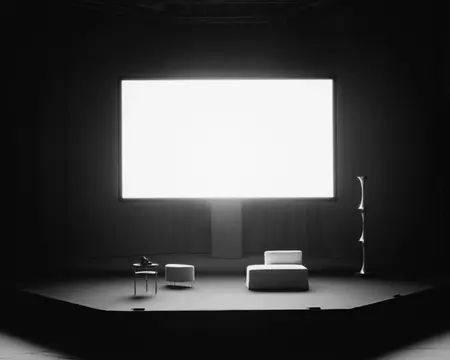
Hiroshi Sugimoto, Theaters (gelatin silver print): 1. Trylon, New York, 1977 (48.6 × 59.4 cm (sheet), edition of 25) 2. Sogetsu Hall, Tokyo, 2017 (50.8×61.0 cm (mount), edition of 25)
On Kawara’s «Today» series operates as a conceptual palimpsest, one built not through physical layering but through systematic repetition. Beginning in 1966 and continuing until his death, Kawara painted the current date on canvas, day after day, in a uniform format. Each painting records a single day — white letters on a monochrome ground, precise and impersonal. Taken individually, these works might seem like simple documentation. Viewed as a series, however, they become a vast accumulation of temporal layers, each date adding to an ever-growing archive of marked time.
The palimpsestic quality emerges from this accumulation. Each painting is identical in gesture yet singular in content — the same act repeated, yet never the same day. Unlike traditional palimpsests where layers occupy the same physical surface, Kawara distributes his layers across space: thousands of canvases, each carrying its own moment, yet all part of a single conceptual structure. The work becomes legible only through its totality — one date gains meaning in relation to the others, forming a network of temporal markers that together constitute a life. The palimpsest here is durational and relational, suggesting that time itself layers conceptually rather than materially. Each day may erase the previous one in lived experience, yet through Kawara’s gesture, all days persist simultaneously as accumulated traces of presence.
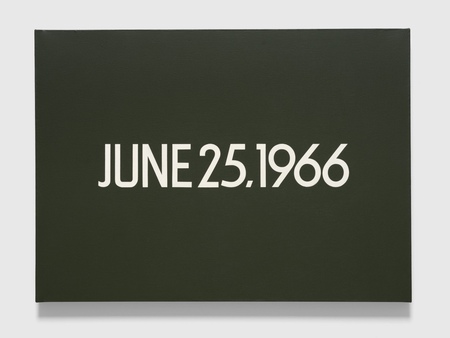
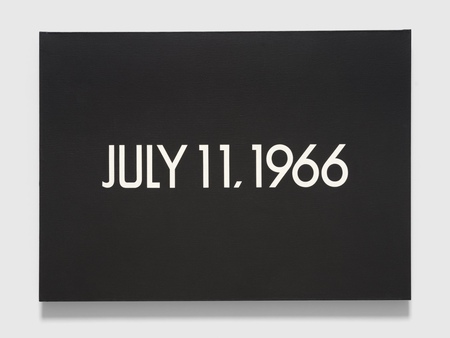
On Kawara, Today, 1966 (acrylic on canvas): 1. JUNE 25, 1966 (66×91.4 cm) 2. JULY 11, 1966 (66×91.4 cm)
Marina Abramović's «Rhythm 0» extends the palimpsest into the realm of the body and endurance. In this 6-hour performance, Abramović stood passively while the audience was invited to use any of 72 objects on her body — from a rose to a loaded gun. As the performance progressed, the audience’s actions escalated from gentle to violent, leaving physical marks, cuts, and traces on her body. Unlike the previous works, this palimpsest is temporal and corporeal rather than material — the layers exist not as visible strata but as accumulated experience inscribed in flesh and memory.
The dialogue here unfolds between the artist’s body as passive surface and the audience’s actions as successive inscriptions. Each gesture — a touch, a cut, a violation — writes itself onto and into the body, layering over previous actions yet never fully erasing them. The body becomes an archive of what has been done to it, carrying traces that may fade physically but persist psychologically. This is perhaps the most vulnerable form of palimpsest: one where the surface cannot be preserved or protected, where erasure and inscription happen simultaneously, and where the layers speak not through visibility but through the weight of accumulated trauma and endurance. The performance suggests that we ourselves are palimpsests — our bodies and psyches layered with experiences that shape us even as they recede from view.
Marina Abramović, Rhythm 0, 1974
Understanding Time
Through these diverse practices, the palimpsest reveals itself not as a fixed form but as a dynamic principle. What unites these works is not the literal presence of layers but the way they stage encounters between temporalities. Each artist negotiates differently with erasure, visibility, and persistence, yet all create spaces where past and present refuse linear separation, where what has been and what is enter into active dialogue.
The palimpsest, as these works demonstrate, is fundamentally about coexistence rather than replacement. Layers do not simply succeed one another; they speak to, interrupt, and reshape each other, creating sites where multiple moments insist on being present at once.
Perhaps what the palimpsest ultimately offers is a way of thinking about time itself — not as a forward march that leaves the past behind, but as a layered condition where nothing is ever fully lost or fully present. The strata remain in conversation, their dialogue shaping what we see, what we remember, and how we understand the surfaces we encounter. Art, in this sense, does not represent time but enacts it, creating objects and experiences that refuse the fiction of the singular moment and instead embrace the complexity of temporal layering.
Badovinac, Z., Carrillo, J., Piškur, B., & Hiršenfelder, I. (Eds.). (2018). Glossary of common knowledge. Moderna galerija.
Enriquez, M. S. (2016). Doris Salcedo: The materiality of mourning. Yale University Press.
Farto, A. (2023). Vhils: Pentimento. Vhils Studio.
Hage, J., & Obrist, H. U. (Eds.). (2025). Gerhard Richter: The overpainted photographs: A comprehensive catalog. HENI Publishing.
Heinzelmann, M., Strauss, B., & Hustvedt, S. (2008). Gerhard Richter: Overpainted photographs. Hatje Cantz.
Rosenthal, M., Salcedo, D., & Princenthal, N. (2015). Doris Salcedo. Phaidon Press.
Sugimoto, H. (2016). Theaters. Damiani/Matsumoto Editions.
Watkins, J. (2015). On Kawara. Phaidon Press.
Westcott, J. (2010). When Marina Abramović dies: A biography. MIT Press.
https://www.vhils.com/en/artwork/walls (accessed 09.12.2025)
https://www.gerhard-richter.com/en/art/overpainted-photographs (accessed 09.12.2025)
https://www.moma.org/audio/playlist/182/2430 (accessed 09.12.2025)
https://fraenkelgallery.com/portfolios/hiroshi-sugimoto-theaters (accessed 09.12.2025)
https://www.davidzwirner.com/exhibitions/2024/on-kawara-london (accessed 09.12.2025)
https://iremimre.medium.com/through-todays-lens-reassessing-marina-abramovic-s-performances-in-the-context-of-violence-8b82d158f156 (accessed 09.12.2025)
https://top-antropos.com/history/20-century/item/813-marina-abramovic-1 (accessed 09.12.2025)