Biography
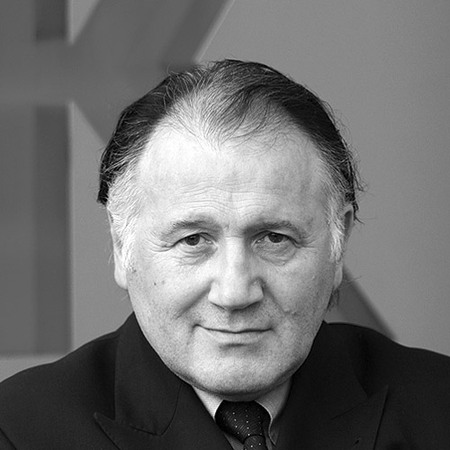
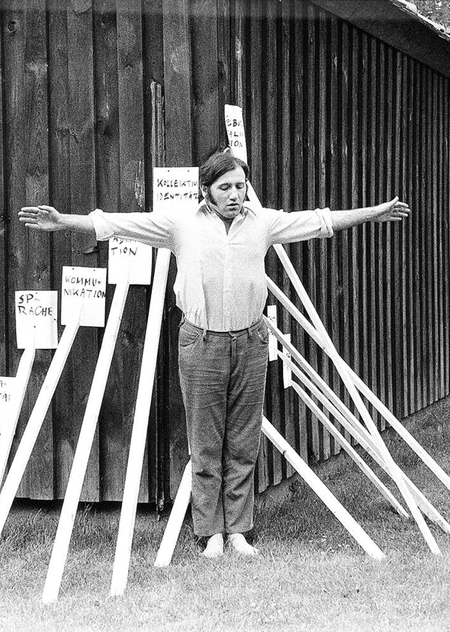
Peter Weibel (1944–2023) was an Austrian artist, curator, and theorist of media art born in Odessa. He studied literature, medicine, logic, philosophy, and film in Paris and Vienna. His artistic practice encompassed performance, experimental film, video, and digital installations. Weibel taught at the Vienna University of Applied Arts and the State University of New York in Buffalo, and he directed the Ars Electronica and Neue Galerie Graz festivals. From 1999 to 2023, he led the Center for Art and Media (ZKM) in Karlsruhe.[1]
Theoretical Works
1. «Gamma and Amplitude. Texts on Media and Art Theory» (2004) — a collection of texts in which Waibel explores the relationship between art, media, technology, and social processes. 2. «Temporal Slot. The History and Future of Apparatus Perception: From Phenakistoscope to Quantum Cinema» (2006) — an investigation into how technical devices and the evolution of media are changing the ways images are created and perceived. 3. «Encyclopedia of Media. Volume 6: Theory and Media» (2024) — a compilation of Waibel’s theoretical texts on art, media technologies, and the social conditions of art production and reception. 4. «Global Contemporary Art and the Emergence of New Art Worlds» (2013) — a collective collection on how globalization is changing the geography of contemporary art, international art institutions, and the relationship between art centers and peripheries.
Vaibel’s theoretical interests are tied to the influence of technology on perception, communication, and the production of knowledge. In his concept of the post-media state, he examines the changing relationship between artistic media within the context of digital culture. His interest in the social and institutional conditions of art is also evident in his curatorial practice—the exhibition becomes a space to investigate the mechanisms of producing and disseminating artistic meaning.
Exhibitions
This topic was explored in the project «Global Contemporary Art: Artistic Worlds After 1989, ” which took place at ZKM in 2011–2012. The exhibition examined the shifts in the art world following 1989—the globalization of the art market, the emergence of new artistic centers, and the reevaluation of the traditional division between center and periphery. The project was linked to the research program „Global Art and Museums“ and investigated how institutions shape the perception of contemporary art.[2]
Project 1. The Global Contemporary: Art Worlds after 1989 ZKM, Karlsruhe. September 17, 2011 — February 19, 2012 Selected Participants. Francis Alÿs, Kader Attia, Bani Abidi, Halil Altındere, What to Do? (Chto Delat?), Hito Steyerl, Mona Hatoum, Rafael Lozano-Hemmer
This issue is illustrated by Mladen Stilinović’s work, «The artist who doesn’t speak English is not an artist» (1994), which ironically comments on the dominance of the English language and its role in international artistic recognition. Hans Belting’s, Andrea Budenzig’s, and Peter Weibel’s collection, Global Contemporary Art and the Emergence of New Artistic Worlds, develops a similar theme by examining the multiplicity of artistic worlds in the context of globalization.[3]
In the exhibition «Global Activism» (Global Activism, ZKM, 2013–2014), Waibel addressed political protests and forms of civil self-organization. The exposition included photographs, films, video recordings, blogs, and social media documents. A visual example is Jörg Pahe’s photograph, «Illegal laser projection, Free Pussy Riot, Berlin, ” which captured a form of public political expression. In the project description, the curator uses the concept of „performative democracy, ” wherein citizens express political positions through public actions and online communications.[4]
Project 2. global activism ZKM, Karlsruhe. December 14, 2013 — March 30, 2014 Some participants. Pussy Riot, The Yes Men, Chto Delat? , Victoria Lomasko, Paolo Cirio.
Veybel’s convergence of activism and art is termed «artivism» [4]. This approach allows artistic means to be viewed as part of political action. Simultaneously, the question arises: does the function of protest change when its documentation finds a home in a museum space?
In the exhibition «Open Codes: Life in Digital Worlds, ” the subject of study was digital codes and their influence on everyday life.[5] A central piece of the project was the interactive installation „YOU: YOUR: CODE, ” created by Bernd Lintermann and Peter Waibel. The viewer watches as their reflection gradually transforms into a digital model, and then into a code readable by a machine.[6] The work proposes the idea: „A person is a collection of codes.”[6] The installation translates the theoretical discussion of digital identity into embodied experience—the visitor personally becomes a participant in the technological transformation of the image.
Project 3. Open Codes: Living in Digital Worlds ZKM, Karlsruhe. October 20, 2017 — June 2, 2019 Various Artists. Bernd Lintermann, Peter Weibel, Refik Anadol, James Bridle, Rosa Menkman
Description of the Curatorial Method and Approach
In Peter Weibel’s curatorial practice, four interconnected principles can be identified.
Interdisciplinarity. Vaibel merges art with science, philosophy, and technology, examining their interplay as a means of investigating contemporary culture. Exhibition as Inquiry. Each project is constructed around a specific problem. In «Global Contemporary Art, ” the curator explores the structure of the international art world; in „Global Activism, ” the connection between art and political action; and in „Open Codes, ” the influence of digital technology on daily life and the human concept. Critique of Institutions and Media. The art market, museums, and digital platforms function simultaneously as conduits for disseminating art and as objects of analysis. Vaibel examines how these elements affect the production of knowledge, public communication, and the recognition of artists. The Viewer’s Active Role. In certain projects, the visitor engages with the works, participates in educational programs, and is given the opportunity to independently explore the presented theme.
A key characteristic of the Vaybel method is that the exhibition becomes a space for the interaction of artistic works, documents, scholarly materials, and technological experiments. This approach expands the functions of curation—it incorporates research work and the organization of public discourse.
However, a contradiction emerges in his practice. While the exhibitions explore the mechanisms of power, the art market, and digital culture, they themselves depend on institutional selection and the methods of presenting the material. The museum dictates which works the viewer will see and in what context they will receive them. Therefore, Vaibel’s curatorship can be viewed as an attempt to critically examine the systems of which the exhibition institution itself remains a part.
ZKM | Center for Art and Media Karlsruhe. Peter Weibel [Electronic resource]. URL: https://zkm.de/en/persons/peter-weibel (Accessed: October 27, 2026).
ZKM | Center for Art and Media Karlsruhe. The Global Contemporary: Art Worlds after 1989 [Electronic resource]. URL: https://zkm.de/en/exhibition/2011/09/the-global-contemporary (Accessed: October 27, 2026).
Belting H., Buddensieg A., Weibel P., eds. The Global Contemporary and the Rise of New Art Worlds. Cambridge, MA: The MIT Press, 2013. 464 p. ISBN 978-0-262-51834-5. URL: https://mitpress.mit.edu/9780262518345/the-global-contemporary-and-the-rise-of-new-art-worlds/ (Accessed: October 27, 2026).
Weibel P., ed. Global Activism: Art and Conflict in the 21st Century. Cambridge, MA: The MIT Press, 2015. URL: https://zkm.de/en/publications/global-activism (Accessed: October 27, 2026).
ZKM | Center for Art and Media Karlsruhe. Open Codes: Living in Digital Worlds [Electronic resource]. URL: https://zkm.de/en/exhibition/2017/10/open-codes (Accessed: October 27, 2026).
ZKM | Center for Art and Media Karlsruhe. YOU: R [Electronic resource]. URL: https://zkm.de/en/artwork/yourcode (Accessed: October 27, 2026).