Concept
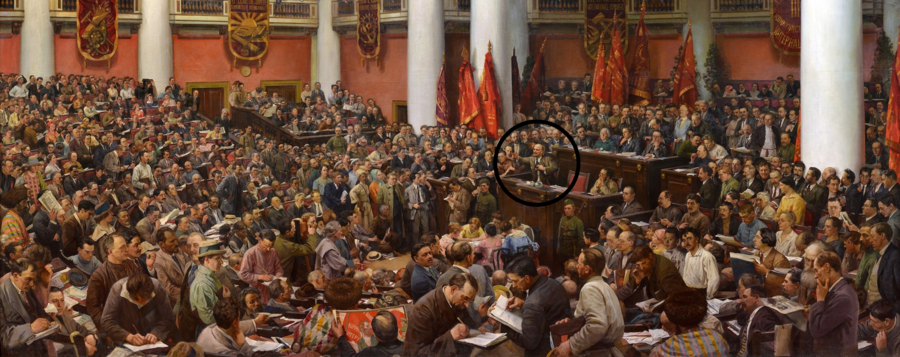
I. I. Brodsky / Grand Opening of the Second Comintern Congress at the Uritsky Palace in Leningrad / 1924 — Fragment
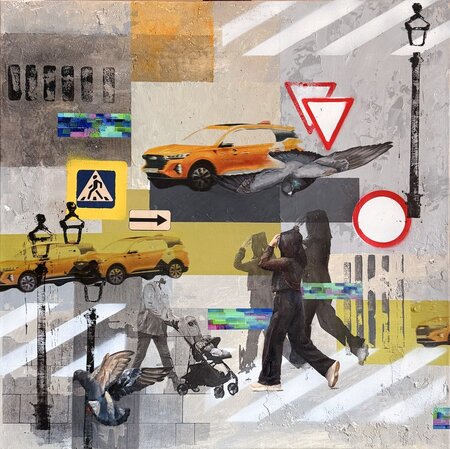
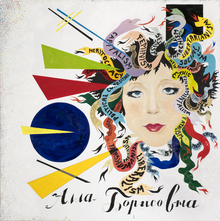
The influence of Socialist Realism on world art is difficult to fully assess due to its sheer magnitude. Modern artists’ works—such as the degenerative realism of D.V. Loktionov or the paintings of Xenia Zhu-Galkina—can serve as examples. Unfortunately, the Socialist Realism style in art is often overlooked; few people are interested in studying Soviet art. It usually appears simplistic and straightforward, leading many to dismiss it as uninteresting. It is crucial to study this vast body of material to understand why Socialist Realist paintings gained such widespread popularity, were valued, and were beloved by many people. One must closely examine the techniques and methods this style employs to impress the viewer. We need to understand how the artist works with form, volume, light and shadow, texture and surface quality, perspective, and, ultimately, how the artist manipulates space itself.
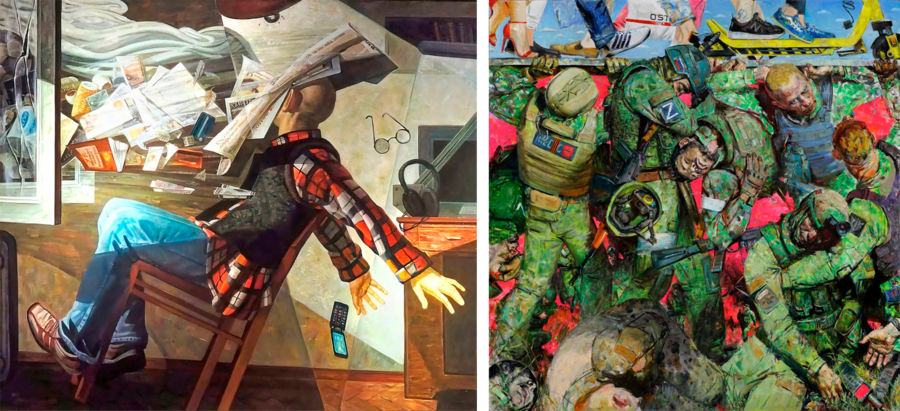
D. V. Loktionov/Ok, Google/2013//K. N. Zhu-Galkina/Atlantes/2023
For textual sources, various historical documents (such as decrees of the VKP (b)), recent monographs, and articles on socialist realism were utilized to understand contemporary perceptions of the style. Older academic articles, such as the monograph «The Art of Vietnam, ” were also consulted to ascertain how socialist realism was perceived previously. Overall, all texts were necessary to create the most comprehensive and objective picture of socialist realism.
For visual material, we drew from various museum and private collection websites, which house paintings, as well as scholarly articles and illustrated studies—these sources were deemed the most reliable. Since there is an abundance of visual material concerning socialist realism, the decision was made to select key works, alongside images that were of high quality and closely aligned with the established canon [4] of socialist realism.
«Under the conditions of socialist construction, art throughout its many-century history became an object of state building and state policy» [4]
Socialist Realism, like any artistic style, is contingent upon economic and political factors. Socialist Realism was developed under the patronage of the Central Committee of the Bolshevik Party (Bolsheviks), so the history and decrees of the Communist Party directly influence the style.
Given this circumstance—and the fact that Socialist Realism is not only a legacy of the USSR but also a vibrant style actively evolving in the PRC, DPRK, and SRB today—the principle of categorization in this visual study will be complex. The entire study is divided into three chapters: the USSR, East Asia, and Eastern Europe—corresponding to the location of the artwork’s creation. Within the second and third chapters, paintings are grouped by specific countries (MNR, PRC, SRB, MPR, CSR). The timeframe for the research extends from 1918 up to the present day.
The chapters are presented in this order because this is the actual trajectory of Socialist Realism. It originated in the USSR, subsequently reached China, which became a second major center for the style in many ways. Eastern Europe, which does not include countries that were part of the USSR, was the least influenced by Socialist Realism. It must be noted that this study does not encompass the entire «Socialist Bloc, ” as in many countries, Socialist Realism either transformed into something new and far removed from the „canon“ [4] or there is very little visual data available on the subject.
One final note on categorization: within each chapter, the artworks are arranged chronologically whenever possible, but not always. Exceptions include cases where paintings are being compared.
What were Socialist Realist artists striving to convey, and how did they achieve it through space?
It seems that Socialist Realism painters aimed for historicity—a style that incorporated both realism and a high degree of idealism. This was an effort to convey the «truth of life» [4]. This is precisely why the human figure in the artwork of Socialist Realist artists often becomes a demiurge, creating the space around them.
Artists from socialist nations sought to promote the ideologies of the Communist parties. They did not turn to abstraction; instead, they created lifelike canvases. The masters relied on national and local schools of painting, utilizing traditional techniques. Influences from various classical painting schools are also visible in their works. By skillfully combining classical and folk art, they construct the vision of a beautiful socialist world.
Union of Soviet Socialist Republics
I. I. Brodsky/Lenin in Smolny/1930
«Among all the riches of life, the images of our leaders Lenin and Stalin take first place in all aspects of life» [4]
In I.I. Brodsky’s painting, «Lenin in Smolny, ” we see a man wearing a simple, solid-colored jacket and trousers of the same shade. The room in the painting seems to echo the depiction of the man. The space is practically empty and austere. The wallpapered walls are unevenly pasted, causing wrinkles to appear here and there. The single sofas are draped with cloths. Many objects appear to be clothed. The color palette across the entire painting is uniform, and subtle echoes can be found throughout. For example, the table and the far sofa are the same color as the clothing, while the walls are slightly grayer than Lenin’s complexion. Brodsky creates an atmosphere of severity and contemplation. He presents a crucial historical moment—then and now.
I. I. Brodsky / Dneprostroy Strike Worker / 1932
A graduation toward naturalism is observable throughout Socialist Realism. If the preceding painting is highly realistic, then in «The Builder of Dneprostroy, ” the imagery becomes increasingly generalized. The painting features a foreground and a background. The builder is the compositional dominant. The artist chooses a low-angle perspective to emphasize the heroic nature of the man. Before us stands the demiurge, constructing a new world. The generalization of the foreground serves to convey the uncertainty of future architecture and the construction process. In the background, we see the vast distance composed of gently sloping rooftops. The great labor undertaken by the ordinary individual is depicted. At the farthest edge, amidst the blue haze, hills dotted with yellow lights can be discerned.
I. I. Brodsky/M.V. Frunze in maneuvers/1929//I. I. Brodsky/Portrait of A. M. Gorky/1937//M. V. Nesterov/Portrait of sculptor V.I. Mukhinina/1940//A. I. Laktionov /Portrait of I. I. Brodsky/1938
M. V. Nesterov/Portrait of Academician I. P. Pavlov/1935//M. V. Nesterov/ Portrait of Academician I. P. Pavlov/ 1930
The spaces within the paintings are organized around the human figure, as if enveloping it. The figure is surrounded by its attributes. If the subject is a sculptor, there are sculptures; if the subject is a soldier, there is a battlefield. In Mukhinaya’s work, the space is indistinct and hazy—the heroine seems to create her own space with her powerful yet elegant hands. Furthermore, these portraits cannot be described as static; rather, they are dynamic, depicting the person actively engaged in their workspace.
V. Yefanov / Unforgettable Encounter / 1938 — Fragment
In 1932, the Central Committee of the VKP (b) issued a resolution «On the Restructuring of Literary and Artistic Organizations.» Socialist realism officially began on this date. It is worth noting that even before this period, immediately following the end of the Civil War (1918–1923), canvases were created that later entered the canon of socialist realism [4]. The CPSU policy did not distinguish between painting and literature, which was reflected in the title of the resolution. This approach was mirrored in the works of painting. Paintings were created around specific themes—to impart morality, to teach, and to glorify.
V. Yefanov/Unforgettable Meeting (Party and Government Leaders at the Presidium of the All-Union Council of Housewives and Engineers and Technical Workers of Heavy Industry in the Kremlin)/ 1938
Individual and group portraits featuring I.V. Stalin are being actively created. For instance, in «Unforgettable Meeting, ” the lighting is skillfully composed, with a slight theatrical quality that goes almost unnoticed. The master uses highlights and shadows to emphasize the two central figures while receding the others into shadow. The volume of the light is discernible because the background figures receive less light, resulting in fewer bright spots or a darker tone. A classic, balanced composition is visible, with the main focus often centered. The paintings are dominated by a clear grid of verticals and horizontals.
A. A. Deineka/Stakhanovites/1937//A. A. Deineka/Relay Race Around the Garden Ring/1947
A. A. Deineka/Wilderness/1944//A. A. Deineka/Future Pilots/1938
A. A. Deineka/Defense of Sevastopol/1942
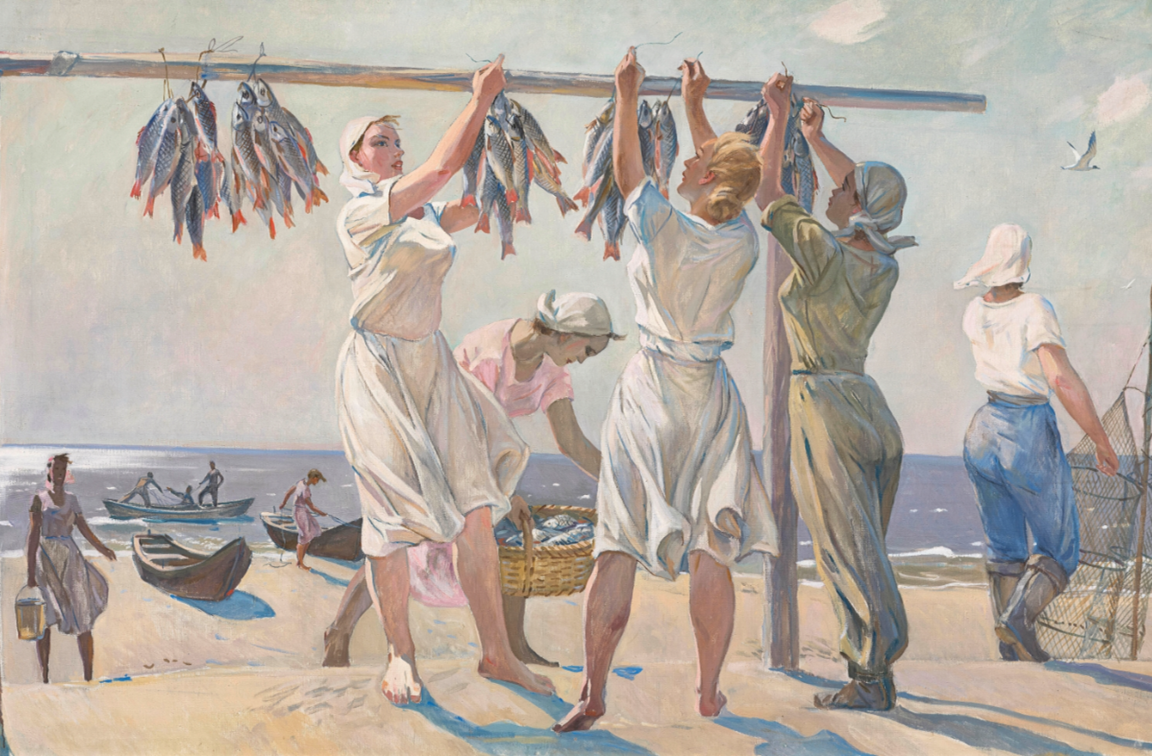
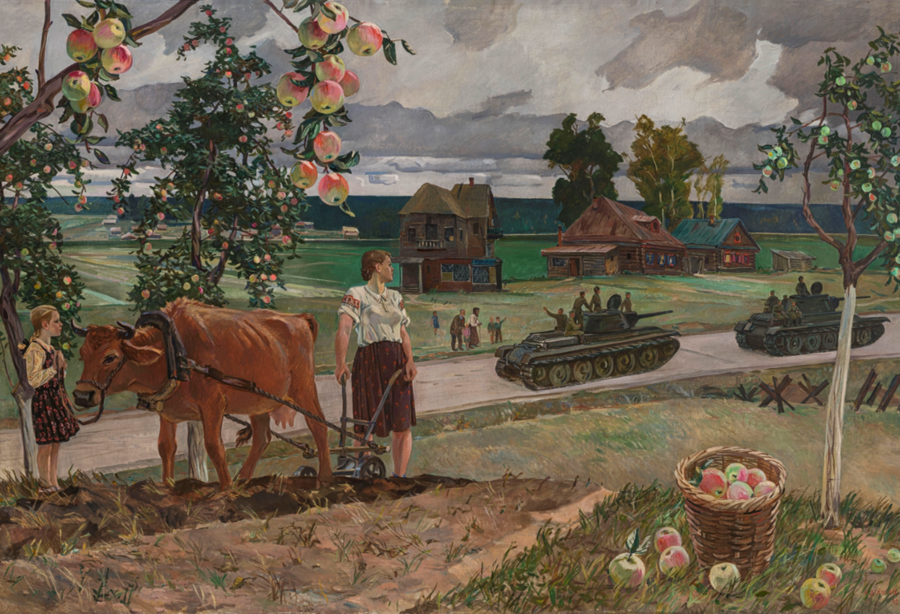
Deineka A. A./The People in the Great Patriotic War/1948//Deineka A. A./By the Sea/1957
A. A. Deineka develops a dominant horizontal line in his work. It often functions as a road or as a horizon line dividing the space into two parts. This allows him to create dynamism and tension in his pieces when the horizontal line is tilted and acts as a road upon which tanks are driving, or conversely, to evoke tranquility when it is the horizon of a turquoise sea.
A. A. Deineka/Damaged Plane/1943
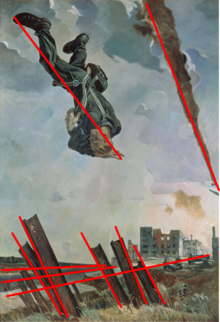
During the war, Socialist Realism continued to evolve. A.A. Deineka utilized not only horizontal lines but also vertical ones. For instance, in the work «Shot-down Ace, ” one can see at least several verticals. Firstly, there is the figure of the falling man; secondly, the falling airplane and the smoke from it; and thirdly, iron rods protruding from the ground and even grass. All of this creates, on one hand, an extremely dynamic scene—the fall of a downed ace—and on the other hand, the verticalities of perspective receding into the distance (such as the river, forest, and road) are set against these diagonal lines. This forms a space of intersecting lines, similar to a corridor, which generates a feeling of stability—as if the ace will not fall at all, but rather float in the air.
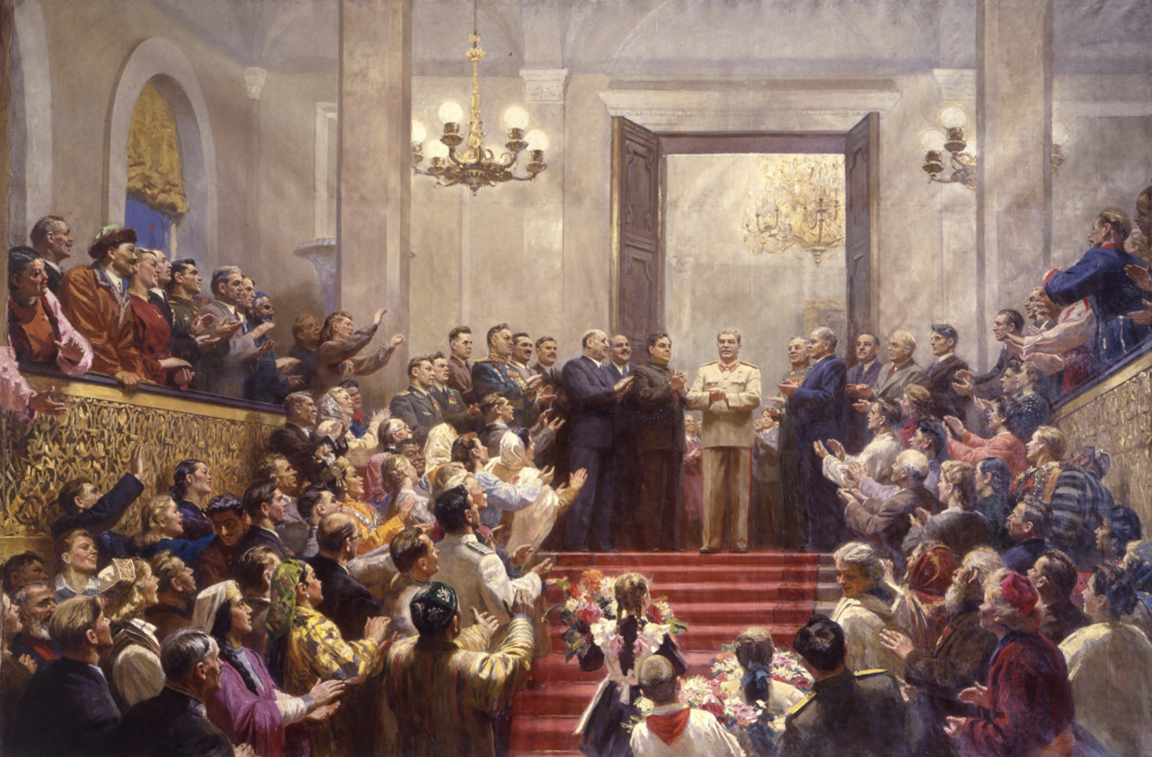
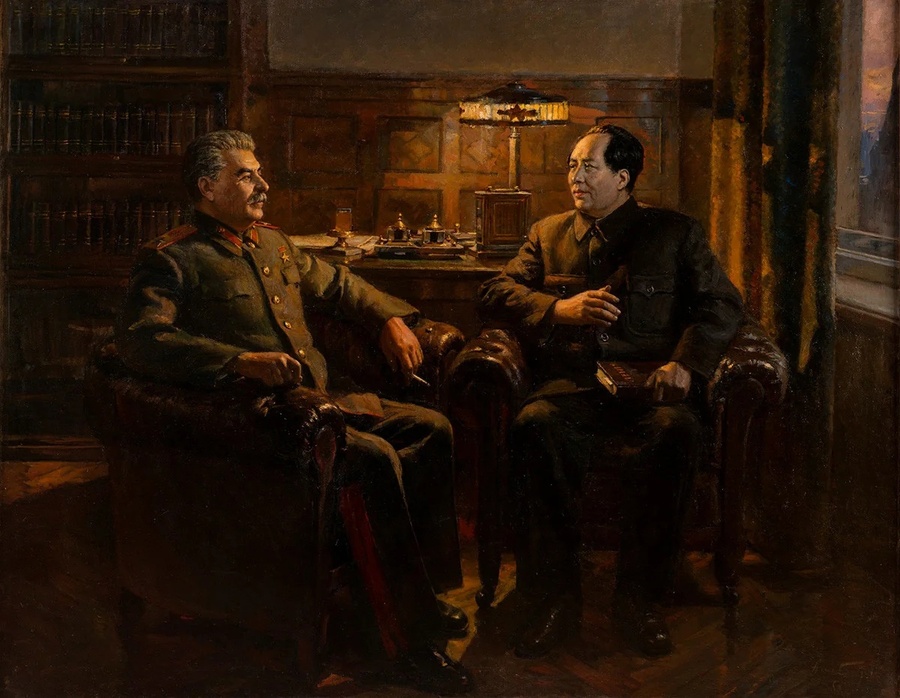
D. A. Nalbandyan/Great Friendship/1950//Kugach Yu. P. Nechitailo V. K. Tsyplakov V. G./Glory to Great Stalin! /1950