Prefix «re-»
Prefix «re-» is usually, morphologically and etymologically, understood as a repetition of an action that took place in the past. I suggest to perceive this word part not as a duplication, copy, clone of some original action or object, but as the formation of a new (object or action) out of the transformed previous experience. For instance, to regain somebody’s trust you should reflect on your actions that led to loss of it. And moreover, to take into account your mistakes from the last interaction.
The Latin re- originally meant «back» or «backwards» while the English «re-» today generally signifies «again.» David Kazanjian
«Re-» — is not about starting an action again or making an object from the blank by eliminating all previous work. To reenact a historic battle, performers and stage directors of that action have to consider modern discourse. To reach the particular pot’s form, ceramists must not only recreate that form from the clay mass that somehow failed in the process of sculpting, but also take into account mistakes because of which mass didn’t give the desired look. Considering flaws or newfound methods for reaching the desired result, transforms the whole process of repeating into new creation.
Suggested way of perception refers to Hegel’s definition of the Truth by instance of flower (fruit/flower) and bud. The appeared flower does not neglect the concept and function of the bud. From egg to animal, from embryo to creature. Condition A transforms into condition B. It is unnatural to level out the first form for the sake of the second. Talking about consistency, there is a need to admit the weight of the hierarchical model of thinking. Admit and offset or smooth the edges. Fruit, foetus or flower might be predicaments to a future form. That kind of the word-part «re-» 's definition determines the process of repeating from a completely different perspective. To elaborate and expand my definition of the prefix «re-», I will provide some examples from contemporary art.
Reenactment
The genre of performance is so diverse that some of its types might well be repeated.
As Lisa Morosova writes in her article «Is it also a feat to repeat the feat?»: «I really hope that the idea of copying famous performances will collapse — a real performance is unique». And provides readers with the remains of famous performances of such artists as Boyce, Acconchi, Burden reenacted by Marina Abramovich in 2005 at the First New York Biennale of the performance «Performa».
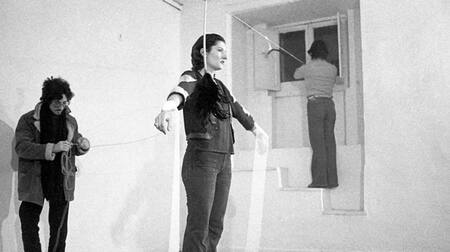

Performance «Rhythm 0» by Marina Abramovich, 1974 Source: https://telegra.ph
An arsenal provided to the participators. Photo: Marina Abramović/Royal Academy of Arts, London / David Parry

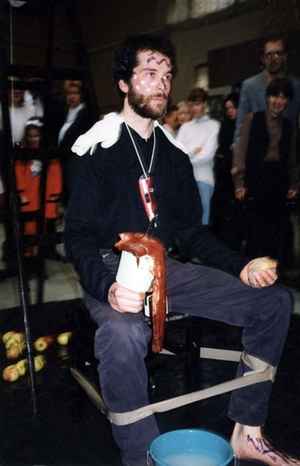
Timofey Kostin, the group «Emergency exit». Performance «Open Day». 1998 The arena.St. Petersburg. Festival of Performance and Experimental Arts
In 1974 one phenomenal artist, Marina Abramovich, made the shocking performance «Rythme 0». The artist offered the audience 72 items with which they could influence her for six hours — the performer only passively perceived everything done over her. This scenario implies filling it every time with personal experience and content, so depending on the context and performer, the performance will be different or at least not the same. In 1998, Timofey Kostin from the art group «ESCAPE» decided to reenact the already popularised «show».
Recreation
The main object for recreation is not «the first» original object. It is the form itself. Visible object is a representation of an invisible idea. Always an imitation, never a duplication.
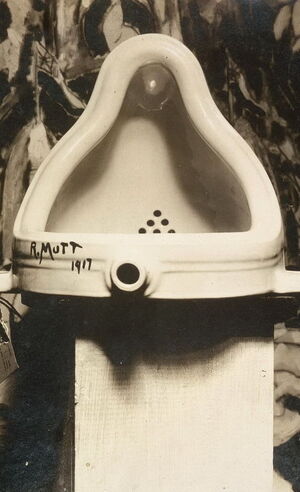
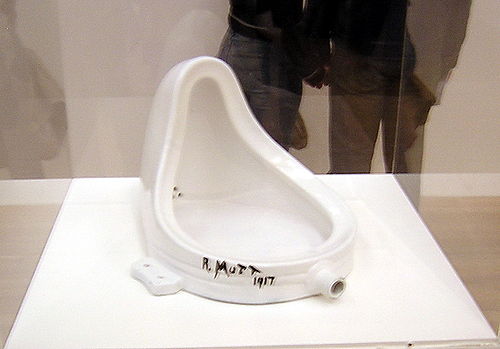
Marcel Duchamp, Fountain, 1917. Photo: Alfred Stieglitz // Marcel Duchamp, Fountain, 1964. Source: David Shank
Source: https://new.artforintrovert.ru
In 1964 Marcel Duchamp recreated his innovating ready-made «Fountain», which first, «original» version was made in 1917. So it could be exposed for public. A museum replica of Fountain is a great representation of a recreation. This new version have same signature (R. Mutt 1917) although at other time. From the breaking through phenomen it turns into a museum object. An artefact in its collection. The replica does not depend on the original urinal’s utility or provenance to embody the concept yet it is not a mere copy because it participates in the transformed set of relations that constitute Fountain’s identity.
Restoration
Re- in «restoration» is the part of the word, not the prefix. However it obscures the meaning of repair, reconstruction and recreation. Restoration suggests to take the work of art out of the archive (in case with architectural elements this storage is the construction itself) and try to give it a complete look according to the saved photos of the work or being navigated by the remaining parts of details.


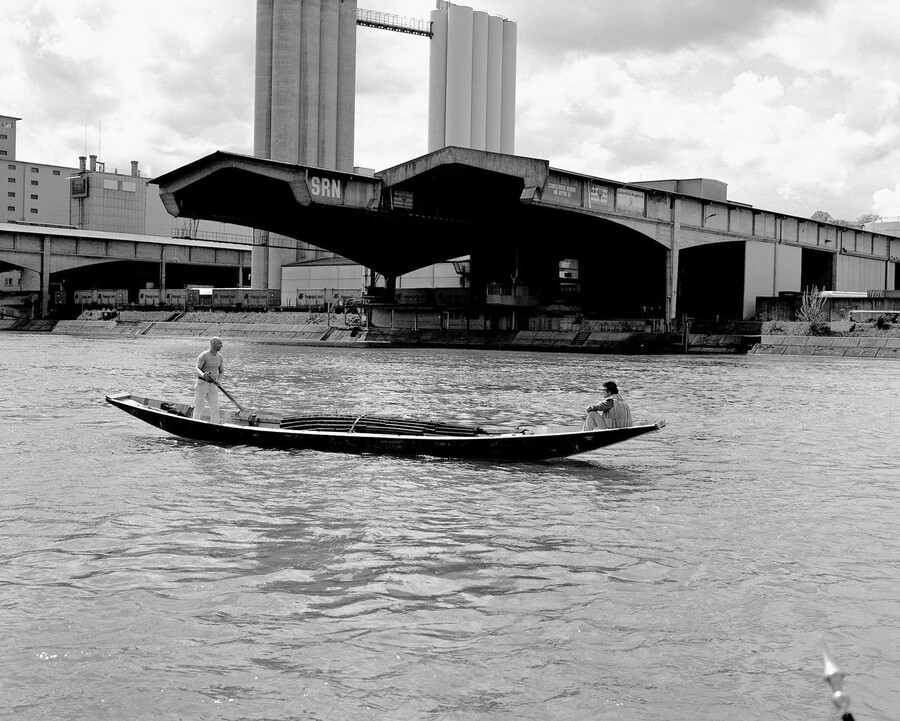
Simon Starling, Mobile Architecture, 2005 Source: https://www.themoderninstitute.com
In the case of «restoration» the «re-» seems to promise a return to a prelapsarian state: literally, a state of bountiful stores. Philomela mourned storation without seeking re-storation. David Kazanjian
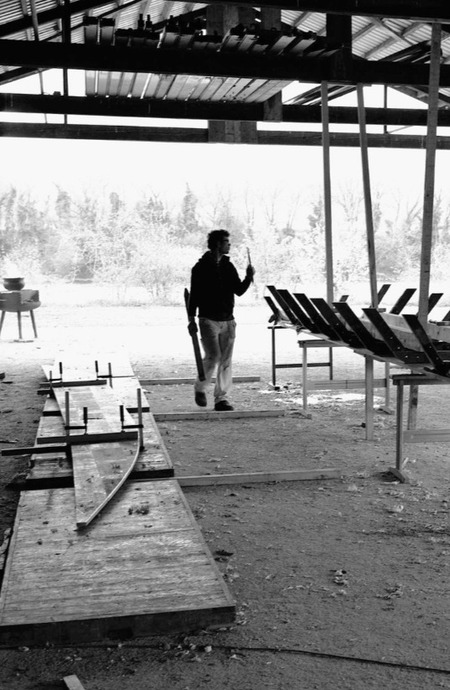
Simon Starling found an old wooden shed with an oar in the village. He dismantled the barn and turned it into a boat, took it downstream to the center of Basel, where the Museum of Modern Art is located. Then he dismantled the boat and reassembled the barn exactly as it was, and placed it in the museum. Therefore, according to my definition, the artist created two objects — a boat and a house 2 — out of the found object. He restored first version of the house by recreating it in other place and conditions, so it means it became a different house after overcoming its transformations.
Representation
Representation is always a reminiscence of the presentation. A representation is not the thing itself but a representation of that thing: a compilation of an object and the object as apprehended through somebody’s perception. In this sense representation stands between world and mind, translating immediate presence into mediated form (image, word, sign, or performance) and thereby opening the object to interpretation, memory, and social use.
Presentation names the directness of being. A face in front of you, the sound of a bell, an event happening now. Representation, by contrast, is what remains after that immediacy has been taken up by perception, language, cultural codes and memory. A photograph, a text, a staged performance, or a reworked archival fragment preserves certain traces of the presentation while erasing, reframing, or amplifying others. This every representation conserves elements of what was presented while transforming them into new objects that travel, circulate, and accrue meaning in different contexts.
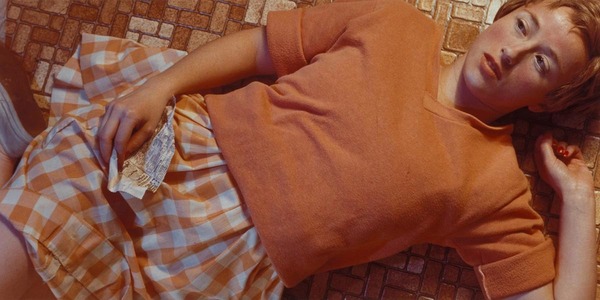
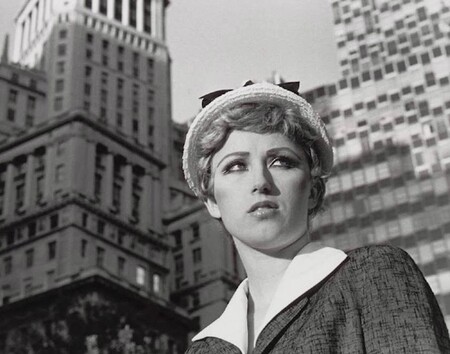
Untitled #96, by Cindy Sherman, 1981. Source: MoMA, New York. // Untitled Film Still #21 by Cindy Sherman, 1978. Source: MoMA, New York.
Through staged self‑portraits, Sherman makes representation explicit. She constructs identities, costumes and cinematic tableaux that reveal how social types (film stars, housewives, professionals) are represented. Her images expose the mechanics by which appearance and stereotype are produced, showing representation as deliberate fabrication rather than neutral reflection.
By defining prefix «re-» not as a simply act of repetition I imply on the autonomous status of each version of an art statement. Reenactment is a new action that overcame its fist version experience, but despite that the fist version will not be neglected. I refer to Hegel’s dialectic as a fundamental idea of that suggestions.
Hegel G. W. F. Phenomenology of Spirit / G. W. F. Hegel. — Jena, 1807.
Wiktionary — record «re-» [Electronic resource] // Wiktionary. — Access mode: https://en.wiktionary.org/wiki/re — (date of request: 10.12.2025).
Kazanjian D. Critical Approaches to Genocide. — [Routledge], 2023.
Web page (Colta / OpenSpace) [Electronic resource] // OpenSpace (Colta.ru). — Access mode: https://os.colta.ru/art/projects/88/details/8630 / (date of request: 10.12.2025).