Project Concept
Dutch still life for the age of delivery, power banks, and marketplaces: learning Stable Diffusion XL on 96 images from the Rijksmuseum and objects of our time
In 1602, the Dutch East India Company was established in Amsterdam, one of the world’s first joint-stock corporations. Within a few years, what was once only seen by royalty—Chinese porcelain, lemons, pepper, Turkish rugs, Venetian glass—lay on the tables of burghers. It was then, in Haarlem, Leiden, and Amsterdam, that the genre the Dutch simply called «stilleven, ” or „still life, ” flourished.
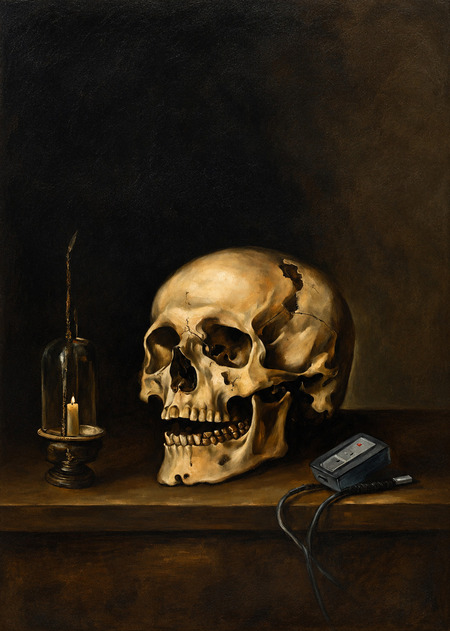
The still life of the Dutch Golden Age functions as both advertisement and sermon. The artist admires the silver cup and oysters so exquisitely that one feels compelled to reach out. Yet, the cup is overturned, the lemon has been peeled (beautiful on the outside, bitter within), a candle is burning down nearby, a clock is ticking, and sometimes a skull lies present. The epitaph for this genre has long been known from Ecclesiastes: „Vanity of vanities, all is vanity, ” or in Latin, vanitas vanitatum.
Four hundred years later, our tables are also filled with items that have arrived from the other side of the world. Only these are not lemons and porcelain, but to-go cups, delivery rolls, headphones, power banks, and energy drinks. They are just as beautiful at the moment of purchase as they are quickly transformed into trash. I decided to see what would happen if I viewed these through the eyes of Willem Kalf and Willem Heda.
The rule of the series is simple: a new element replaces an old symbol while retaining its original meaning.
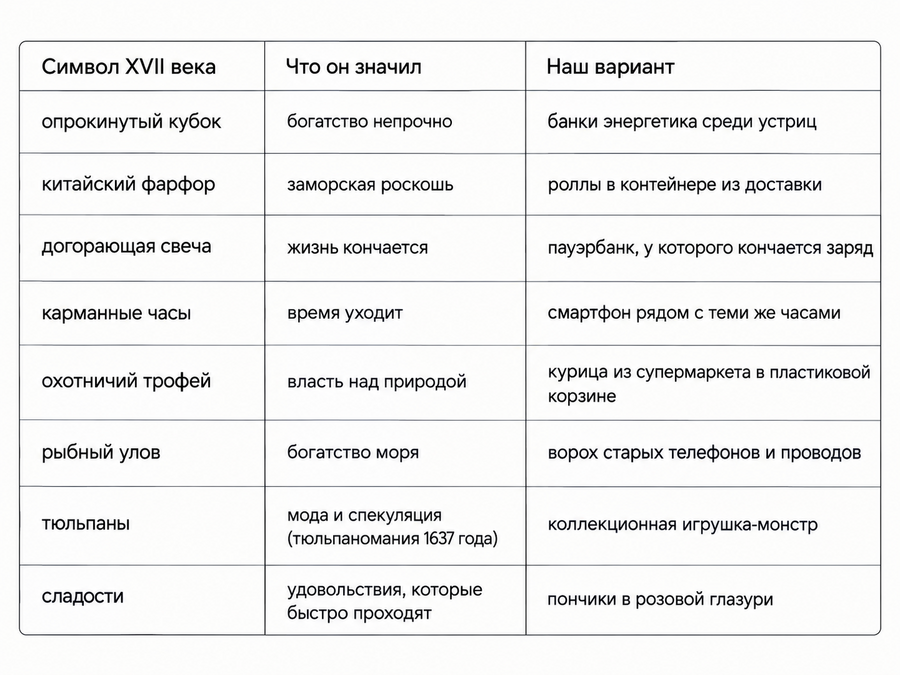
Image Sources
The dataset was compiled from the Rijksmuseum’s open collection in Amsterdam, the premier museum of the Dutch Golden Age. The museum makes image files available in the Public Domain (Public Domain Mark 1.0), and descriptions are licensed under CC0. The script tools/fetch_rijks.py used the museum’s API to find 230 paintings containing terms like «stilleven, ” „vanitas, ” „ontbijt, ” and „bloemen“ in their titles.
Admissions Selection
I selected 96 paintings by 68 artists from 140 candidates. I excluded:
— scenes with people (cooks, children, maids) where the still life is merely in the background;
— garlands, cartouches, and illusions in light stone niches: different painting, different lighting;
— still lifes set against a landscape;
— paintings with large amounts of text written on them (newspapers, letters, inscriptions on parapets), to prevent the model from learning to render pseudolegibility;
— images presented within a frame.
Image Format
The model trains on 1024×1024 squares. The script tools/build_squares.py crops a centered square from each image. Still lifes are usually composed around a single grouping of objects, so the center almost always captures the entire scene.
Signatures
I described each painting in English: the vnts trigger, the genre, and the list of objects:vnts, a breakfast still life, an overturned silver tazza, a roemer, a gilded beer tankard, a half-peeled lemon on a pewter plate, olives, a knife
Model Training
I trained Stable Diffusion XL base 1.0 using LoRA: the model’s weights were frozen, and small trainable matrices were added to the UNet attention layers. The ready-made script was not used.
Cycle Structure
I run all 96 images through the VAE (the image is transformed into a latent space of 128×128×4) and all the captions through two text encoders of SDXL. I store the result in memory and offload the encoders: this frees up several gigabytes on the T4 for UNet.
At each step, I take two images, add noise of a random strength to their latents, and ask UNet to predict this noise, given the caption.
I weight the error (MSE between the actual and predicted noise) using Min-SNR and update only the LoRA.
Noise offset
A standard diffusion model performs poorly when rendering very dark or very bright images: since the noise average during training is always close to zero, the model assumes that the average brightness of the image should also be neutral. A Dutch still life, for instance, is half composed of an almost black background, and without adjustment, the model brightens it to a brownish-gray. The noise offset technique adds a small overall shift to the noise in each color channel, allowing the model to learn how to adjust the overall luminance of the frame.
Exhibition. Resulting image series
The series is displayed across three halls, like in a museum: breakfasts and banquets, flowers and trophies, vanitas. Each piece has a label, much like in the Rijksmuseum, only the technique is different.
Hall I. Breakfasts and Banquets
Breakfast Delivery
Stable Diffusion XL, LoRA vnts, 2026. Seed 1648
Dutch «ontbijtje, ” a modest breakfast: bread, herring, and a glass. In the frame, there is a paper cup of takeaway coffee and a croissant on a pewter plate, alongside a stack of pewter cups, just like in a real ontbijtje.A delivery bag and a charging cable hanging in a spiral, like a lemon peel by Heda, were also in the prompt, but the model omitted them: the table remained stark and bare, à la Dutch.
Energy Drink Buffet