Navigation Menu
- Concept
- Reflection and Transparency
- Mass
- Foam and Splashes
- Water Contact
- Underwater World
- Conclusion
Concept
Water in cinema is traditionally considered one of the most challenging elements to shoot. Working with it on set involves numerous limitations: natural conditions are difficult to control, waves and currents are unpredictable, and large-scale water scenes demand complex logistics, specialized sets, and sometimes even pose a high risk to actors and the crew. Furthermore, the camera only captures the specific state of the water at the moment of filming—it is impossible to alter the shape of a wave, the direction of spray, or the amount of foam. Computer graphics allow us to mitigate some of these limitations. With CGI, one can fully control the form and mass of the water, the speed and direction of the waves, the density of the foam, and its interaction with objects in the frame. This is especially crucial in scenes that are difficult or impossible to capture in reality: a massive storm, a giant wave, a digital ocean surrounding a ship, or a complex underwater environment. CGI allows one to return to a scene at any stage of production to adjust the simulation, change the lighting, enhance the dramatic effect, and precisely tailor the image to the frame’s composition.
Computer graphics allow us to depict the state of water in a shot—a state that is difficult or even impossible to reproduce in reality—but this technology demands immense attention.
Water remains one of the most complex challenges in the field of visual effects due to the unique physics of fluid dynamics. Achieving a realistic result requires careful consideration of wave motion, environmental reflection, light refraction, as well as accounting for the water’s mass and its interaction with submerged objects—all of which must then be integrated into a real shot. Viewers instantly notice errors because water is familiar to everyone, and its behavior is easily read on an intuitive level. Thus, computer graphics does not simplify water creation; rather, it offers greater control and expands the visual possibilities of cinema. It allows for the creation of scenes impossible to film practically, yet it simultaneously demands high technical precision and a wealth of visual detail. This is precisely why water remains one of the most complex and costly elements of modern computer graphics. The objective of this visual study is to analyze how water is depicted in cinema using computer graphics and to determine why water simulation remains one of the most difficult visual effects. The core of this study revolves around specific shots from films where water becomes an integral part of the composition and narrative. The analysis is built upon observing the water simulation within the frame. This approach allows us to examine water not just as a technical visual effect, but as a complex cinematic material that shapes the atmosphere in the shot and the viewer’s perception of space.
Reflection and Transparency
One of the main properties of water is reflection and transparency. This is particularly noticeable on an open water surface in a shot when there are no waves. It is worth noting that the water surface never perfectly mirrors its surroundings: the reflection is distorted and constantly changes shape depending on the direction of the water. Computer graphics are precisely what is used to control this complex process.
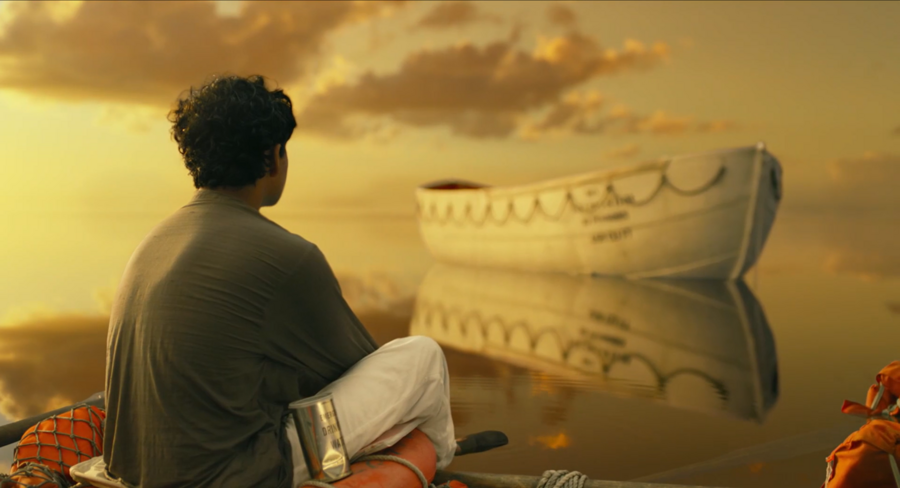
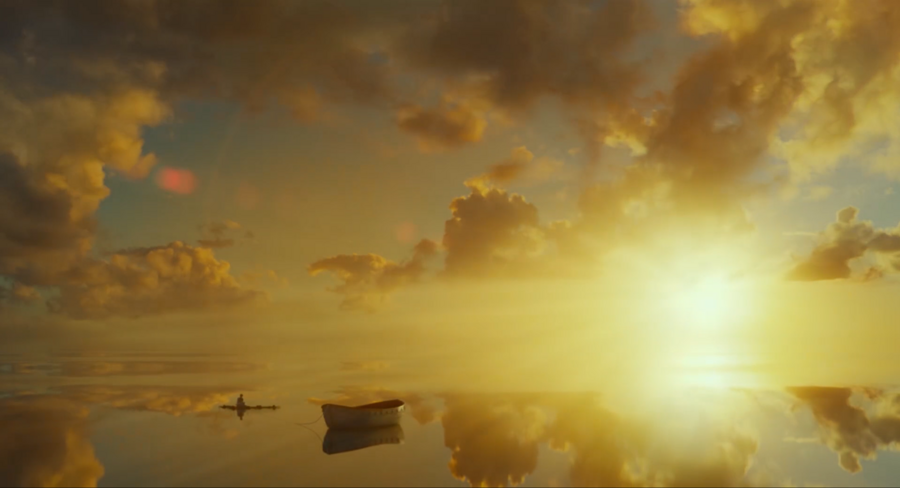
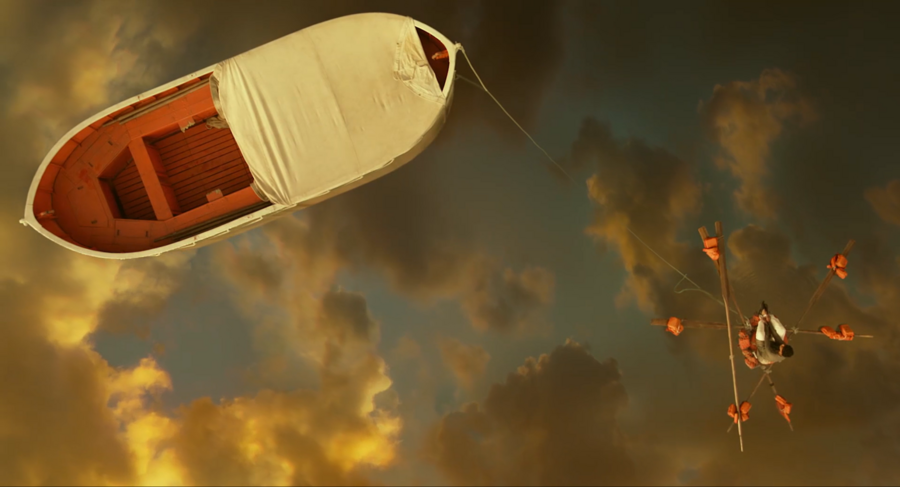
Stills from the film «Life of Pi, ” 2012
This methodology is clearly evident in «Life of Pi.» Bill Westenhofer, the film’s VFX Supervisor, stated that the condition of the sky and sea reflected Pi’s mood during the scene, which is why they received immense attention. The sky was composited onto the frame during post-production, and consequently, the reflection in the water was as well. Sunlight, clouds, the boat—all of this was intended to be reflected on the water’s surface.
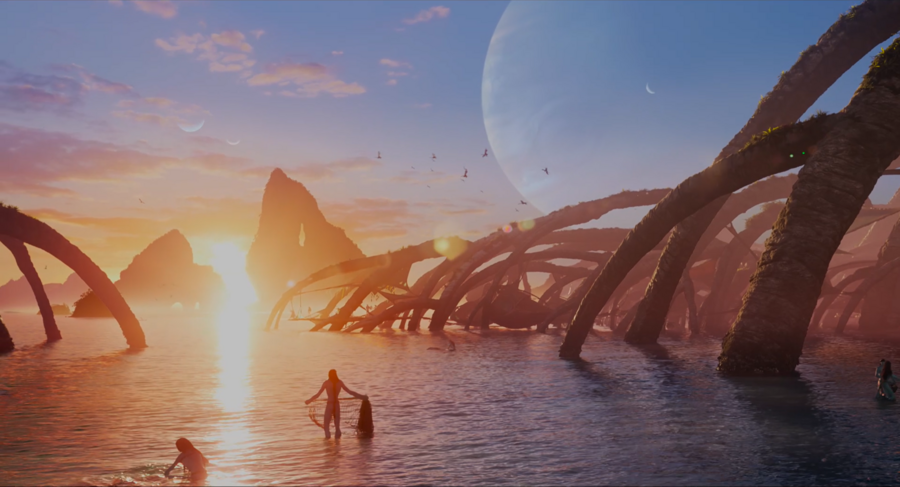
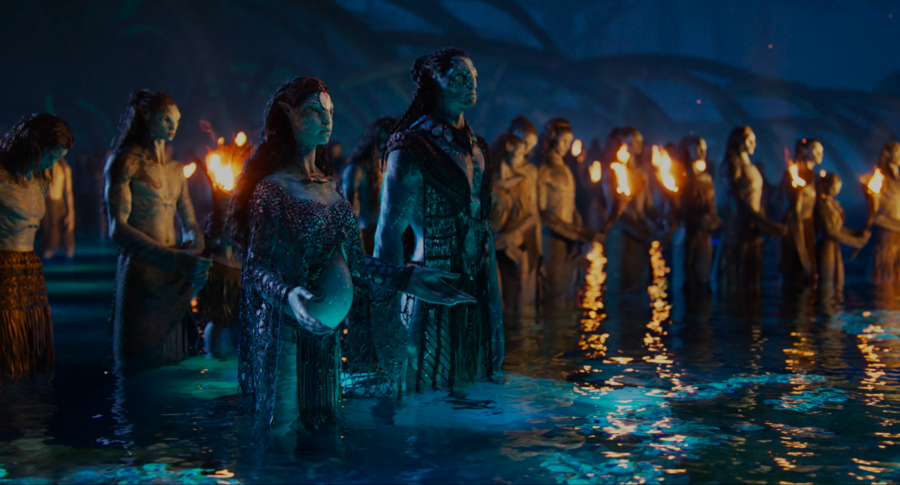
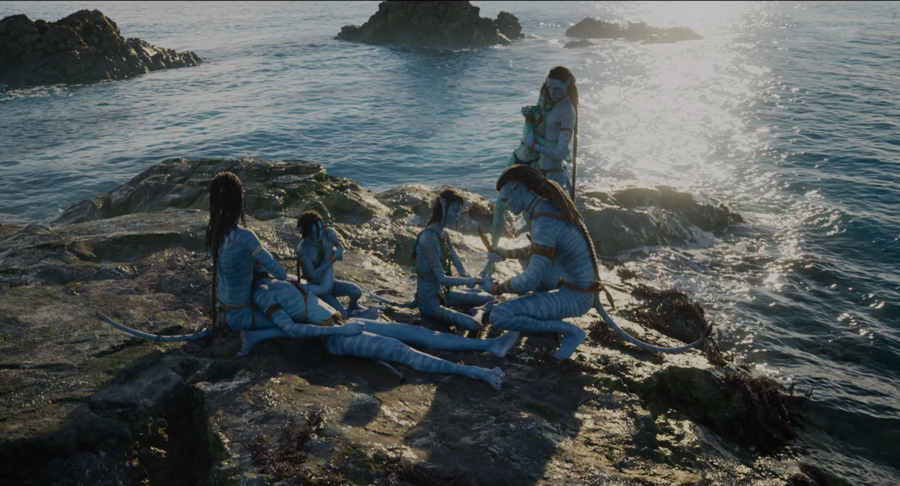
Stills from the film «Avatar: The Way of Water,» 2022
The film crew for «Avatar: The Way of Water» relied heavily on underwater work: most of the filming took place in and on the water. For some scenes, they even used screens and special spotlights to ensure the reflections on the water closely matched the final image. However, computer graphics tools were, of course, still necessary. Sun glare, the reflection of lampposts, and the shadows cast by the canopy—everything was hand-painted in post-production.
The Scene Creation Process for «Avatar: The Way of Water»
Water transparency is typically conceptualized as a volumetric medium rather than simply a transparent material: the final image is built up in layers—first the seabed, then the coral and marine life, and finally the water’s surface. It is crucial to account for the fact that water gradually absorbs light: warm tones disappear first, while the cool spectrum penetrates deeper. Therefore, transparency depends on the thickness of the water layer—on shallow water, the seabed is visible almost entirely, but at depth, silhouettes gradually dissolve into a blue haze.
A scene from the film «Avatar: The Way of Water,» 2022
Mass
One of the key characteristics of realistic water in a shot is the perception of its physical mass. Unlike a static surface, a wave is always perceived as the movement of a large volume of liquid in space. The viewer registers not only the form of the water but also its weight, density, and force. This is why a wave, especially a large one, often becomes the most challenging element when creating water in computer graphics: it must look not just dynamic, but heavy and convincing.
A scene from the film «Passengers,» 2016
A striking example for visualizing a mass of water is a scene from the film «Passengers.» The shot features a vast body of water in zero gravity, sinking downward under the influence of gravity. Such a shot can only be achieved using computer graphics, as this allows for complete control over the movement of the water mass. Prior to filming, the team spent several months developing the scene—creating storyboards and preliminary digital animations to understand the water’s trajectory and its behavior in weightlessness. They succeeded in conveying the fluid’s mass through the slow rate of the water’s fall and the deep blue color, which reflects its depth and density.
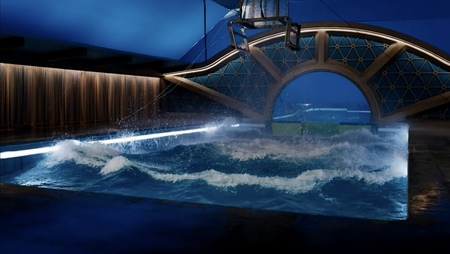
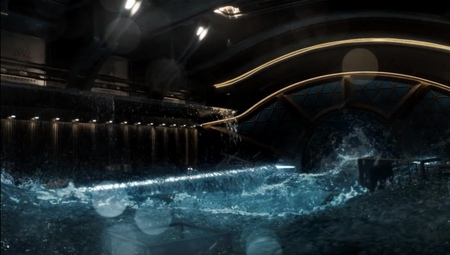
VFX breakdown scene from the film «Passengers,» 2016
In the film 2012, VFX artists used a computer that calculated the trajectory of the water’s movement—the direction of the waves, their collision with surfaces, and the spray. This technology greatly simplified effect creation because the water in the film constantly interacts with the city. The wave in 2012 needed to appear immense yet remain realistic. To achieve this, the artists utilized multiple levels of detail: from a distance, the water is perceived as a single mass, but as the viewer gets closer, individual splashes, foam, and subtle surface movements emerge. This allows the audience to simultaneously grasp the overall scale of the catastrophe and the physical detail of the liquid, which grants it believability.
A scene from the film «2012», 2009
The weight of the water in the frame is also felt through speed and inertia. The flow moves quickly but retains a sense of heaviness. The water’s movement is not chaotic; it follows its own trajectory: it builds volume before impact, delivers the strike, and only after the collision shatters into foam and spray. This evokes a sense of preparation for action, characteristic of character animation. Because of this, the viewer senses the wave’s weight and its destructive power.
Gimpville, VFX breakdown scene from the film «2012,» 2009
Foam and Splatter
Splashes are not merely minor details; they represent how water interacts with its environment. While a body of water can be easily stylized or simplified—especially if the liquid is still—splashes must be rendered as realistically as possible. The overall perception of water heavily depends on them.
A scene from the film «Avatar: The Way of Water,» 2022
In one interview, Eric Saindon, Senior VFX Supervisor from WETA FX, who worked on «Avatar: The Way of Water,» discussed how the film’s splashes were created. According to him, the team analyzed numerous different forms of splashes and developed a computer system that generated them autonomously. Ultimately, the computer simulated large scattering droplets, mist, airborne disintegrating droplets, and droplet impacts with surfaces.
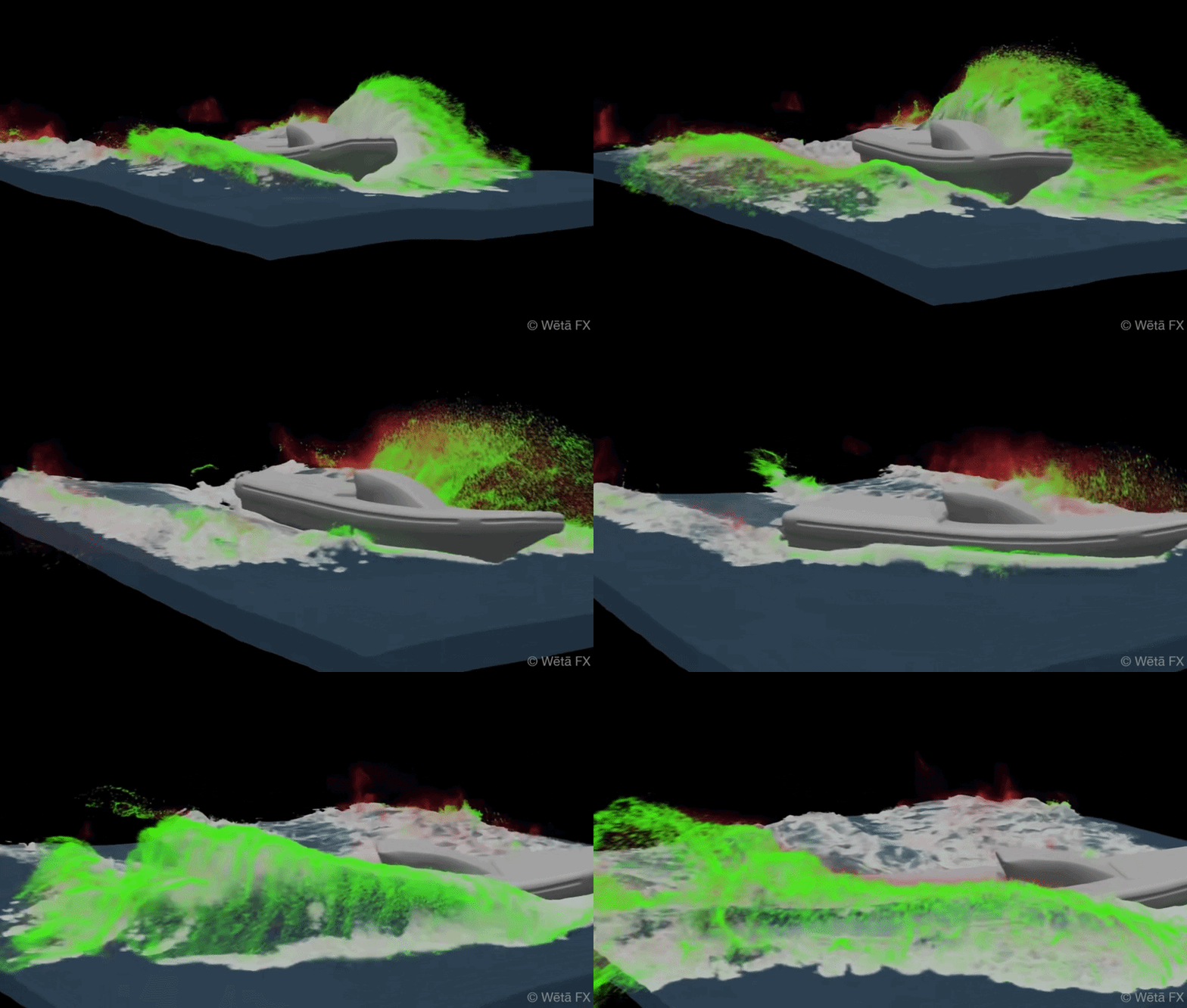
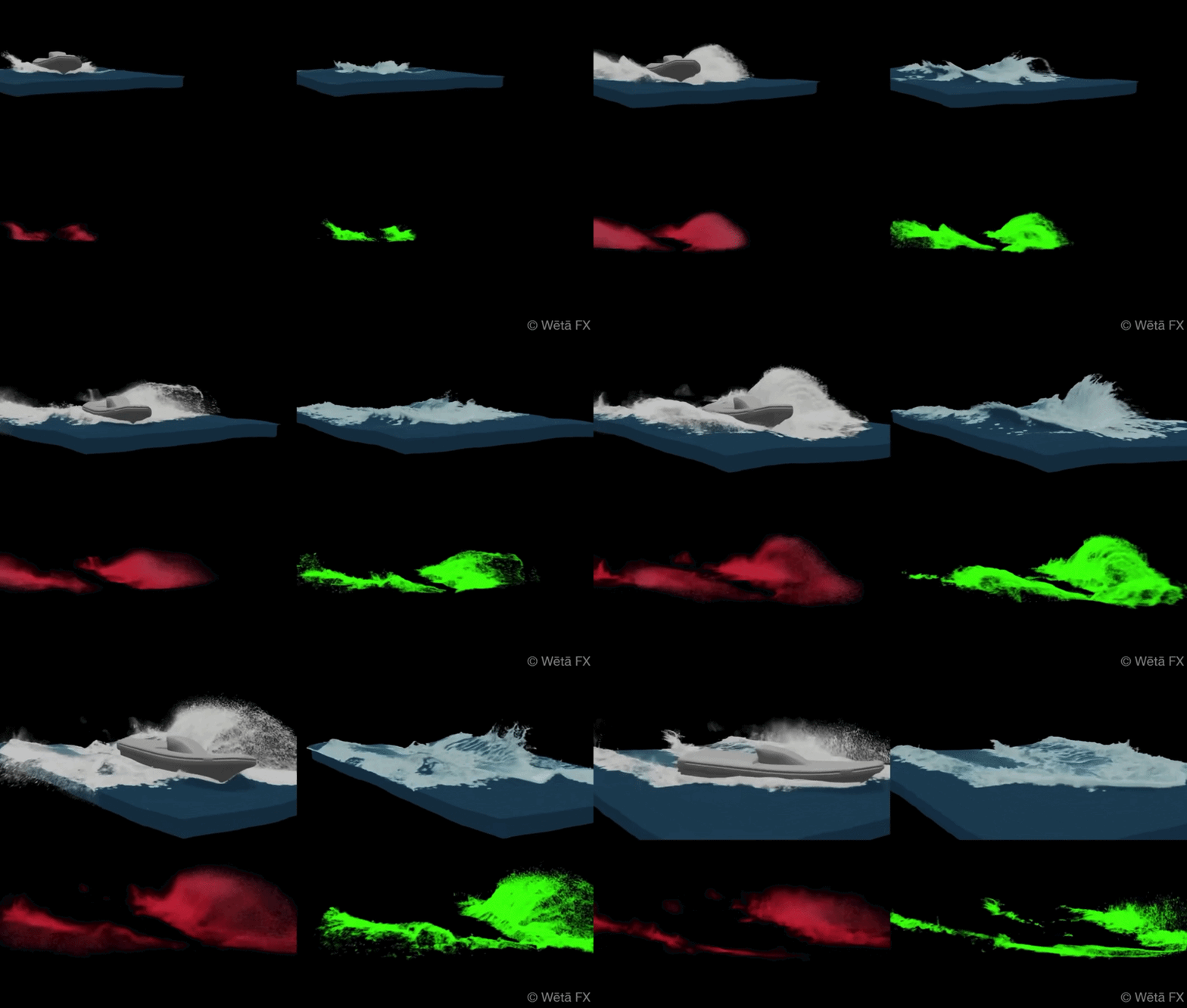
Weta FX, splash test for «Avatar: The Way of Water»
In the same interview, Eric Saindon noted that to create convincing splashes and foam, one must consider what happened before they appeared. For the scene to generate underwater bubbles, he first needed to capture air with the mouth, otherwise, there would be none. The VFX artists even thought through that moment.