i. Concept
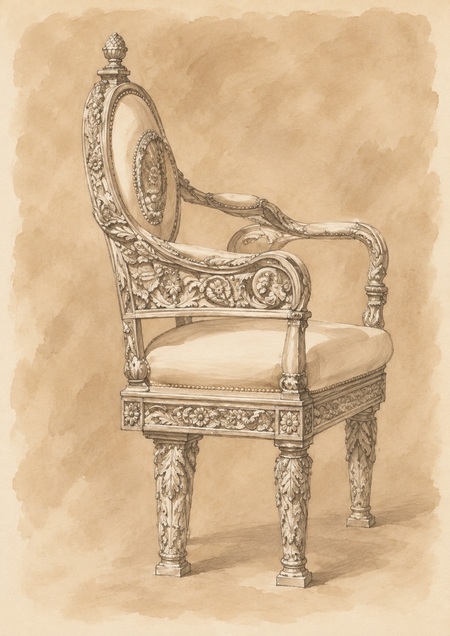
This project is rooted in an interest in the architectural and decorative graphics of Giuseppe Barberi and a desire to explore how his artistic language can evolve within new spaces and forms. Barberi’s drawings merge delicate line work, soft washes, and warm paper tones with architectural symmetry and the free movement of ornament. These characteristics form the basis for creating an imaginary palace that exists solely on paper.
I am working with an open archive—drawings that include architectural plans, interiors, furniture, and decorative compositions. The objective is to train a generative model to convey the visual principles of this graphics and apply them to new subjects. It is fascinating to consider whether a LoRA, trained on a set of Barberi’s drawings, can capture his overall graphic style while shifting the scale and function of the object—from a façade to an armchair.
ii. Setting up the Environment
I use Colab with a GPU for training. The implementation is based on Stable Diffusion XL, DreamBooth, and LoRA.
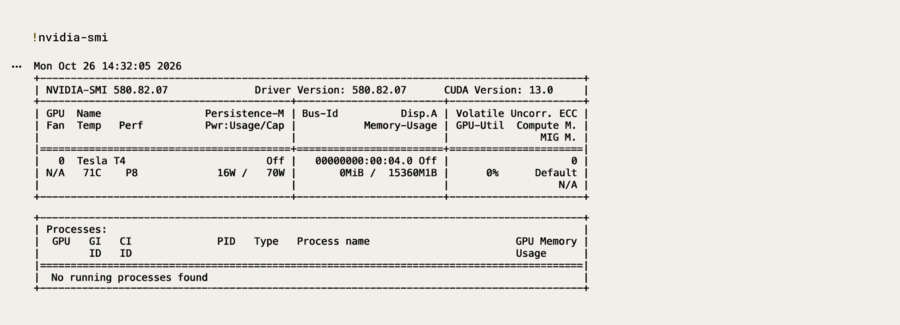
GPU Connection Check

Computation Acceleration

Loading the Diffusers repository

Download script for fine-tuning
First, I check the GPU availability. Next, I install libraries for handling models, data preparation, and resource efficiency, including tools for LoRA. Then, I install Diffusers from the Hugging Face repository. Finally, I download the SDXL training script using the DreamBooth method with LoRA to later adapt the model to the graphic style of the chosen illustrations.
iii. Dataset Preparation
For instruction, we are using 100 drawings by Giuseppe Barberi from the Cooper Hewitt, Smithsonian Design Museum collection. According to the archived card data, the images hold CC0 status. All files have been pre-prepared in a 512×512 pixel format. The captions include the names and descriptions of the works.
Downloading and unpacking the archive of Barbie illustrations
Image examples from the archive
iv. Image Caption Generation
Checking 100 images for caption accuracy, 512 × 512 dimensions, and CC0 licensing.
Assembling a grid of eight images for visual dataset validation.
v. Model Training
In the captions, a unified GBBR style marker is used. I am keeping the training parameters close to the example: 512 pixels, 500 steps, LoRA, and 8-bit Adam.
Authorizing to Hugging Face for model access
vi. Image Generation
I will create six parts of one imaginary palace: the facade, the vestibule, the ceiling, the fireplace, the chair, and a garden pavilion. These objects are connected by a shared idea and resonate with the themes of the original sketches.
Loading SDXL and connecting the trained LoRA with an influence strength of 0.7
I am setting 6 prompts for image generation
I generate, save, and display images in a unified grid.
I gather the images and requests into a ZIP archive and download it.
vii. Outcome