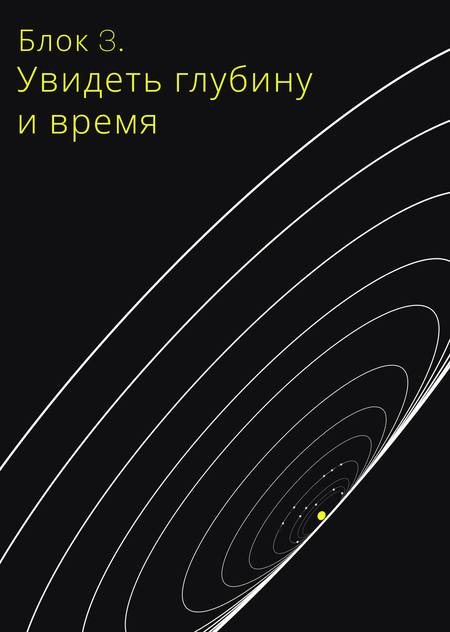
At first glance, all the stars appear to be positioned on a single surface—as if glued to a massive dome.But in reality, some objects are relatively close, others are thousands of light-years away, and some galaxies are millions and billions of light-years from us.
The third section focuses on two core ideas: The sky has depth, and when we gaze into space, we are always looking into the past.

LESSON 3.1
THE SKY STOPS BEING FLAT
The Big Question
How much bigger is space than the human brain is capable of imagining?
When we look at the sky, all objects seem equally distant.
But that is an illusion.
One object might be hundreds of thousands of kilometers away, another might be millions, a third trillions, and the next might be millions of light-years away.
Therefore, the first step is to organize the night sky into layers of depth.
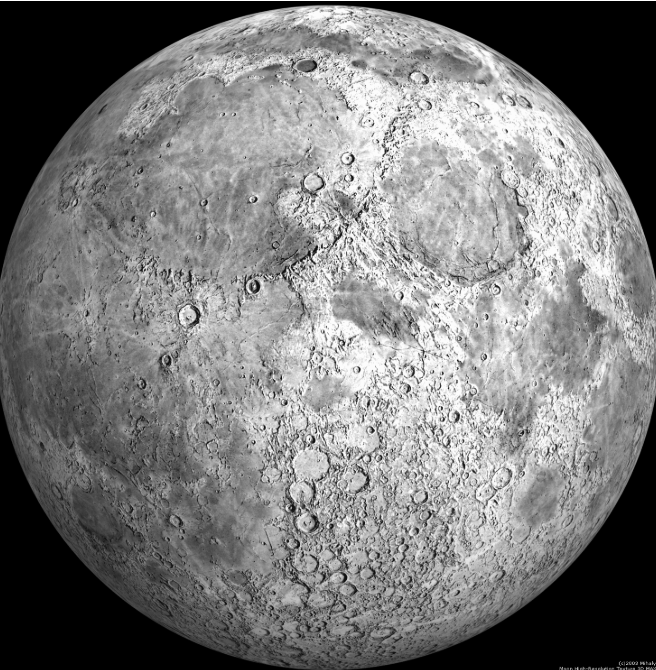
The Moon is the nearest large celestial object to us.
Its average distance is about 384,000 km.
Light travels this distance in approximately 1.3 seconds.
This is how the first convenient astronomical unit—the light-second—is formed.
The Sun is approximately 150 million kilometers from Earth.Its light takes about 8 minutes and 20 seconds to reach us.Here, it is more convenient to talk not only in kilometers but also in light-minutes.
Kilometers become too cumbersome for interstellar distances.The nearest star to us, after the Sun, is located over four light-years away.
Light-YearIt is not a time, but the distance that light travels in one year.1 light-year ≈ 9.46 trillion kilometers.
All the stars we see with the naked eye are located within our galaxy—the Milky Way. Its diameter is approximately 100,000 light-years. Even light would require tens of thousands of years to cross such a system. Yet, the human eye can only perceive a tiny fraction of the stars in our own Galaxy.
The Milky Way is just one galaxy.The nearest large galaxy to us—the Andromeda Galaxy—is located about 2.5 million light-years away.Under a clear, dark sky, it can be seen with the naked eye as a faint, bright spot.This means that on a visually flat map, objects can exist simultaneously:in hundreds of thousands of kilometers, millions of kilometers, light-years, and millions of light-years from us. The sky appears flat only because the human eye hardly perceives this depth.
LESSON 3.1 OUTCOME
The participant understands:
— that the Moon, Sun, stars, and galaxies are at fundamentally different distances; — the difference between a light-second, a light-minute, and a light-year; — why kilometers cease to be practical on cosmic scales; — why the night sky only appears flat.
LESSON 3.2
LOOK UP — MEANS LOOK BACK
A big question. Can we see the past with our own eyes?
In fact, we do this every time we look at the sky.
The speed of light is approximately 300,000 km per second. This is incredibly fast, but not infinite. Therefore, any light signal requires time to travel the distance from an object to an observer. This is where distance begins to transform into observation time.
THE MOON — SECONDS AGOLight from the Moon takes approximately 1.3 seconds to reach Earth. This means we are always seeing the Moon as it was slightly more than a second ago.THE SUN — MINUTES AGOLight from the Sun arrives in about 8 minutes and 20 seconds. In other words, the Sun we see now is its image from the past.STARS — YEARS AGOIf a star is 100 light-years from Earth, the light reaching our eyes today left it approximately 100 years ago. Therefore, the distance in light-years simultaneously shows how old the image of the object we are observing is.ANDROMEDA — MILLIONS OF YEARS AGOAndromeda is located about 2.5 million light-years away from us. This means that today we are seeing it as it was about 2.5 million years ago. The light began its journey to Earth long before the emergence of modern humans.
The night sky is a collage of different moments from the past.
The further the object is located, the more distant moment of its history we observe.
INTERESTING FACT
Physically, humans have only traveled a few light-seconds away from Earth.Yet, through our eyes and telescopes, we can observe objects billions of light-years away.We are capable of seeing the universe much farther than we are capable of traveling into it.
LESSON 3.2 OUTCOME
The participant understands:
— why light images always arrive with a delay; — how distance relates to observation time; — why we see different objects at different moments in the past; — why looking far out into space means looking back in time.
LESSON 3.3
LABORATORY II: HOW TO PORTRAY THE IMPOSSIBLE