Concept
Close your eyes. Imagine ancient Greece. Among all the images that come to mind, you will surely see—and almost feel—the warm surface of marble.
Legend has it that God created Greece by casting the remnants of the primordial stone over his shoulder. And indeed: Greek art seems born from stone. Statues stand in the open air, and temples rise from rocky plateaus.
Yet, alongside the marble ensemble, another image inevitably emerges—that of trees. Pliant, curved by the wind, clinging to the cliffs, they form a «vegetative architecture"—the living component of the Greek landscape.
Many sanctuaries arose around groves, springs, and solitary trees, which were perceived as spatial markers of divine presence. A palm tree on Delos guarded the altar of Apollo. The laurel at Delphi preceded the path to prophecy, and the olive tree near the sanctuary of Athena on the Acropolis was inviolable. Thus, trees accompanied the Greeks everywhere and acquired sacred significance.
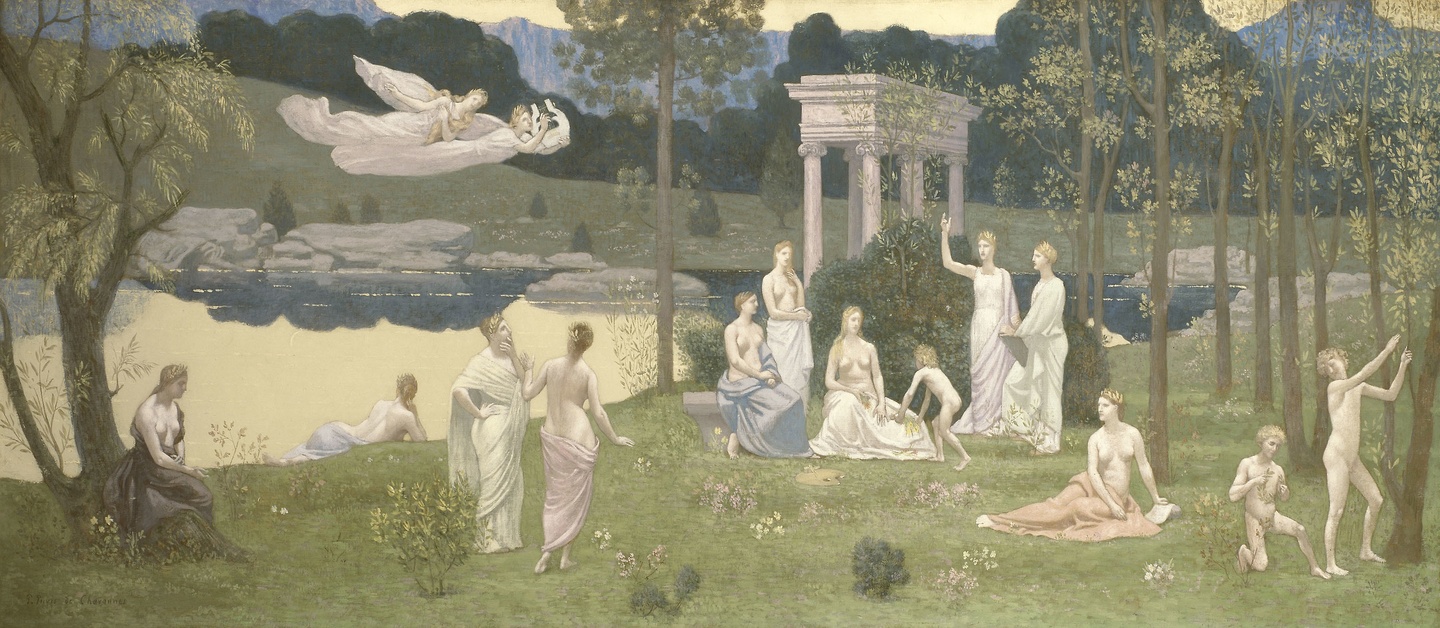
Pierre Puvis de Chavannes — «Sacred Grove, Beloved by Arts and Muses, ” 1922. Art Institute of Chicago
This visual study is dedicated to the trees of Greece, which continue to embody the proportions, structural logic, motifs, and very spirit of ancient classical art.
Is the plasticity of classicism obligatory for trees growing in the Mediterranean region? What specifically transfers from the natural environment into artistic practice, and why?
My hypothesis is that the Greeks observed the trees of their region, and these observations—both consciously and unconsciously—formed the basis of artistic thought. The forms, proportions, cycles, and symbolism of the trees served as a universal model of beauty, rhythm, and sacred order.
To explore the multifaceted influence of flora, the study’s structure is organized by the principle of scaling: from large architectural forms—to sculptural plasticity—to objects where botanical borrowings function at the level of ornament and material.
The visual examples are united by a single idea: art objects technically executed in stone adopt the imagery of the plant world, and it is this imitation that becomes the language of classical form.
The principle for selecting visual material is based on a straightforward methodology. First, the Mediterranean landscape and its flora are analyzed, with special attention paid to trees—those that are sacred, culturally significant, or commonly found in the region. Next, visual motifs are identified that can be correlated with the architectural, sculptural, and decorative forms of ancient art.
The textual sources are selected according to two typologies: — historical and ecological (Scully, Grove & Rackham, Hughes), to study the natural environment of antiquity; — formal and artistic (Dinsmoor, Dmitriyeva), to trace visual and constructive borrowings. Primary emphasis is placed on authors who describe not only the art but also the landscape in which it arose.
Animating Stone in Spatial Architecture
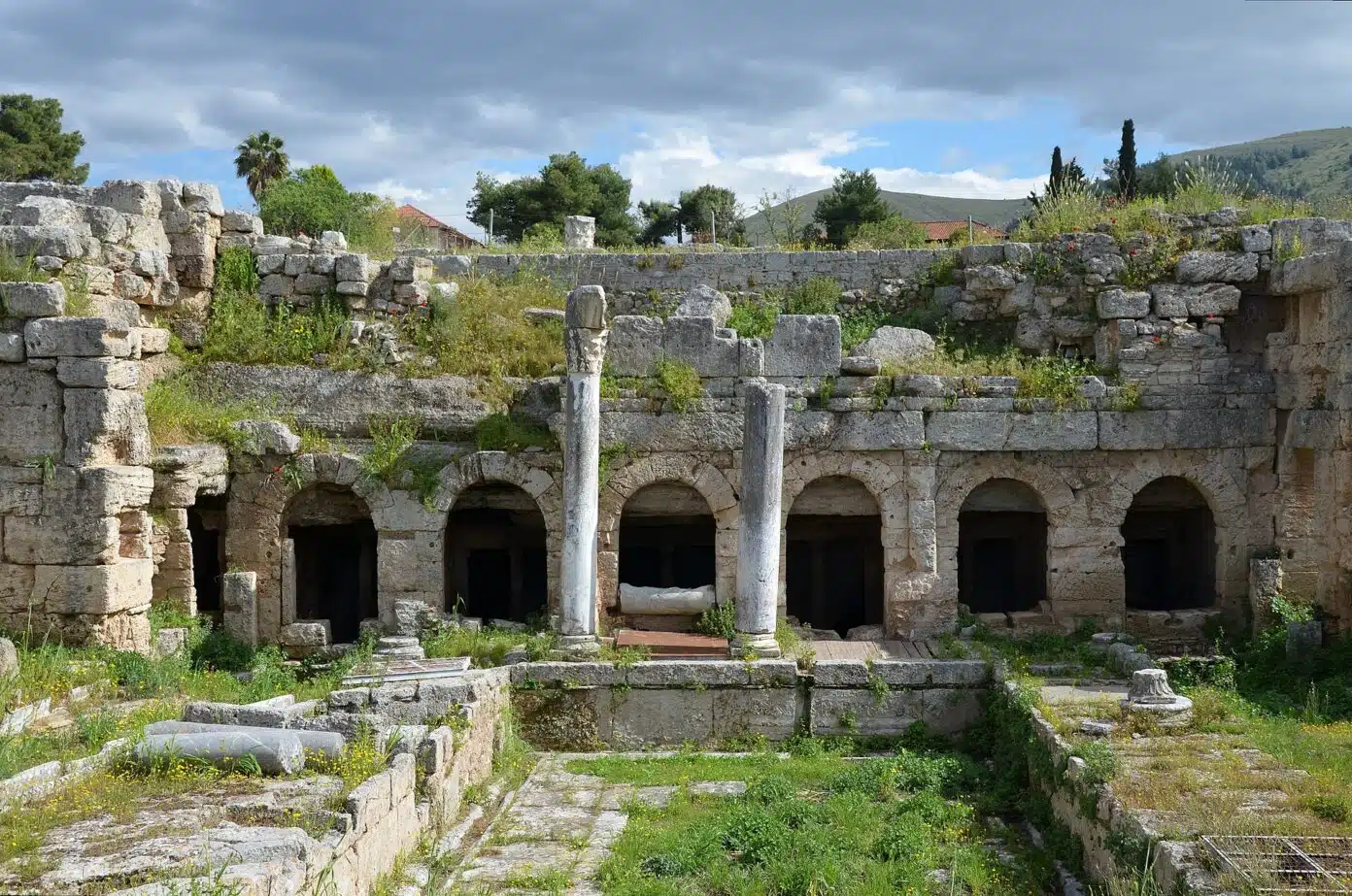
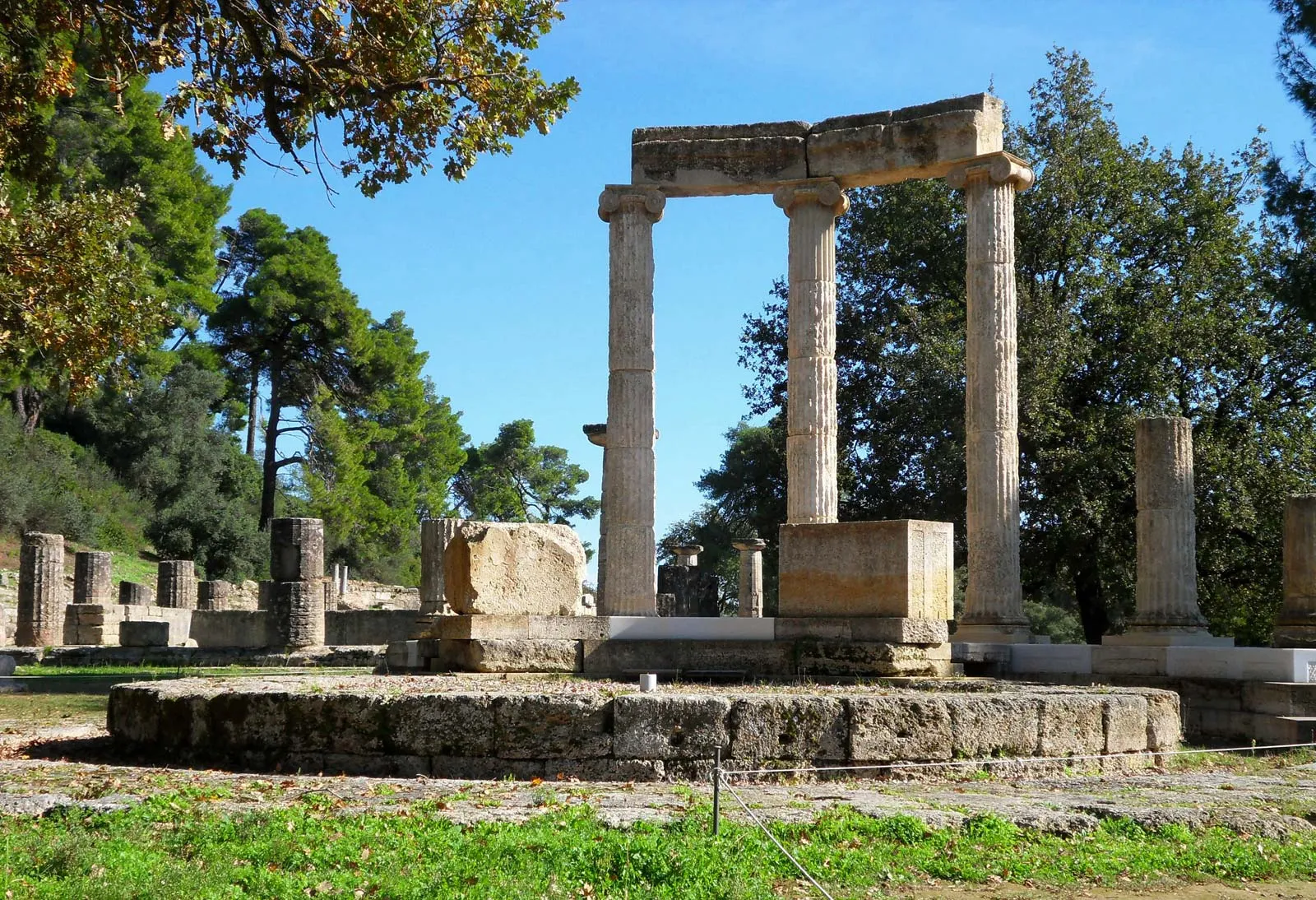
Sacred springs were places where people came to pay homage to the gods. Remains of a sacred spring in Corinth (8th century BCE) and the Peloponnesian Toros in Olympia, Greece (338 BCE).
The connection between gods and trees was especially strong in Greek consciousness. It is likely that the Greeks first worshipped in groves and only later began erecting temples among them.
If there were no groves—such as on the rocky peak of the Acropolis where the Parthenon was built—they would carve pits into the solid rock and plant trees in rows to frame the temple.
Temple of Apollo at Thermopylae, Etolia (8th century BCE), was originally erected on wooden columns, which were later replaced with stone ones. Photo: Marc Landon
Primitive classical architecture—Brent Hall—carpentry, restoration, and construction in Fort Worth, Texas.
The Greek stone temple appears as a triumph of marble, yet its forms still «think» in wood.
One of the most enduring traces of wooden construction is the Doric frieze. Triglphs likely emerged as a solution to cap the ends of wooden beams. The metopes placed between them served as infill—in stone, they lost their functionality but retained the organization of the beam system.
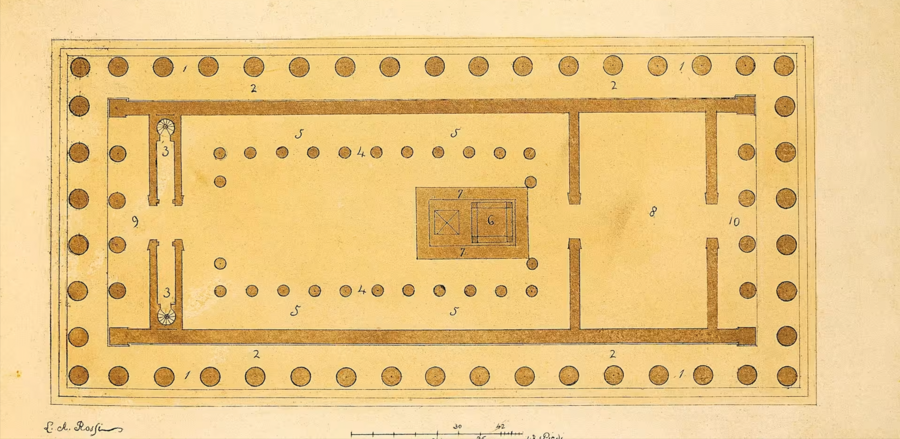
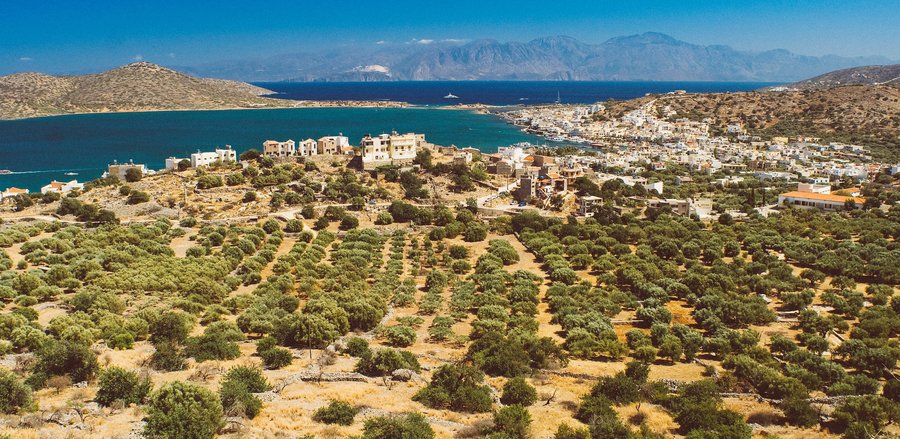
Plan of the Athenian Parthenon from the publication «Ancient and Modern Costumes» (Il costume antico e moderno) by Giulio Ferrario (1767–1847) and olive groves of Crete, Greece
The most basic typology of the Greek temple is the peripteral. The colonnade surrounding the rectangular sanctuary originated in the sacred groves of Greece.
Parthenon, Athens, Greece (447–438 BCE, architects Iktinos and Callicrates). Photo: Jerome Feldman and Elliot Porter
The Parthenon appears fundamentally geometric, yet it gives the impression of a living organism—as if it «grew» out of the earth atop the hill.
It turns out that the structural perfection of the Parthenon is accompanied by subtle deviations from strict regularity. For example, the corner columns are placed closer together than those in the middle, and the spacing between them is not uniform overall.
Because of this, the growth of the columns around the cella resembles a grove planting: no matter how carefully the trees are planted, the distances between them always fluctuate.
Architects deliberately avoided frontality and parallelism—in this free plan, symmetry was replaced by more «natural» principles of rhythm and balance.
Ruins of the Temple of Hera (Geraion) in Olympia, Greece, c. 600 BCE.
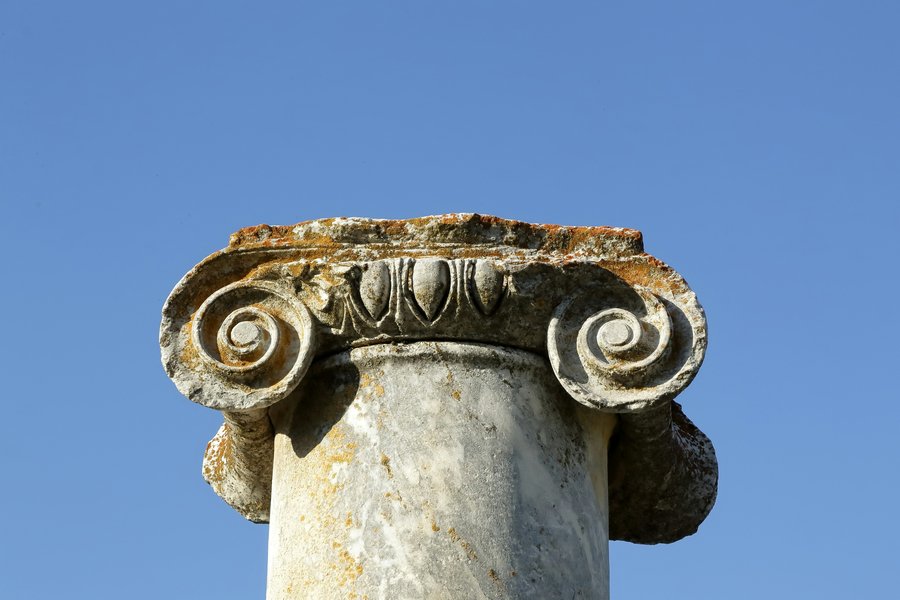
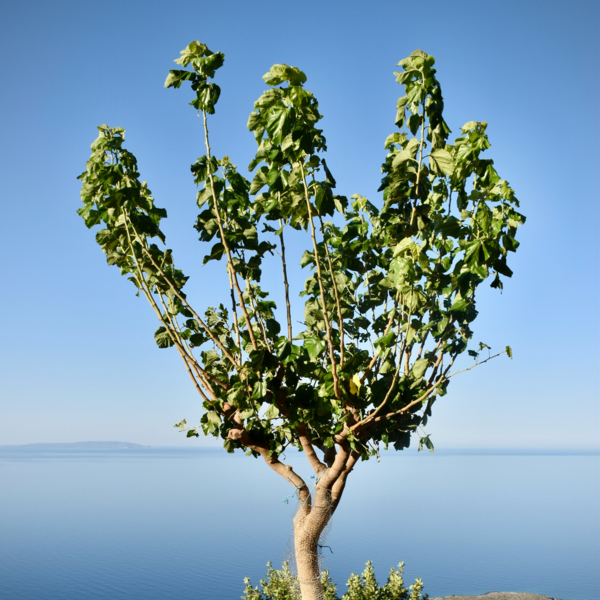
Ionic column capital, Chios, Greece, and the crown of the Mediterranean white poplar
The capital in Greek architecture also retained a trace of the column’s natural origin: even in the strict Doric order, one can sense the memory of a tree trunk widening toward the top to «receive» the load—much like the thickening of a living trunk under its canopy. In the Ionic order, the volutes resemble not only rolled scrolls but also the supple curve of a budding shoot ready to unfurl.
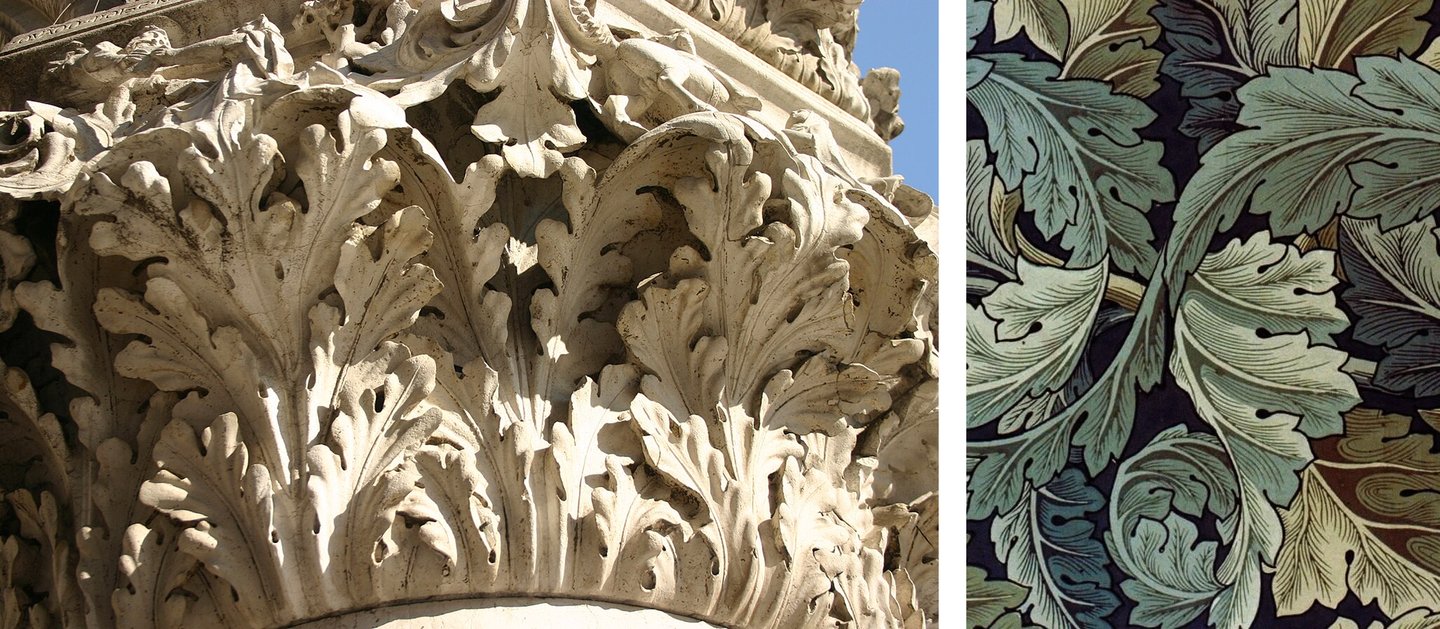
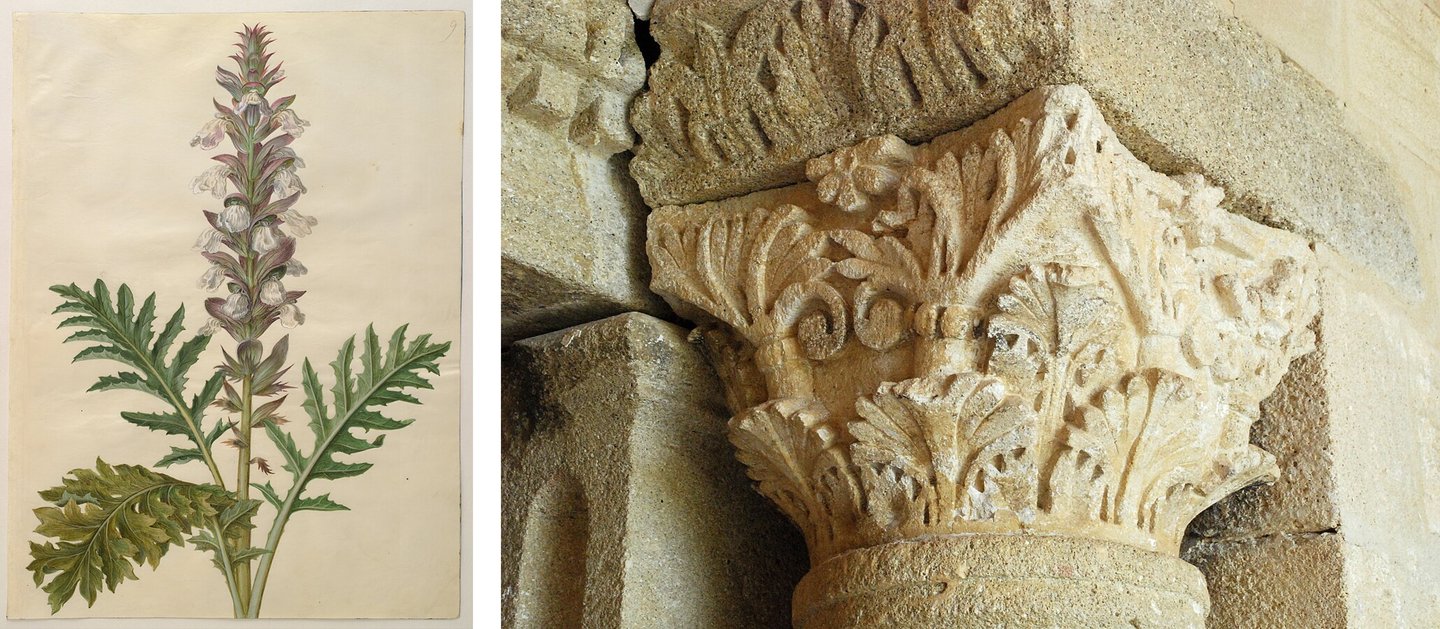
Akanthus and capital drawing from the Basilica of the Annunciation, Nazareth, 12th century. Akanthus (William Morris, 1875) and Capital No. 36 from the Doge’s Palace (Palazzo Ducale), Venice, 13th–14th century. Photo: Giovanni Dall’Orto.
The Corinthian order gives the wooden source prominence. The capital grows from the acanthus—a wild plant with intricate, deeply carved leaves that can easily be imagined as a marble equivalent of living foliage.
Legend has it that Callimachus first saw this image in a chance composition: an acanthus had pushed through a basket left on a girl’s tomb, and its leaves softly encircled the woven edges.
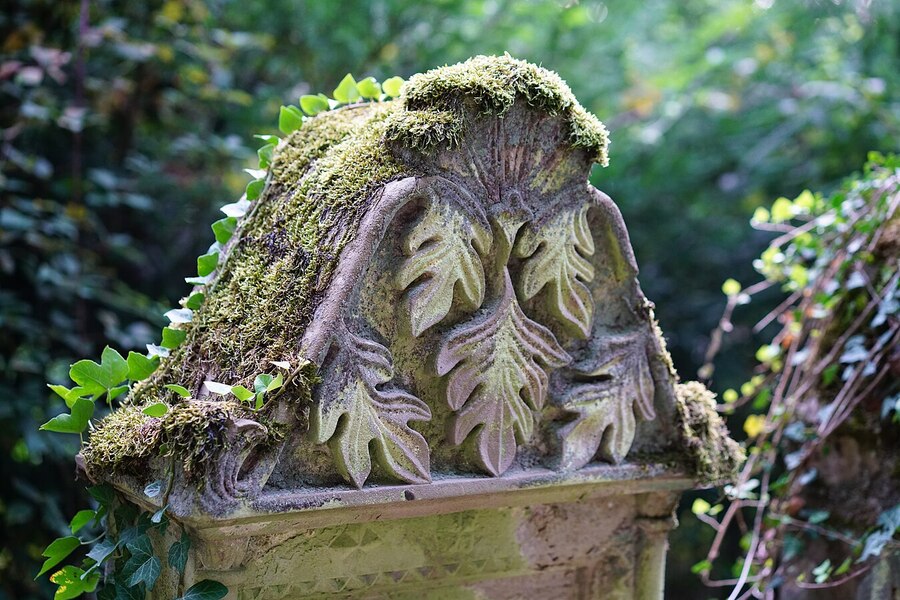
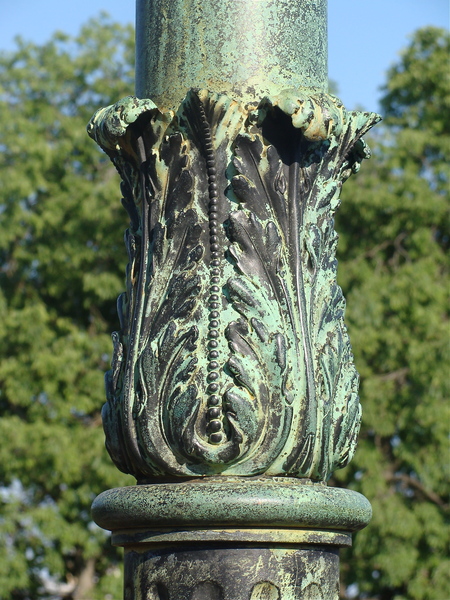
Tombstone with acanthus leaves, Jewish cemetery in Weinstadt, Germany, and part of the support of the Gloriette de Buffon, Botanical Garden, Paris (1786)
Copies of tombstones from the 4th century BCE, displayed at the Necropolis of the Athenian Potter
The acanthus bush is depicted in the acroteria above gravestones and temples; its branches form a palmette divided into two symmetrical parts.
Sculptures Growing Out of the Earth
A vital rhythm dominates the sculptural compositions of the classical era. It is inspired by the endless multiplicity of plastic motifs of movement found in tree trunks.
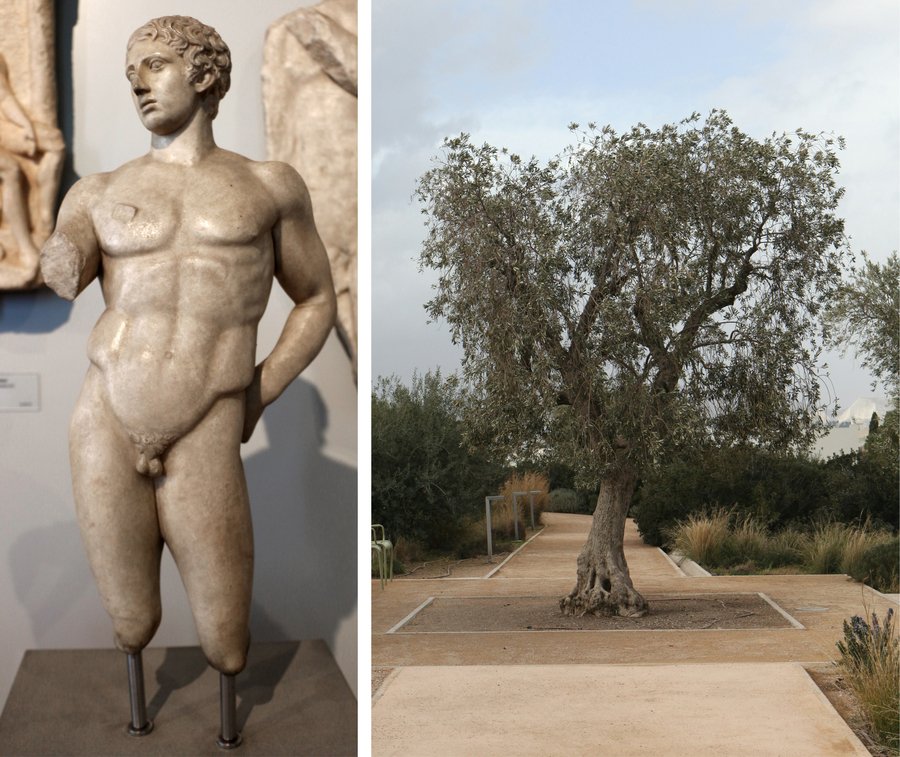
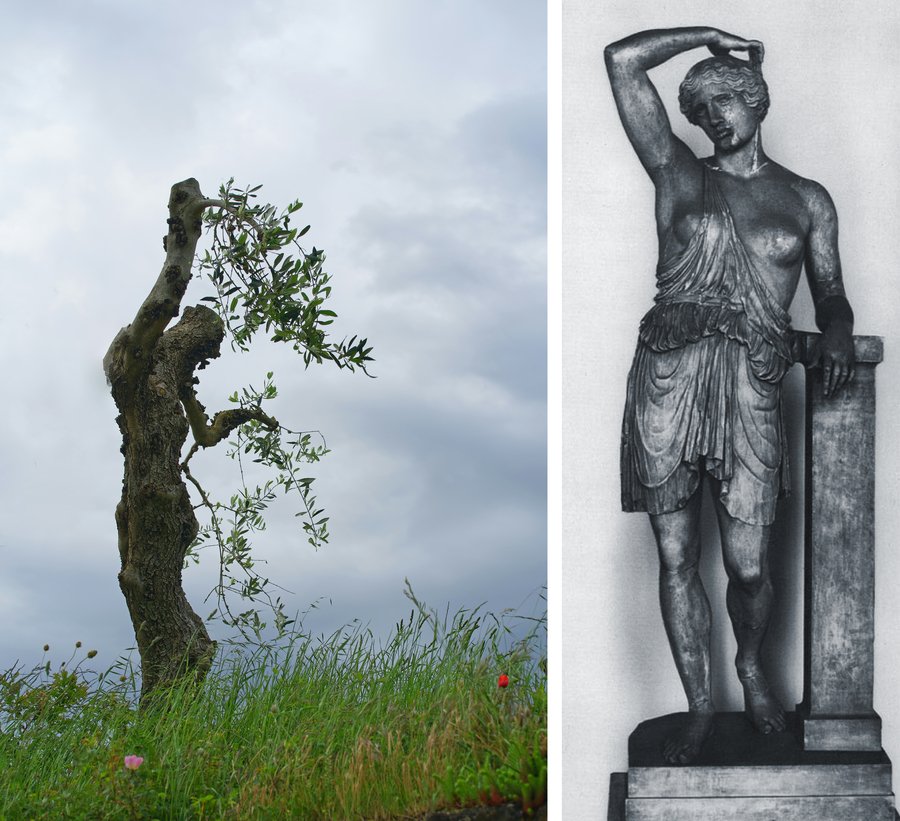
Sculptures of «Hercules» (Polykleitos) and «Wounded Amazon» (Roman copy of the bronze statue of Chryselaios), 5th century BCE. Olive trees