Research Concept
1. Context

A portable dwelling exists in two states. At a campsite, it forms a living space, but while traveling, it becomes cargo. The felt yurt of the Buryats of Transbaikalia allows one to see how these two states are embedded within the very structure. Wooden lattices fold up, poles are transported separately, and the felt covering is removed. After assembly, the same components again form the walls and roof. This mobility is connected to pastoral life and the seasonal relocation of campsites. In this work, I examine the disassembled felt yurt as one of the historical types of Buryat housing.
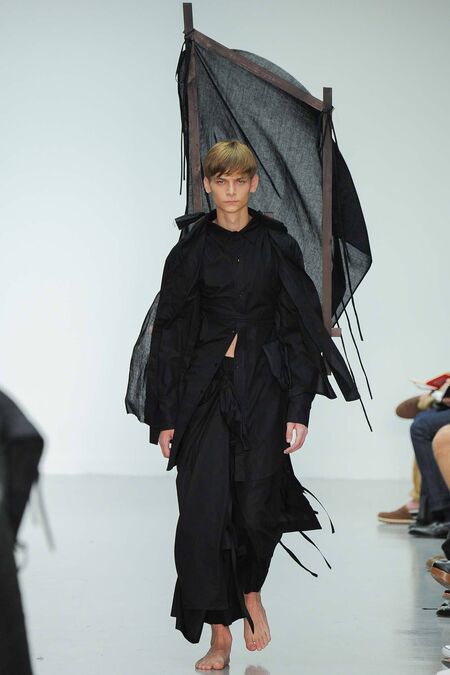
In a previous project, the author explored the Buryat costume as a mobile environment. In this study, the author continues to work with the theme of space surrounding the body, using Craig Green’s collections as an example. The designer draws inspiration from tents, kites, sails, and life rafts. His clothing reveals how the properties of these structures are expressed through tailoring, stitching, cords, rigid supports, and folding methods.
(Author’s project: 19th-Century Buryat Men’s Everyday Attire.)
2. Research Subject
The research object is quilted jackets, long parkas, overlays, and foldable down jackets by Craig Green and Moncler × Craig Green from 2015–2019. The subject of the research is the construction of these garments compared to the structure of temporary housing. I am examining what holds the garment’s shape, how the fabric is affixed, how the clothing creates free space around the body, and what happens to its volume during transport.
3. Research Question
How does Craig Green translate the principles of portable housing into garment construction? Which details create the silhouette of shelter, and which allow for volume manipulation when wearing or transporting the garment?
4. Hypothesis
The author posits that the similarity between Craig Green’s clothing and portable dwellings is primarily evident in the distribution of functions among support, covering, and fasteners. In one garment, a wooden frame defines the shape; in another, it is held together by stitching and stuffing; and in a third, the lines between down sections allow the piece to be folded. The more states accounted for in the garment’s construction, the closer it aligns with the logic of a portable home. This hypothesis can be tested by comparing runway photographs with museum descriptions and designer commentary.
5. Structure of the Analytical Section
After a brief examination of the felt yurt, the author moves on to five groups of pieces. SS15 demonstrates the connection between stitching, ties, and the external frame. In Fall 2018, I consider the long parka as a shell surrounding a form. The first Moncler Fall 2018 collaboration allows for the deconstruction of the insulated volume. In Moncler SS19, the author compares the presentation cloak and the production coat. Moncler Fall 2019 concludes the work with an example of an item whose construction is designed for folding. In each chapter, the author correlates one detail of the garment with a specific element or state of a portable dwelling.
Analytical Section
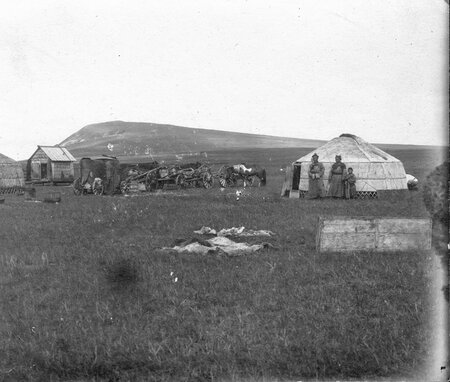
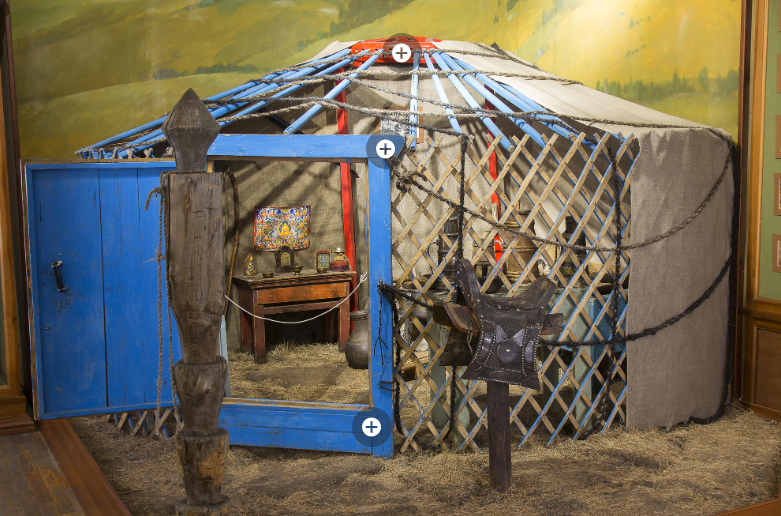
Felt Yurt as a Starting Point On the museum yurt, part of the covering is left open, which clearly shows the relationship between the lattice wall, the roofing poles, the felt, and the ropes. The lattice defines the wall’s contour, the poles support the roof, and the covering encloses the interior space. The archival photo by Sergey Rudenko from 1923 shows the yurt already assembled at a campsite. These two images offer different perspectives on the same principle. On the museum exhibit, one can examine the details, while the archival photo conveys the scale of the dwelling in relation to people and the landscape. (S. I. Rudenko, Transbaikalia, 1923, REM)
Exhibit from the Transbaikalia Regional Museum of Local Lore
House between parking spots
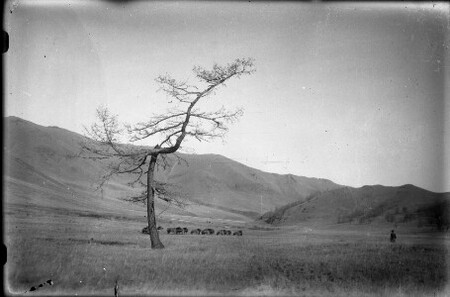
Text for slide. Portable housing can be considered in two states. At a stopping point, it creates a space for living, and during relocation, its components are transported along with household belongings. A photograph of a caravan of ox-drawn carts in Central Mongolia shows that mobility depends both on the design of the home and on how the cargo is organized. (A caravan of ox-drawn carts on a plain, Central Mongolia [1930s])
Caption for the photo — Details of a Mongolian yurt before assembly at a new campsite. Sukhbaatar Aimag, Mongolia, 2023. Photo by Manish Swarup, Associated Press.
1. Quilted jacket and wooden frame — Craig Green SS15
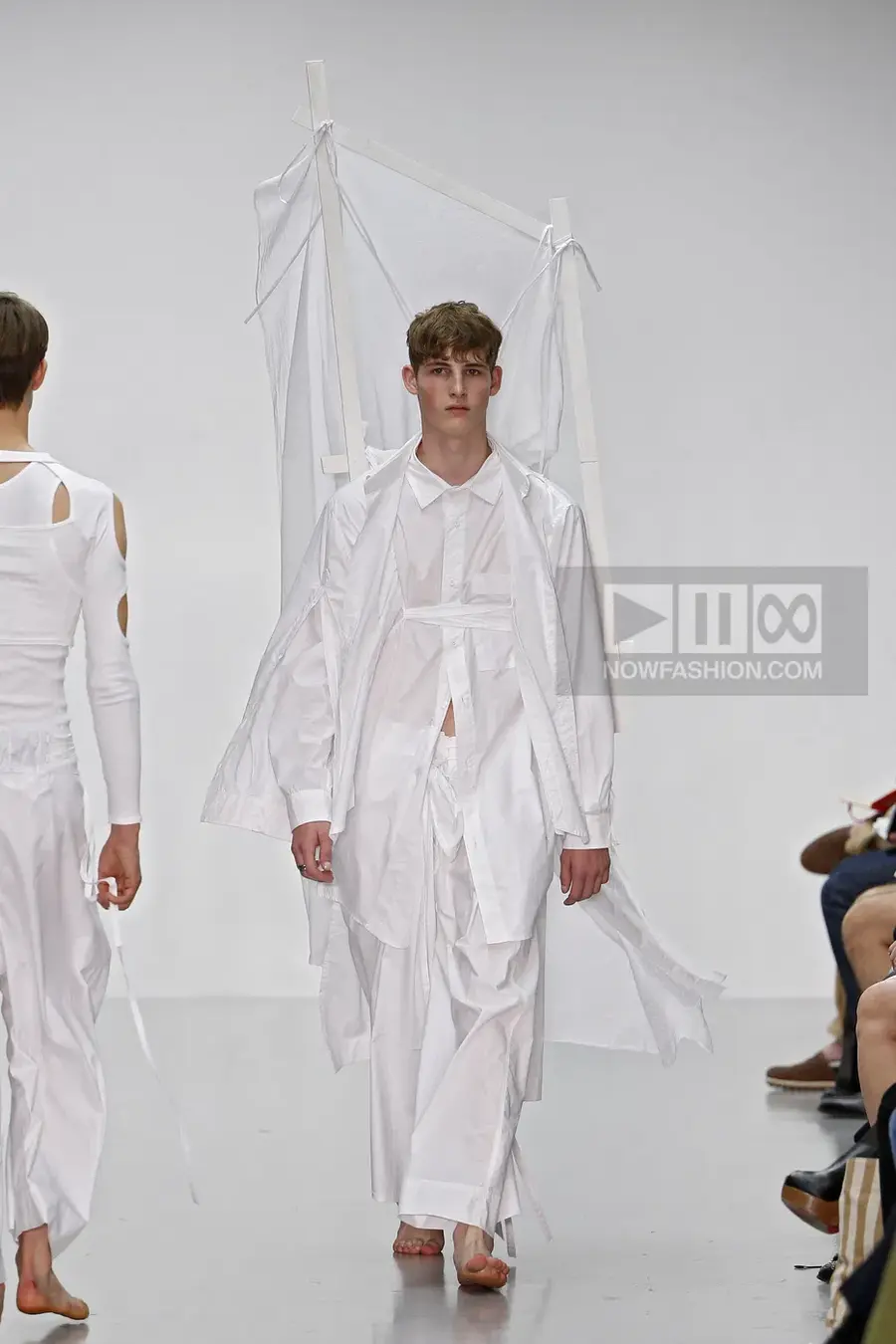
Comparison with a yurt. In a yurt, a rigid support and a soft covering are distinct parts. In Image No. 5, these can also be discerned, but the human figure becomes the central point of support for the entire composition. The comparison on the quilted jacket works at the surface level. The felt covers the gaps in the latticework frame, while the quilting organizes the fabric of the jacket itself. The drawstrings offer another parallel: in the yurt, they connect parts of the structure; on the jacket, they gather the edges of the clothing around the body.
№ 1
№ 5
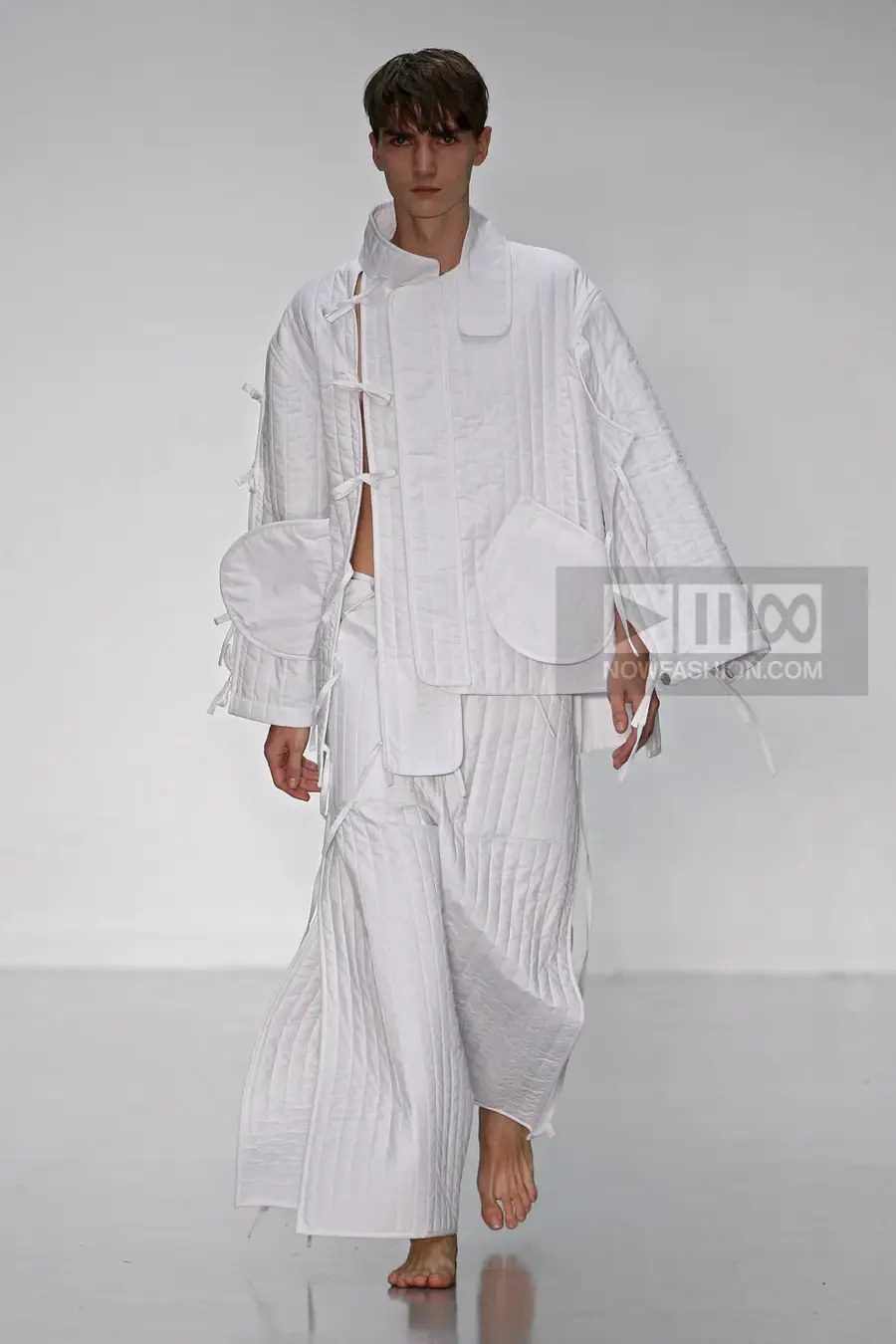
Craig Green SS15 NOWFASHION
In the first SS15 look, a white quilted jacket creates a broad, rectangular silhouette. Vertical stitching divides the surface into narrow channels, a standing collar continues the body line, and the front panels are fastened with ties. The construction of the garment is clearly visible on the white fabric—one can trace the quilting pattern, the placement of the patch pockets, and the points where one panel attaches to the other.
In look No. 5, an additional structure appears at the back. A wooden frame rises above the shoulders, and a light fabric is secured to it, hanging freely. When viewing the two looks side-by-side, one can observe how the supporting structure changes. In the first jacket, the shape is defined by the cut and the quilted material. In the second look, the external frame pulls the fabric away from the body, giving the figure an additional contour.
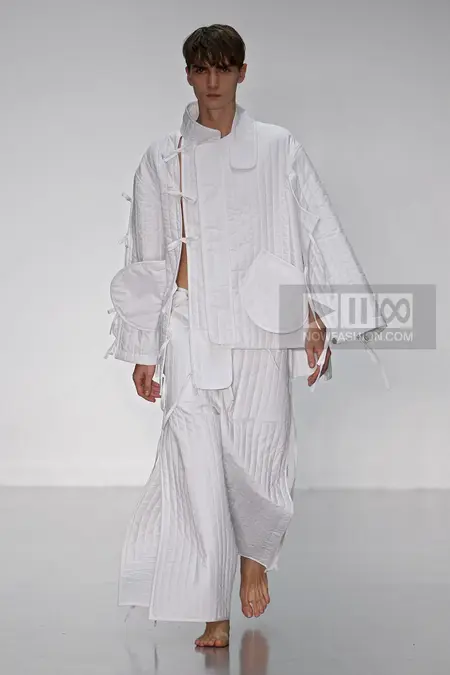
On Green’s white jacket, ties mark the points where the front panels join. The edge of the fabric remains loose between them. In the felt yurt, rope connections link the elements of the lattice wall. The similarity is visible at the level of detail: the flexible tie holds two parts together, and it can be untied. For the jacket, this allows the front of the garment to open; for the yurt, it allows the frame sections to be separated during disassembly.
2. Long Park as a Shelter — Craig Green Fall 2018
In looks #26 and #28, a unified shell—from the hood to the hem—plays the main role. In both cases, the hood projects forward, partially shadowing the face. Cords run across the surface, their ends remaining visible and extending beyond the silhouette. In #26, red, blue, and light areas more strongly emphasize the panel boundaries. In #28, the muted colors allow for a better tracing of the vertical lines and the hood’s overall shape. It was this group of long parka styles that Green compared to «tents for a person.»
№ 28
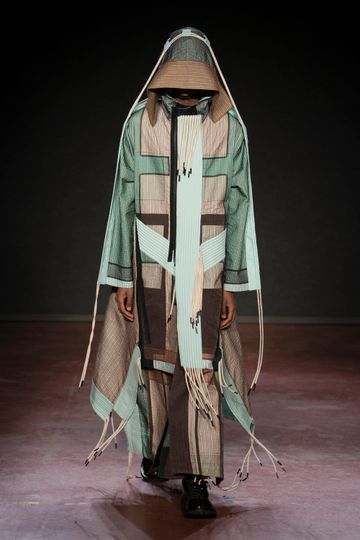
№ 26
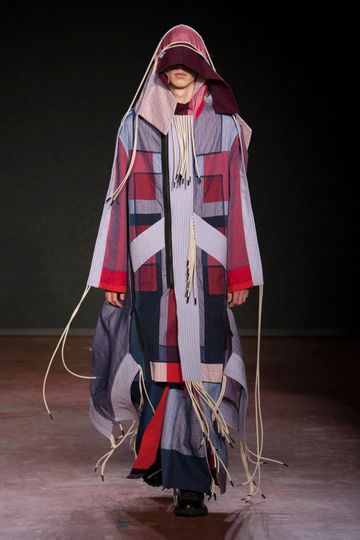
Fall 2018, CRAIG GREEN
If you zoom in on the top of Park No. 26, you can see how the edge of the hood projects forward, partially shading the face. A depth emerges between the face and the fabric—a depth comparable to the entrance into a shelter. The scale and function of the openings differ: one enters through the yurt door, while the open part of the hood provides the person with a view. In both cases, the fabric edge frames the transition between an enclosed volume and the external environment.
Yurt in Sundutuy Village, REM
Comparison to the yurt. The dwelling has enclosed surfaces and open areas through which the person interacts with the external environment. This boundary is particularly evident in the hood on the parkas. Its edge is pulled forward, creating a slight indentation between the fabric and the face. At human scale, this can be compared to an opening in the dwelling’s envelope. Cords offer a different type of connection. In a yurt, ropes tie down parts of the frame, whereas on the parkas shown in the photographs, they primarily define the lines of the garment. The cords' placement and length can be illustrated through images. The function of each cord must be determined by examining the garment itself or its description.
3. Insulated Shell — Moncler × Craig Green Fall 2018