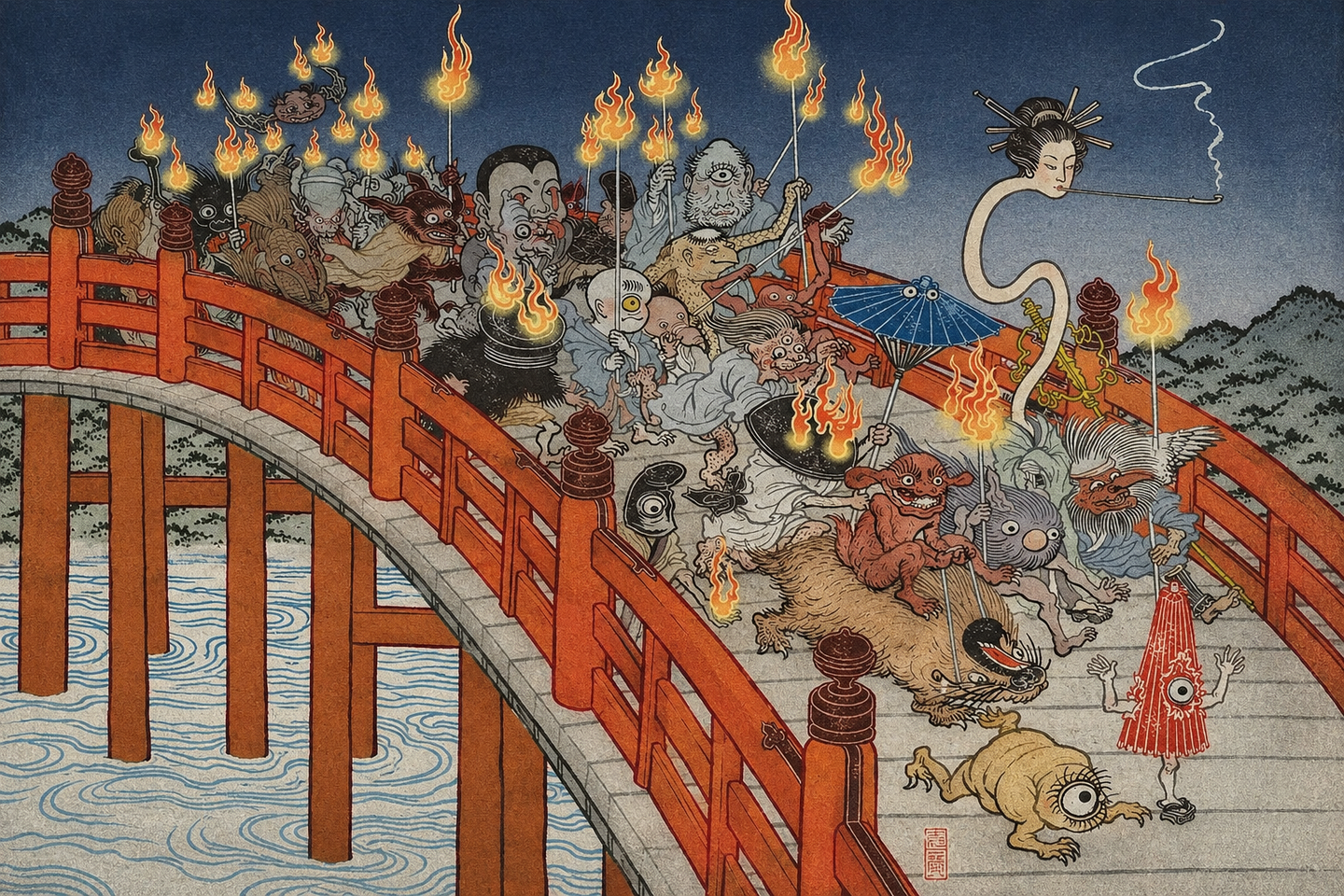
Welcome to a world where the boundary between the real and the ethereal blurs—where unseen forces underpin everyday phenomena, where foxes take human form, the spirits of the deceased return for vengeance, and intense emotions gain a life of their own.
The journey begins!
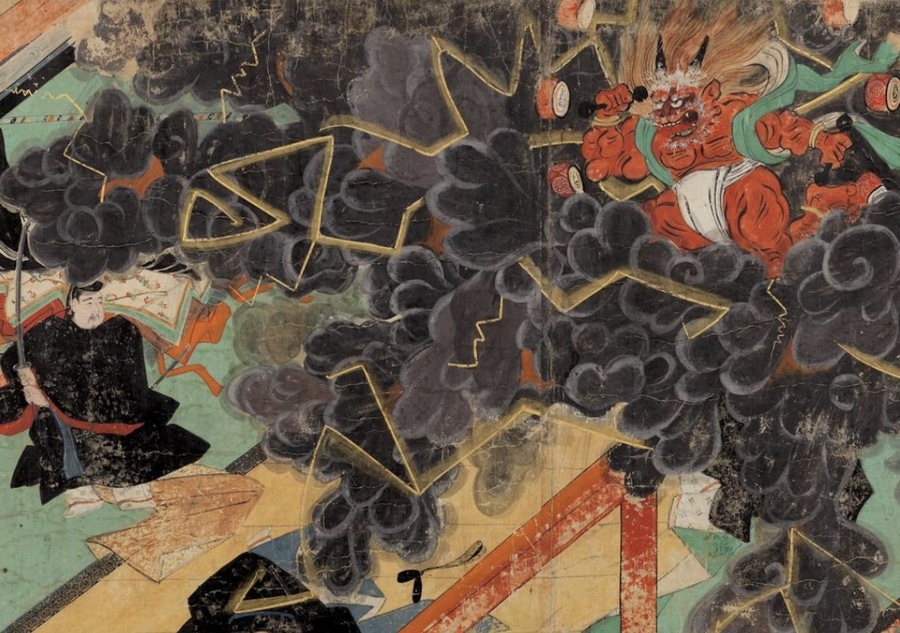
«Kitano Tendzin Engi Emaki» 1219 AD · Kitano Temmangu Shrine, Kyoto
Concept
How did conceptions of spirits and supernatural beings influence the daily life, worldview, and visual culture of Japan from the 8th to the 14th centuries?
In Japan during the 8th–14th centuries, the supernatural was not confined to ancient folklore. Spirits, demons, and deities were present in religious beliefs, literature, artistic works, and explanations of surrounding events. The unseen world was not perceived as entirely separate from the human realm; it was believed capable of intruding upon daily life, affecting people’s health and fortunes, and even the well-being of an entire nation.
Illnesses, natural disasters, inexplicable events, and intense human experiences were sometimes attributed to the action of supernatural forces. These beliefs reflected not only societal fears but also its moral values, its relationship with nature, life, death, justice, and human actions. Mythological beings became unique embodiments of what is difficult to see or explain. Werewolf foxes blurred the line between human and animal. Vengeful spirits served as a reminder of the consequences of injustice. Hungry spirits personified insatiable desires and suffering, while demons with human and avian features allowed for commentary on pride and spiritual delusion.
Goal of the visual research
Explore the role of mythological imagery in shaping the cultural identity of medieval Japan, demonstrating how human fears, beliefs, and worldviews were embodied in the figures of supernatural beings.
Japanese mythology is filled with various spirits, deities, and mysterious beings whose stories blur the line between the real and spiritual worlds. During my research, I encountered numerous fascinating legends, but I was particularly drawn to the Hyakki Yagyō, the Oni, the Kitsune, and Amaterasu. Through these figures, I aim to explore how the supernatural reflected the fears, beliefs, and worldview of the Japanese people, influencing their daily life, culture, and art.
Hyakki Yagyō—a nocturnal procession of hundreds of demons
The earliest surviving depictions of Hyakki Yagyō date back to the 16th century, placing them at the end of the Muromachi period. However, there is an interesting historical detail: the belief in the night parade of demons existed much earlier—during the Heian period (794–1185). Furthermore, researchers mention evidence of early illustrated scrolls that may have existed in the 12th–14th centuries, though they have not survived.
This illustration belongs to the famous Japanese scroll, «Hyakki Yagyō Emaki» (百鬼夜行絵巻)—"The Night Parade of a Hundred Demons.» It depicts a whimsical procession of yōkai, which includes demons and animated objects. Artist: unknown. The original is housed at Shinzū-an Temple, Daitokuji complex, Kyoto, Japan.
This is perhaps one of the creepiest stories associated with everyday life in medieval Japan!
Just imagine: Kyoto at night more than a thousand years ago.
The narrow streets are plunged into darkness, the houses are shuttered, and somewhere in the distance, strange sounds can be heard. Suddenly, a procession of creatures appears on the road—beings that cannot be mistaken for humans: one-eyed monsters, horned demons, and creatures with animalistic bodies
and terrifying faces.
According to medieval legends, a chance encounter with them could turn into disaster. Sometimes, prayer was considered the only way to survive.
A story of Fujiwara no Morosuke’s encounter with demons in the capital city streets
A court carriage depicted on a 13th-century scroll. Similar carriages were used by Japanese aristocracy and help to illustrate the nighttime journey of Fujiwara no Morosuke.
This story is recorded in Okagami—a historical and literary work from the late 11th to early 12th century. Its protagonist is Fujiwara no Morosuke, an influential courtier. One night, Morosuke was traveling through Kyoto in a bullock-drawn cart. Suddenly, he sensed something dangerous ahead.
He ordered his attendants to stop, unhitch the oxen, and lower the cart’s curtains. His servants did not understand what was happening. Morosuke drew the curtains, adopted a reverent posture, and began reciting a Buddhist protective spell.
He remained inside the cart for about an hour. Only afterward did Morosuke allow the journey to continue. Later, it was discovered that the cause of the stop was an encounter with a nocturnal demon procession.
Ethics
Morosuke did not try to run from or fight the monsters.
He acted as if a powerful procession was passing before him, one that must not be interrupted.
His behavior resembled adherence to strict court etiquette: stopping, showing deference, and waiting until the dangerous creatures moved on.
How Yōkai influence Japanese lifestyles and how people protected themselves from this phenomenon.
Belief in the Yaksha-gyō—the nocturnal procession of hundreds of demons—caused the Japanese to regard the onset of darkness with extreme caution. To avoid encountering supernatural beings, people refrained from venturing out on unfavorable nights, wore protective talismans, and recited Buddhist incantations.
If an encounter was unavoidable, one had to take shelter and wait for the procession to pass. Thus, the fear of the unseen world influenced even daily decisions: when to leave the house, which path to follow, and how to protect oneself from danger. Night became not merely a time of day, but a space where the familiar world could give way to the otherworldly.
They (oni) are demons that attacked humans
«Hyakki Yagyō Emaki» (Scroll of Night Parade of One Hundred Demons) — «Night Parade of a Hundred Demons.» Artist: Unknown. Location: Imperial Library of Sōyōbo, Japan, Tokyo.The painting depicts a massive red demon with sharp claws, fangs, and disheveled hair. It is attempting to open an antique wooden chest—a karabitsu. Small, fantastic creatures peer out from inside, as if disturbed by its actions. This is part of a longer procession of yokai, among which are tsukumogami—inanimate household objects that have come to life.The distinct feature of the scene is the combination of the terrifying appearance of the red demon with a nearly comical situation. The artist does not only portray the monstrosity of the creature but also its expressive movements and character.
Imagine you are traveling through Japan a thousand years ago. Ahead of you lies a deserted bridge, an abandoned house, or an unfamiliar woman who appears in the middle of the road. For a person from the Heian period, even such a mundane encounter could turn into an encounter with a demon.
They are among the most dangerous and multifaceted beings in Japanese mythology. They were believed to have the ability to attack humans, assume another’s form, spread diseases, and inhabit the afterlife.
Yet, their role was not limited to frightening tales. Concepts of the Oni influenced religious rituals, attitudes toward dangerous places, art, and even state ceremonies.
The legend «Kibi Daimyō Nyū-Tō» (吉備大臣入唐) — «The Journey of the Minister of Kibi to China»
This is an authentic Japanese work from the second half of the 12th century. Artist Unknown; traditionally attributed to Tokiwa Mitsunage, but authorship is unconfirmed. Location: Museum of Fine Arts, Boston, USA.
The fragment depicts a meeting between the Japanese scholar and courtier Kibi no Makibi and the red demon Oni.
Legend has it that Kibi traveled to China, where he was imprisoned in a tall tower and subjected to various trials. One day, a terrifying creature approached the tower—it had red skin, disheveled hair, claws, and unusual facial features.
However, it turned out that this was not an evil demon, but the spirit of the Japanese poet Abe no Nakamaro, who had taken the form of Oni. He came not to harm Kibi, but to help him overcome the trials of the Chinese court.