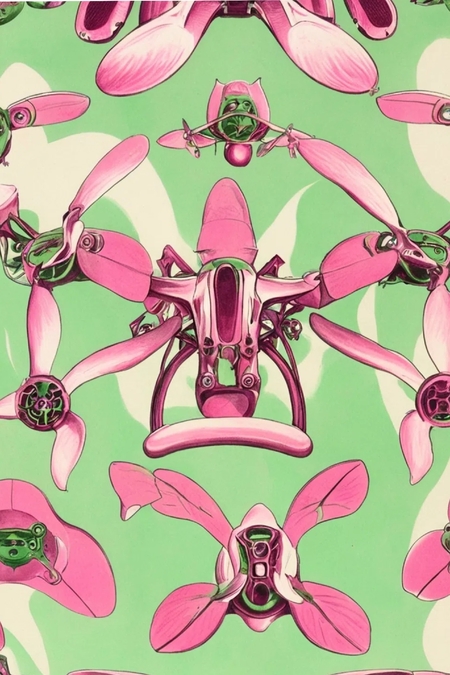
Project Concept
In 1904, German zoologist Ernst Haeckel finished publishing the book «Forms of Art in Nature.» It contains one hundred tables showing radiolarians, jellyfish, corals, mosses, and orchids arranged in symmetrical, almost ornamental compositions. Haeckel, who introduced the term «ecology» to science, wanted to demonstrate that nature itself creates art. The book became a source of forms for the Art Nouveau movement: inspired by Haeckel’s radiolarians, architect René Lalique designed the main gates for the 1900 Paris World’s Fair.Since then, the environment surrounding humans has changed. A calculation published in the journal Nature in 2020 showed that the mass of everything created by humans (concrete, metal, plastic, technology) has equaled the mass of all living biomass on Earth. Cables, chips, antennas, and screens have become the landscape we inhabit as naturally as a mollusk inhabits its shell.The project asks a question: what would this new «nature» look like if described by a naturalist from 1904?
Source images for training
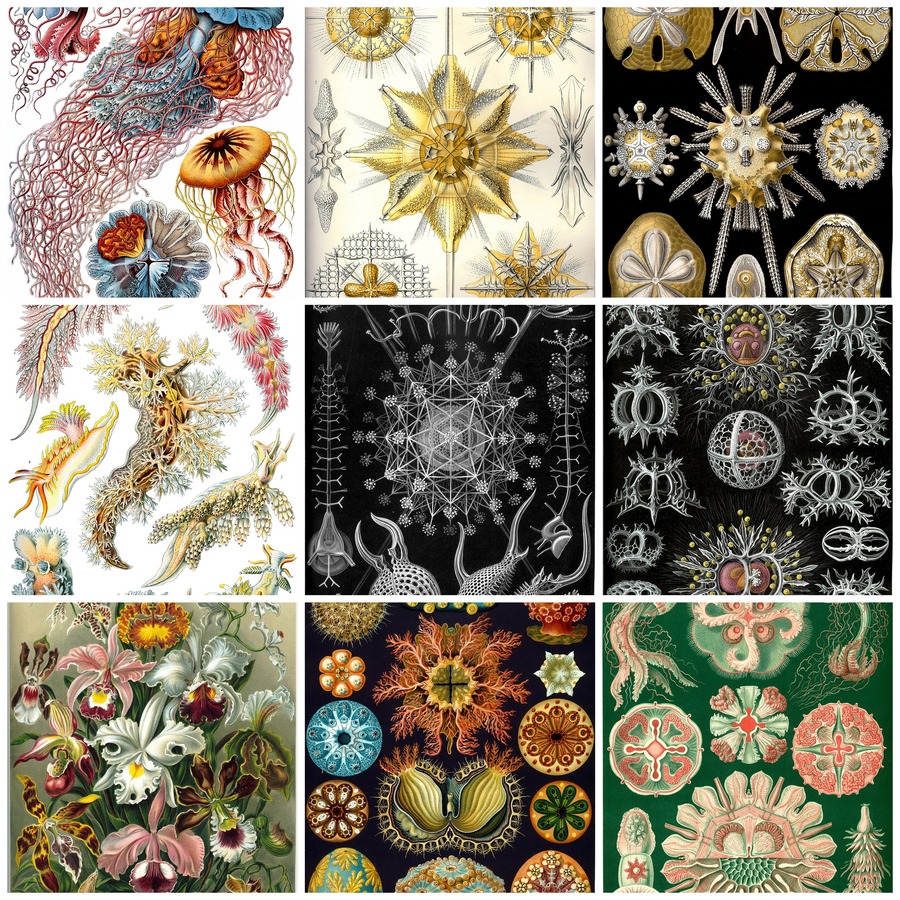
Sources and Usage Rights:— The dataset is composed of all the tables from «Kunstformen der Natur» (Leipzig and Vienna, Bibliographical Institute, 1904). The illustrations were created by Heckel, and the lithographs were executed by Adolph Gilcher. — The book was published over a hundred years ago, its authors have long since passed away, and the tables are in the public domain. — Scans were taken from Wikimedia Commons.
Selection
All one hundred sheets were produced using a single technique, in one workshop, and for one book. This is an ideal situation for teaching style: the manner remains constant, while the subjects vary (from single-celled organisms to antelopes). It is easier for models to grasp that what unites all the images is the style.
Image Format
The original sheets are oriented vertically (approximately 1:1.4). The script scripts/prepare_dataset.py crops the central square from each sheet and resizes it to 1024×1024. The center of the sheet was chosen because Heckel’s compositions are built around a central axis, and the table headers and captions remain outside the frame.
Signatures
Each image includes a caption following this scheme: trigger, leaf type, subject, palette, background:kdn style scientific plate, star-shaped acantharian radiolarians, golden yellow and ochre, pale cream background
Model Training
DreamBooth LoRA fine-tuning was used for Stable Diffusion XL base 1.0. The weights of the base SDXL model itself are not altered. Small low-rank matrices (LoRA) are added to the UNet neural network’s attention layers, and only these matrices are trained. The resulting file is approximately 180 MB and attaches to the base model as an extension, whose intensity can be adjusted.
Training is launched using the official script train_dreambooth_lora_sdxl.py from the diffusers library.
loss function graph
The loss function of the diffusion model is noisy: at each step, the image is corrupted by a random value, and the error heavily depends on that value. Therefore, a moving average is crucial on the graph. Individual steps jump from 0.01 to 0.35, but the average over 25 steps stays within the 0.07–0.19 corridor and shows no significant decrease after 1,000 steps. There are no sharp drops here: SDXL already knows how to render images; LoRA merely shifts it toward the style of Heckel. Consequently, quality was assessed based on the generated images.
One table at stages 0, 250, 500, 750, 1000
The same Table 101, generated with the same seed after a different number of training steps. Step 0 represents the base model without LoRA: it renders a golden mandala—a flat, decorative ornament. By step 250, the table’s structure begins to emerge: the sheet divides into fields, and individual «instances» are placed around the central form. By step 500, the Hekkel composition takes shape: a large instance in the center, circular shapes in the corners, and small details along the edges, all against a black background. Steps 750 and 1000 are almost indistinguishable from step 500; only minor details change. This indicates that 1000 steps are sufficient, and there are no signs of overfitting: the model is not copying specific dataset tables or rendering their labels.
Series Image Generation
Hekkell’s book concludes with Table 100. The series continues the numbering and is divided into three chapters, repeating the logic of the determinant: from the microscopic to the macroscopic, from the sea to the land. The palettes and backgrounds are taken from real Hekkell tables so that the new sheets look like part of the same publication.
A series of 12 images was generated based on the prompts.
The Microcosm of Data:
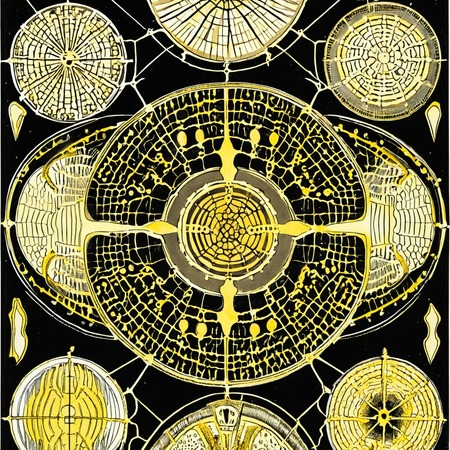
- «Microprocessor Radiolarians» — many radiolarians build skeletons from silica, and microchips are made from silicon. One chemical element, two different architectures: a lattice sphere and a printed circuit board. On the table, they merge: the intricate shells of the radiolarians are composed of golden traces, like a circuit board under a microscope.
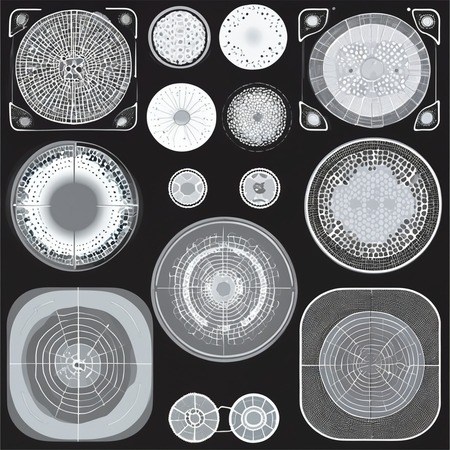
- «Pillared Diatoms"—diatom algae live in siliceous «glass» shells. Here, these shells have become smartphone screens and touch panels, and their intricate patterns have transformed into a pixel grid.
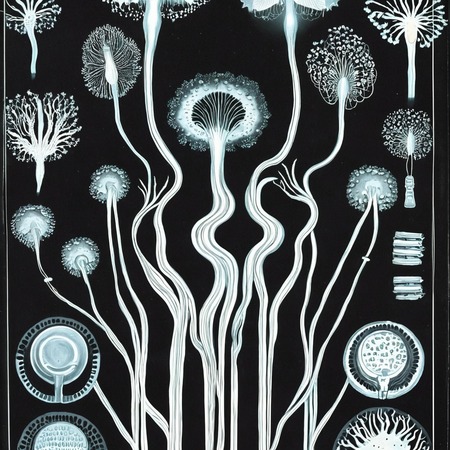
- «Network Slime Molds”—in 2010, Japanese scientists demonstrated that a slime mold growing toward food scraps replicates the railway map of Tokyo. Here, the slime molds themselves become a network: luminous fruiting bodies on long stalks are connected by threads resembling fiber optic bundles.
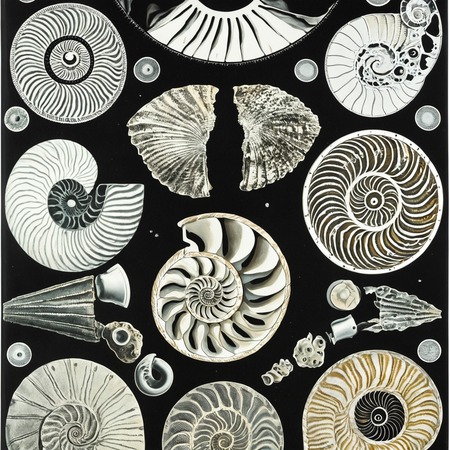
- «Magnetic Ammonites» — geologists date rock layers using ammonite shells. A coiled magnetic tape, cassette tapes, and hard drive platters could very well become guiding fossils of the Anthropocene. Among the spiral shells on the table lie metal fragments, and the spirals themselves resemble a wound tape.
Cable Sea:
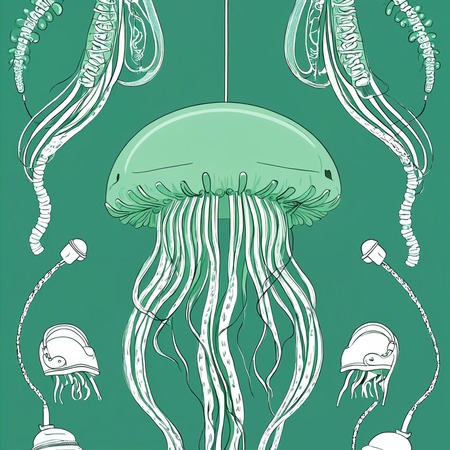
- «Acoustic Jellyfish"—a central jellyfish bell is suspended on a wire, resembling a headset cup, while small insert jellyfish with wired connectors float alongside it. The turquoise background is taken from Table 78, featuring cube-jellyfish.