Research Concept
The art of František Kupka (1871–1957) is not a sudden revolution, but a grand journey—a passage from a recognizable world to a realm of pure vibrations, from static form to dynamic energy. He was not merely one of abstraction’s pioneers, but also its philosopher, driven by a profound interest in spiritual teachings, science, and the fundamental laws of the universe. This study traces step by step how the figurative shell of the world dissolved on his canvases, yielding to rhythm, light, and cosmic harmony.
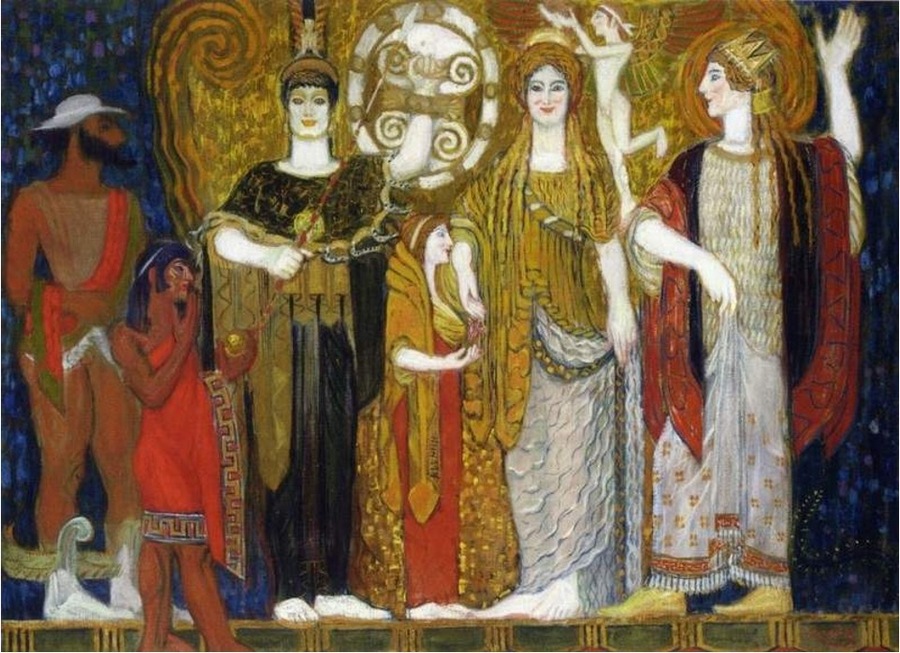
Elena’s Coronation. 1906.
I. Origins: The Spirit Hidden in Form (Pre-1910)
Early Kupka was a Symbolist. His works, such as «Bather» (1907) and «Beginning of Life» (1900), are filled with allegories and mystical imagery.
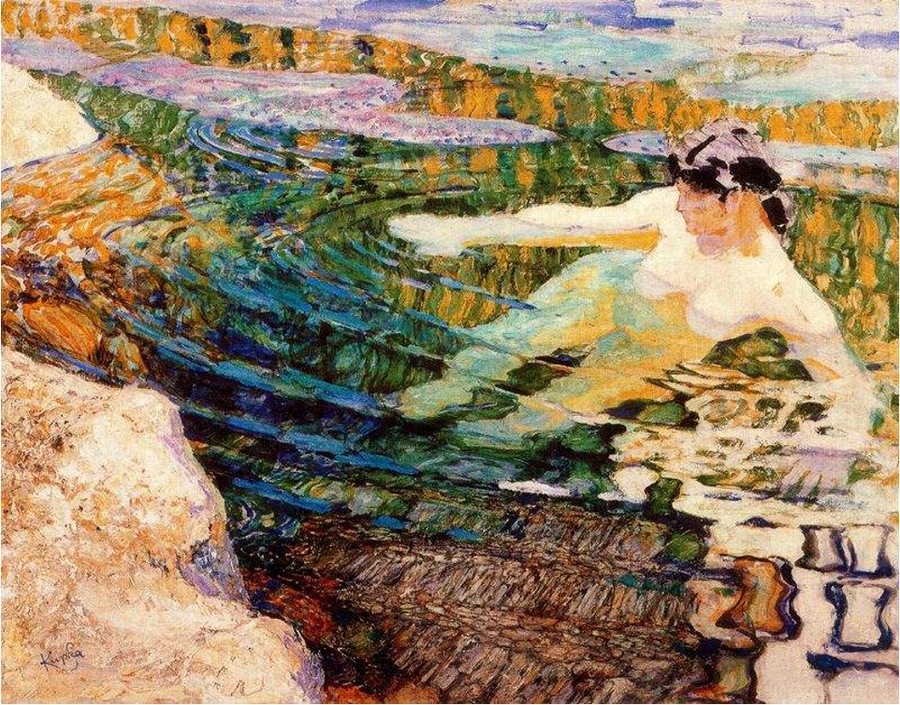
Bather. 1907.
The beginning of life. 1900.
However, his unique approach is evident here: form is not self-sufficient; it serves as a conduit for an unseen force. In «Bather, ” the woman’s body merges with the element, her contours blurring—this is an early attempt to depict the very energy of nature, its fluidity. In „Beginning of Life, ” a clump of pure, tender light is born and pulsates in the center of the canvas from the chaotic energy of warm ochres and gold—a visual metaphor for life itself in its primal genesis. Even in the more concrete „Wave“ (1902), Kupka is interested not so much in the seascape as in the universal rhythm, the overwhelming power, and motion.
Wave. 1902.
Self-Portrait with Wife. 1908.
The key question of this stage is: how to express not the subject, but the idea or energy behind it, using the means of painting?
II. Deconstruction: Analysis of Movement (1908–1912)
A turning point in Kupka’s creative work arrives under the influence of the scientific discoveries of his era. He is fascinated by chronophotography—the decomposition of motion into sequential phases. This analysis leads to a systematic deconstruction of form. The central work of this period is the series «Woman Gathering Flowers» (1908–1910). Here, the figure literally unfolds across time and space. We do not see a single woman, but a process—a «life impulse.» Numerous sketches related to this series illustrate how Kupka fragments the body into color planes and arcs, striving to capture the kinetic essence of the gesture rather than its static shell.
Woman Gathering Flowers. 1909.
The key question of this stage is: how to show the life of form over time? How can painting compete with science in analyzing movement?
Gallic Maiden. 1910.
III. Apex: The Birth of the Non-Objective World (1911–1913)
In 1912, Kupka achieves a definitive breakthrough. At the Autumn Salon, he presented two works that entered history as some of the first fully abstract canvases: «Amorphous. Fugue of Two Colors» and «Amorphous. Warm Chromatics.»
Amorphous. Fugue of Two Colors. 1912.
Amorphous. Warm chromaticity. 1912.
«Fugue» is a manifesto. The title references music and art that exists purely in time. Circles and ovals rotating around an unseen center evoke the sensation of planetary orbits, cellular division, and cosmogony. This is no longer an abstract shape, but an image of life’s energy, its rhythm, and its cyclical nature. In «Warm Chromatics,» the focus shifts to color as a source of heat and solar-like radiation.
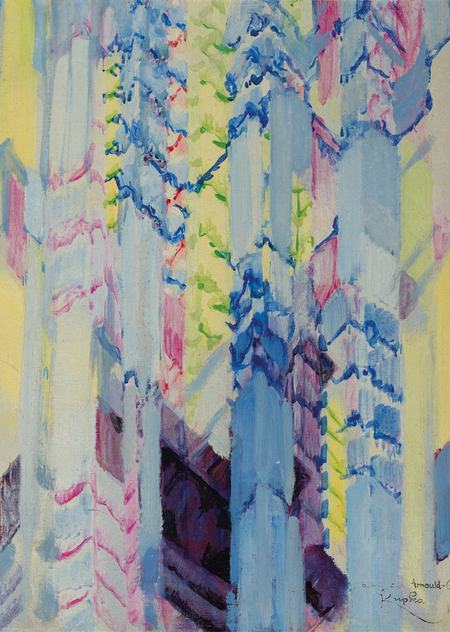
Concurrently, he develops another approach—the geometric. «Vertical Planes» (1912–1913) and «Organization of Graphic Motifs II» (1912–1913) are an exploration of the structural power of line and contrast.
Vertical Planes. 1912.
Organization of Graphic Motifs II. 1912.
While «Amorpha» embodies the organic pulsation of life, «Vertical Plans» expresses the energy of architectural order—strict and structural. These works are based on clear lines and planes, reminiscent of crystalline lattices where energy is subordinated to the laws of geometry.
The study «Newton» serves as a bridge between these approaches. Inspired by optical experiments, Kupka transforms the scientific principle of light dispersion into a pictorial fugue. The colored rays, colliding on the canvas, create a complex polyphony where rational knowledge is melted down into pure color energy.
Newton’s Discs. Study for a Fugue in Two Colors. 1911.
The key question of this stage is: can a painting exist as an autonomous universe, governed only by its internal laws, much like a musical piece or a celestial body?
IV. Systematization: Cosmic Order (1920s–1930s)
Following the First World War, Kupka’s art became more rigorous and philosophical. He sought universal formulas for the cosmos. Works from this period—"Black Idol» (1920), «Blue» (1921–1925), and «Around a Point» (1920–1925)—resemble archaic symbols or schematics of fundamental physical processes.
«Black Idol» is an icon of abstraction. Its simple, monumental forms carry the sensation of ancient, sacred knowledge regarding the harmony of the celestial spheres.
«Around a Point» is a visual model of the Big Bang or the birth of a galaxy, where all elements are engendered by the energy of a single center.
Black Idol. 1920.