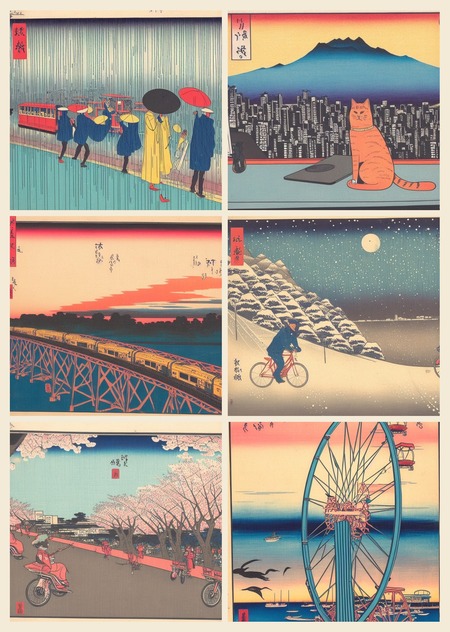
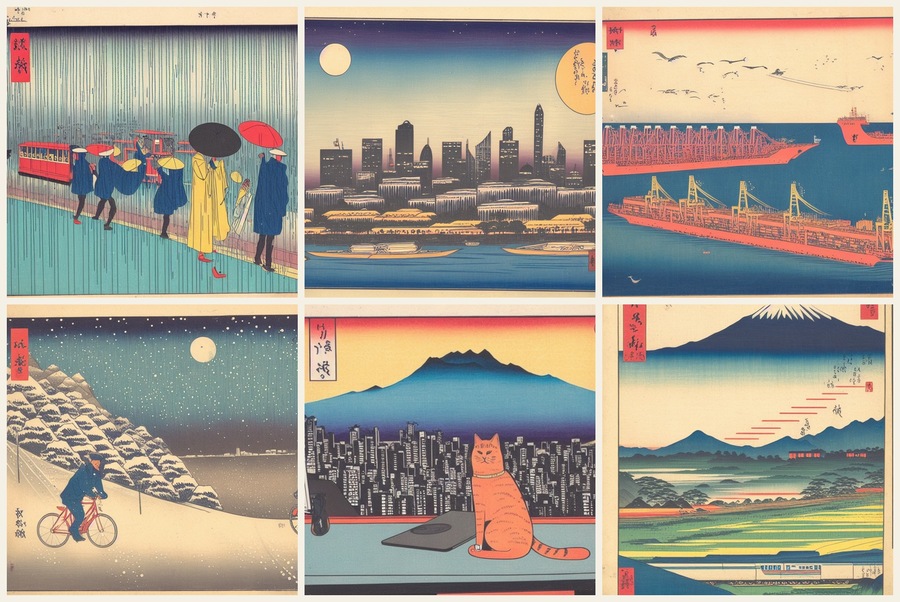
The Stable Diffusion neural network was fine-tuned on 36 woodblock prints by the Japanese artist Hiroshige and now renders a modern city in his style: subways, skyscrapers, delivery couriers, ports, and much more.
PROJECT IDEA
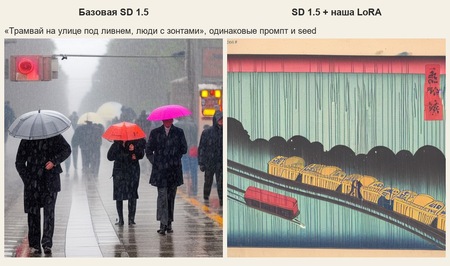
Utagawa Hiroshige (1797–1858) was a master of Japanese ukiyo-e printmaking. He depicted the city of Edo (now Tokyo) and the Tokaido road—bridges, boats, travelers, rain, and snow. His prints are easily recognizable by the blue band of sky at the top, the flat coloring, the rain rendered through fine lines, and the small human figures.I became curious about how he might portray the modern city. Therefore, the project idea is this: to teach a neural network Hiroshige’s style and ask it to illustrate things that did not exist in his era—subways on bridges instead of boats, skyscrapers instead of castles, and a courier on a bicycle instead of a traveler. Many subjects draw inspiration from specific prints. For example, «Sudden Shower over a Bridge» became a tram under the rain, and the cat from «Asakusa Rice Fields» became a cat next to a laptop.The style, not the character, was chosen because style can be applied to any subject. If the neural network renders a subway in Hiroshige’s manner, it means it has grasped the style, rather than simply memorizing images.
SOURCE IMAGES
For the instruction, 36 Utagawa Hiroshige engravings from the Metropolitan Museum of Art’s open collection have been used. These feature cityscapes and views from the series «One Hundred Famous Views of Edo» and «Fifty-three Stations of the Tōkaidō, ” depicted in various weather conditions and times of day. Each image has been cropped to a 512×512 square.
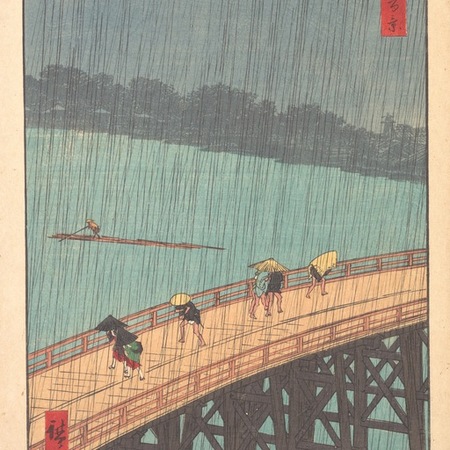
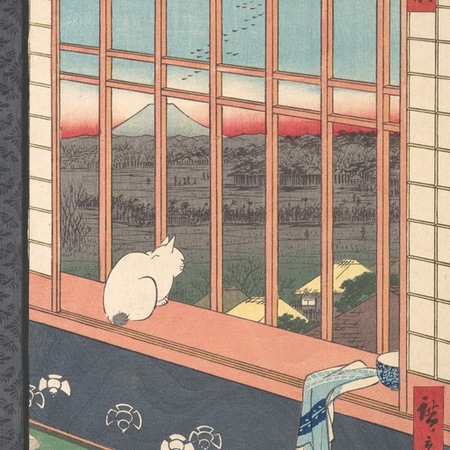
«Sudden downpour over the Shin-Ohashi and Atake Bridge, ” 1857 „Asakusa Rice Fields“ (Cat by the Window), 1857
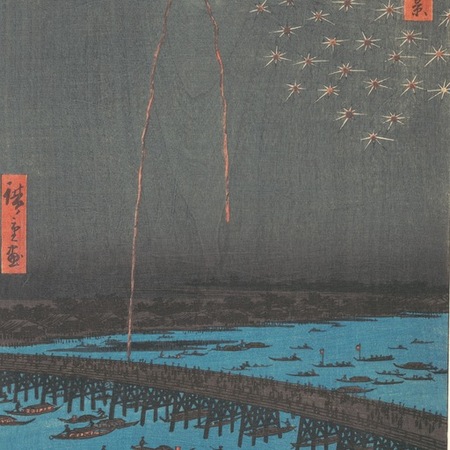
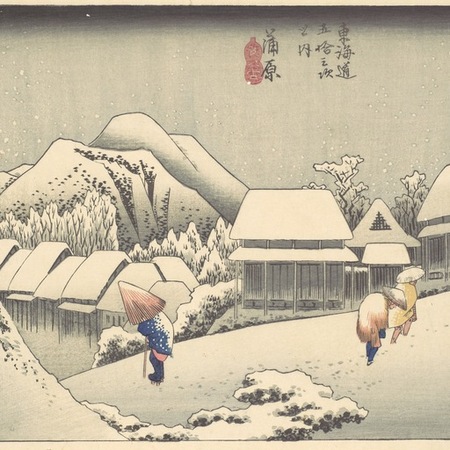
«Fireworks at the Meguro Bridge, ” 1858 „Evening Snow in Kanbara, ” c. 1833–1834
FINAL EPISODE
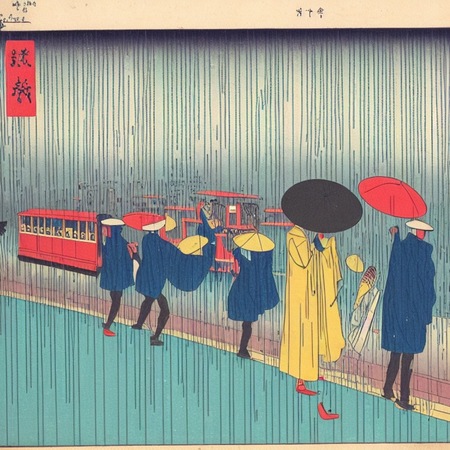
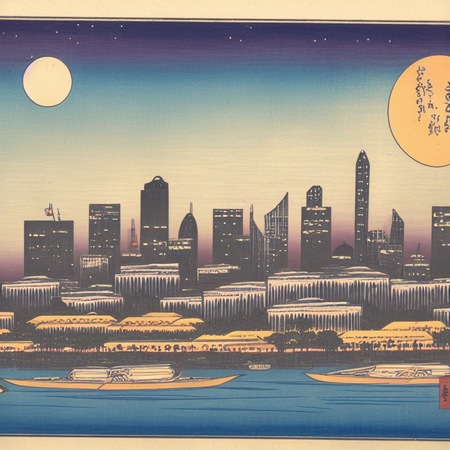
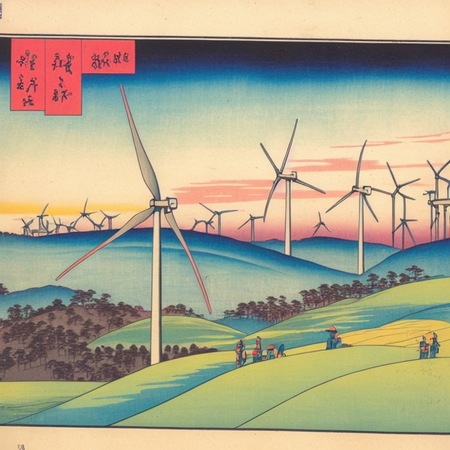
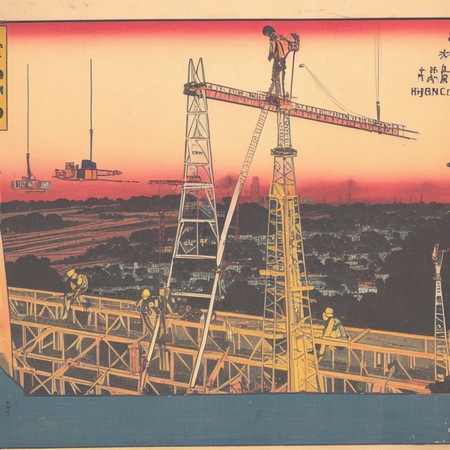
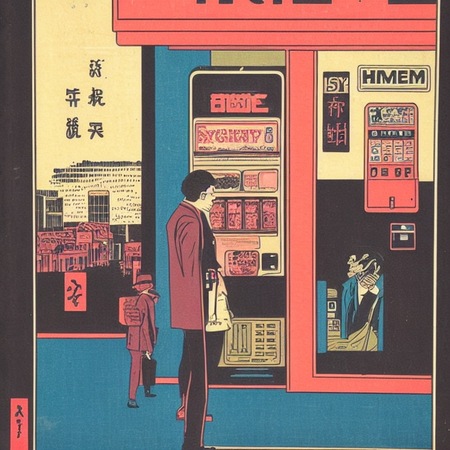
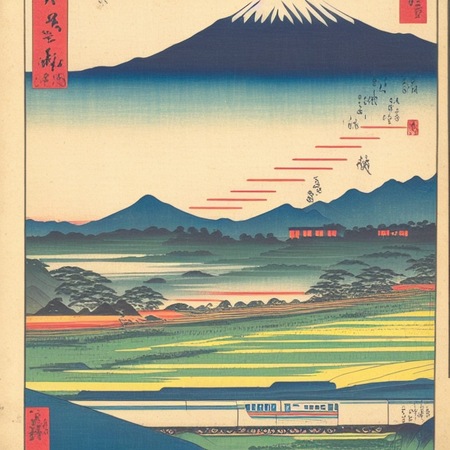
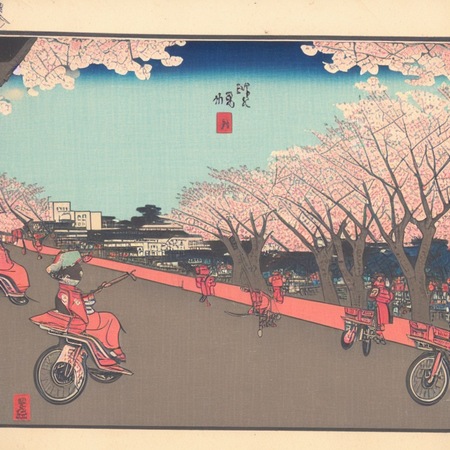
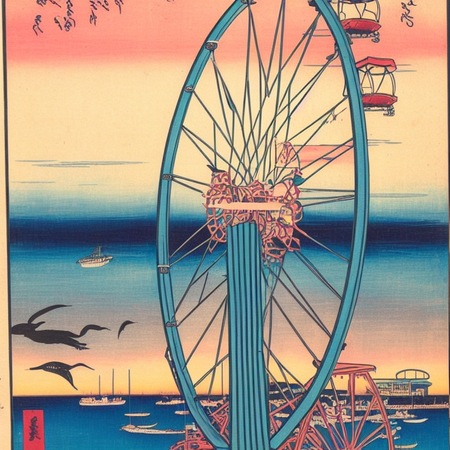
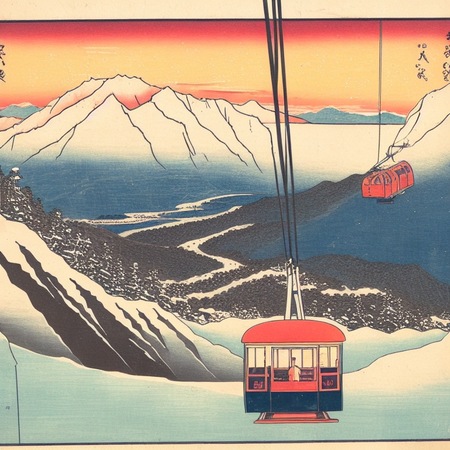
18 images, 768×768, generated by a trained neural network. Nothing was manually added.
SUMMARY
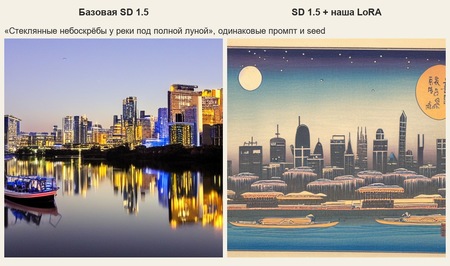
What worked well: Like Hiroshige, the focus of the series is not on people, but on the settings, transportation, and weather. The neural network successfully absorbed his techniques: — The blue or red strip of sky at the top, which lightens toward the horizon; — His palette: blue water, subdued greens, pink sunsets, and paper beige; — Rain rendered in thin lines and snow in white dots; — Flat color with outlines instead of shadows; — A large object in the foreground, such as a Ferris wheel; — Signage with text and what resembles the artist’s seal in the corner.
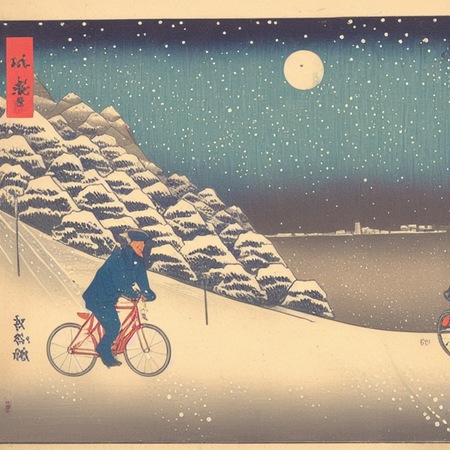
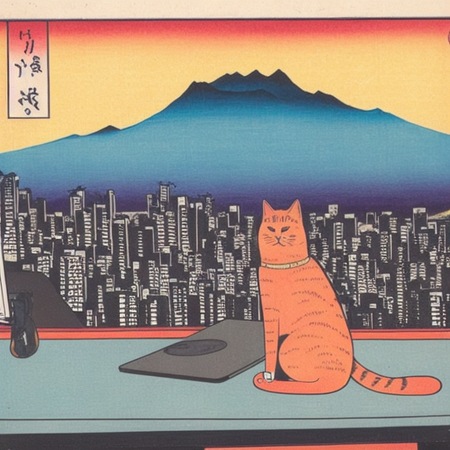
Some images directly echo the woodblock prints. The courier in the snow resembles «Evening Snow in Kanbara, ” and the cat by the window sits like the cat in Asakusa.
What worked less well: — The text is artificial: the neural network cannot write kanji, and the letters on the signs devolve into nonsense. — The faces and hands of the small figures are overly simplified. — Modern elements look somewhat antiquated: the airplane ended up biplane-style, and the cars looked like toys. — The neural network has a tendency to add Mount Fuji and the moon even when not asked to. — 36 images are few, so toward the end of training, the model began to memorize individual prints. For instance, the train in the rain occasionally transforms into a copy of „Sudden Downpour“: the train becomes very small, and umbrellas become the central focus of the frame.
Did it match the concept? Overall, yes. All 18 images look like a series by a single artist, despite featuring subways, skyscrapers, and neon lights. The style holds up whether it’s a close-up of the cat or a panorama of the port, meaning the neural network learned the specific manner. The modernity comes across as somewhat „aged, ” but it almost suits the concept.
How the data was prepared: The images were cropped into squares and downscaled to 512×512. Furthermore, every image was used in mirrored form—a total of 72 examples.
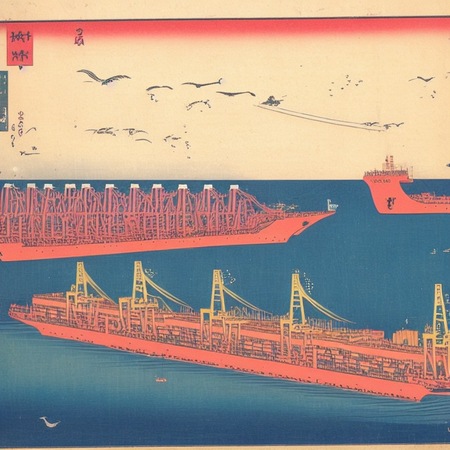
How the images were generated: The prompt was: „hrsgstyle, a delivery courier riding a bicycle through a snowy city street at night.“ Two variations were created for each scene, and the best one was included in the series. To make the pictures sharper, we used hires fix: first, the image was drawn at 512×512, then upscaled to 768×768, and passed through the neural network one more time. Image 34 clearly shows how the cranes and ships become sharp after this process.
Comparison with a standard neural network