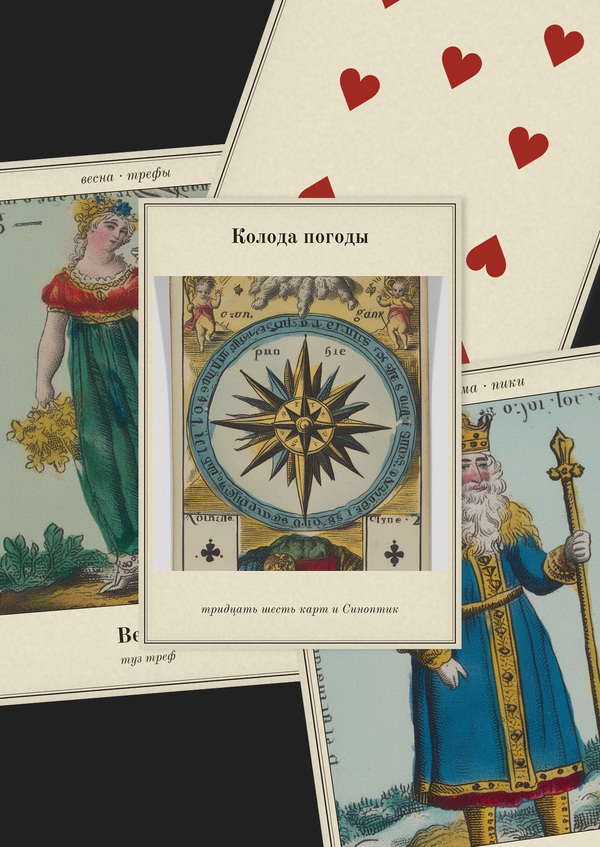
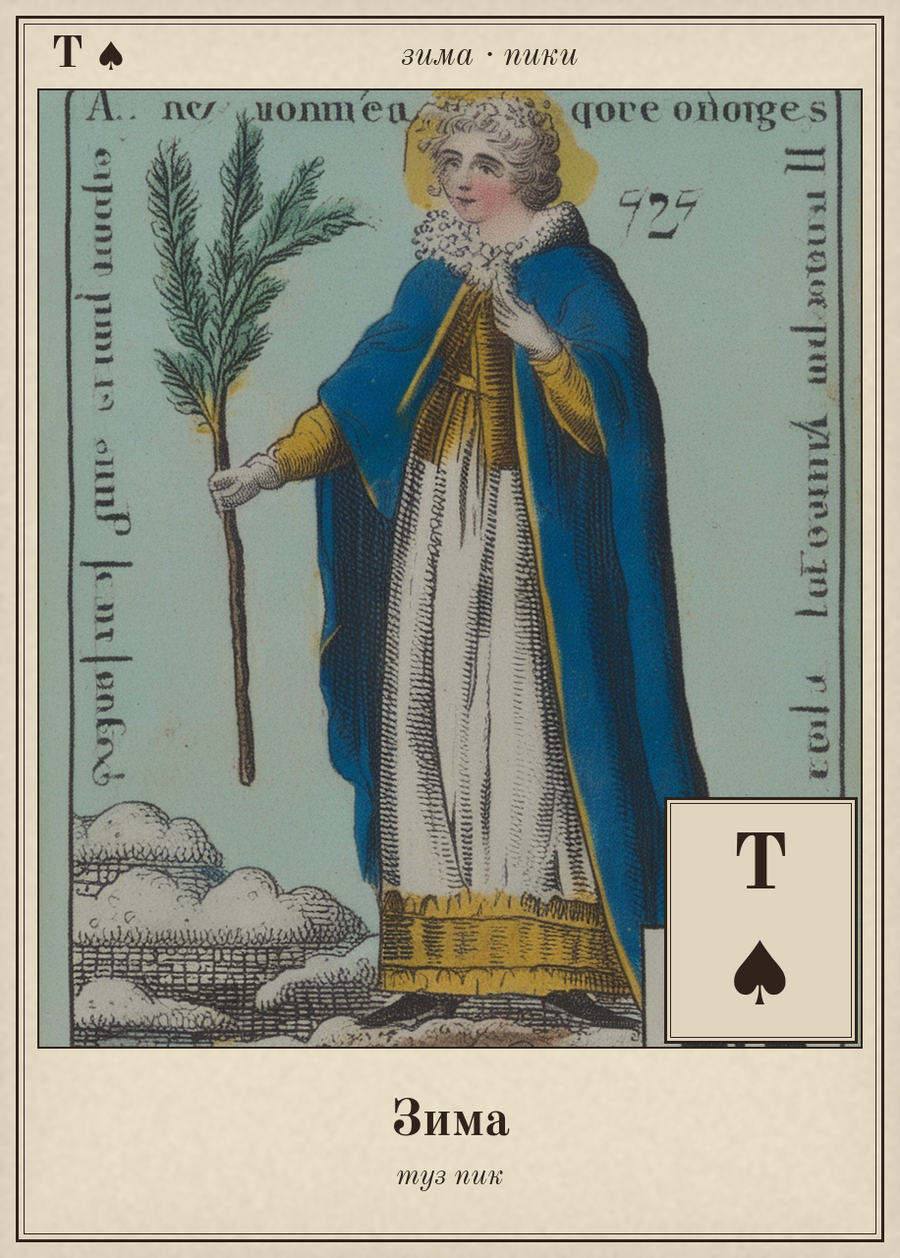
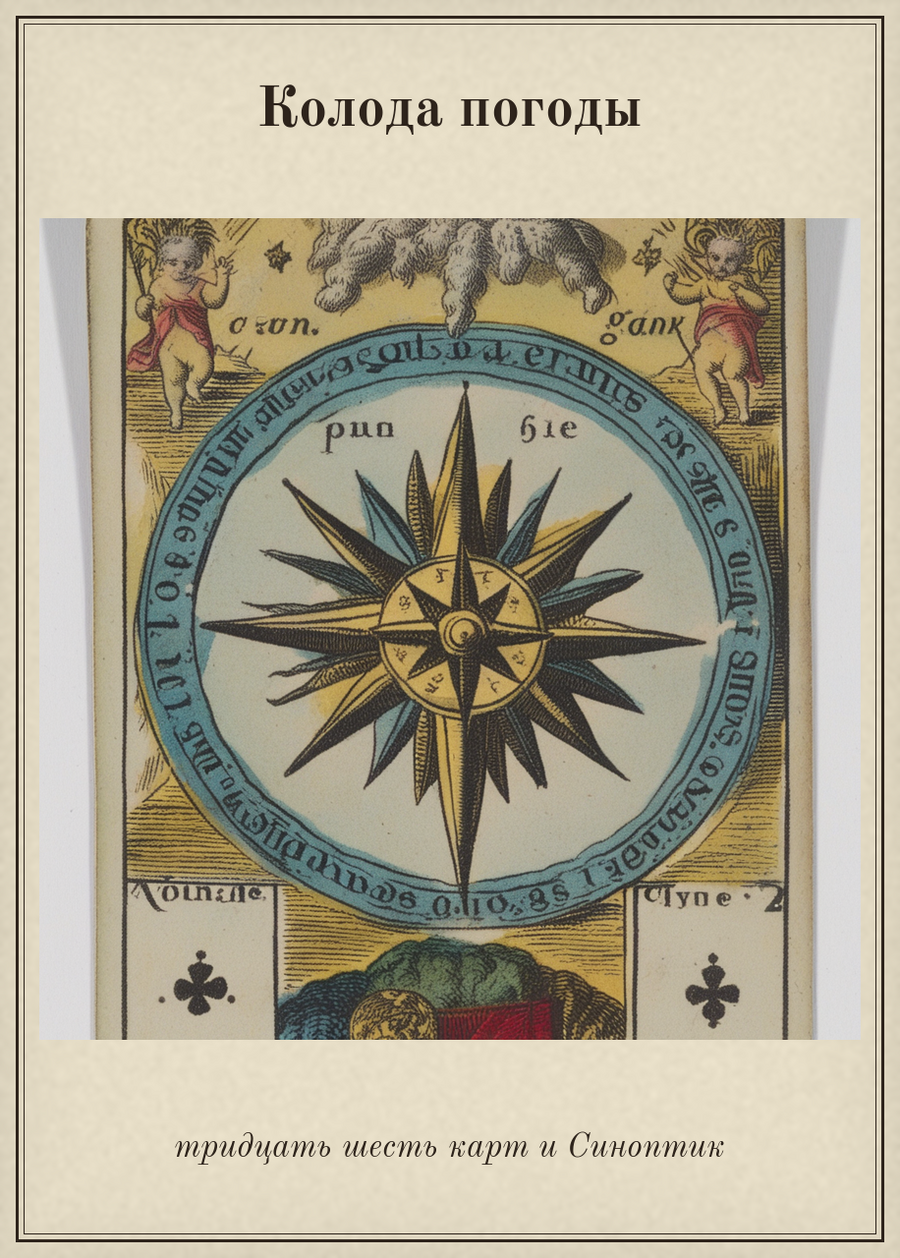
Thirty-six playing cards where the suits represent the seasons and the kings, queens, and jacks represent the weather: Frost, Blizzard, Drip, Thunderstorm, Leaf Fall. The figures were illustrated by Stable Diffusion XL, which was trained on fifty hand-colored cards from the late 18th-century Metropolitan Museum.
Concept
Playing cards were almost always slightly larger than the game itself. In the 18th century in France, decks were printed that taught geography, the history of kings, and mythology. Such a card functioned simultaneously as an illustration, a short encyclopedic article, and a gaming object: the top featured an allegorical image or portrait, while the bottom contained a condensed explanatory text. Therefore, French playing cards can be viewed simultaneously as an early form of visual infographic, a «pocket knowledge base, ” and an object bearing a symbolic reading of fate.
The generative deck references the historical multifaceted nature of maps, where they were used for more than just entertainment.The suit is not merely an icon. Each has its own season and weather:Spades — winter Clubs — spring Hearts — summer Diamonds — autumn
Material Selection
The model studied two French decks from the late 18th century from the Metropolitan Museum of Art’s open collection. «Jeu d’Or»: a pale turquoise sky, a full-length figure on a green mound, a question at the top, answers on the sides, and the country name at the bottom. «Costumes des Peuples Étrangers»: the same genre, warmer paper, and in addition to costumes, there are allegories. Justice with scales and Victory with a laurel wreath float on gray clouds. This image was taken as the inspiration for the aces.The technique for both is the same: etching, which was later hand-colored with stenciled watercolor. From this came the main stylistic characteristics the model needed to learn:— fine cross-hatching in the shadows; — bright, open colors (orange, blue, yellow, green) that are applied unevenly over the hatching and often bleed outside the contour; — the figure stands on a small, grassy mound with almost empty sky around it; — handwritten lines along the edges and a small border with the suit in the lower right corner.
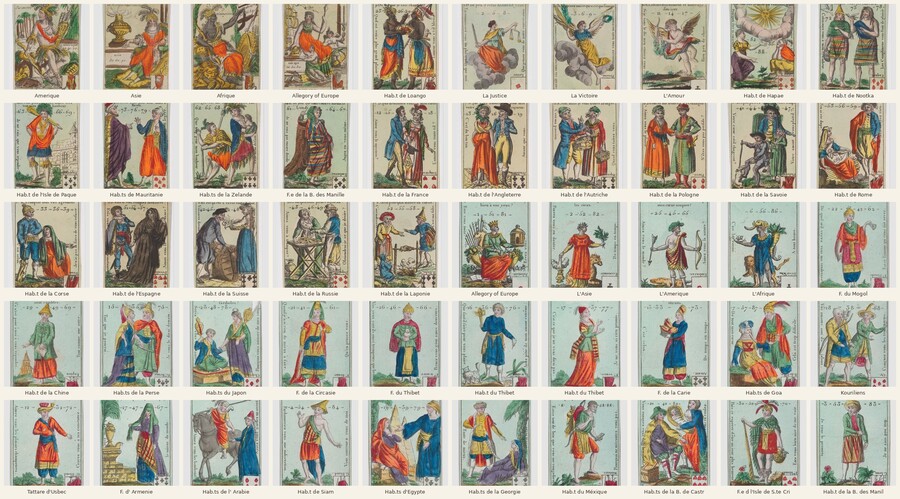
Captions. Each card is hand-captioned: who is depicted, what they are wearing, and what they are holding. At the beginning of each caption is the trigger crdz and a description of the technique; at the end of the line are the borders and the suit pattern:
«crdz, a hand-coloured etching on an antique French playing card, a woman in a long purple gown and a green veil beside a golden urn on a stone pedestal, a palm tree, handwritten French words along the borders, a small suit box in the lower corner»
The captions divide the artwork: anything mentioned in words (outfit, pose, objects) can later be changed by the model using a prompt. What is not named—namely, the etching itself, the watercolor, the paper, and the border—will be linked to the word crdz.
Model Training
Model: Stable Diffusion XL 1.0.Method: DoRA (Weight-Decomposed Low-Rank Adaptation), LoRA variant.<emDoRA first decomposes the weight into two parts: length and direction. The direction is learned through the same LoRA, while the length is learned via a separate vector—one value per output layer.
How the model learned to draw. Already after 300 steps, a turquoise sky and borders appear—these are the most noticeable and most recurring elements in the dataset. By 600 steps, a frame with a crest in the corner appears. Between 900 and 1500 steps, the image barely changes; only the faces and crosshatching are refined. In Valet Komar’s image at 300 steps, real mosquitoes are flying nearby, but by 900 steps, they disappear, and instead, Valet grows wings and antennae. The model stops drawing the weather around the character and begins drawing it on the character itself.
Final Portfolio
The figures were generated entirely by the neural network: the person, the costume, the landscape, the sky, the border lines, and the corner frame. Everything else was assembled by the script tools/make_deck.py: the paper, the double border, the corner index, the figure title, the large suit frame overlaid on the image, the arrangement of icons on number cards, and the omens. The Old Standard TT font was designed based on 19th-century Russian book typography and pairs well with old engravings.
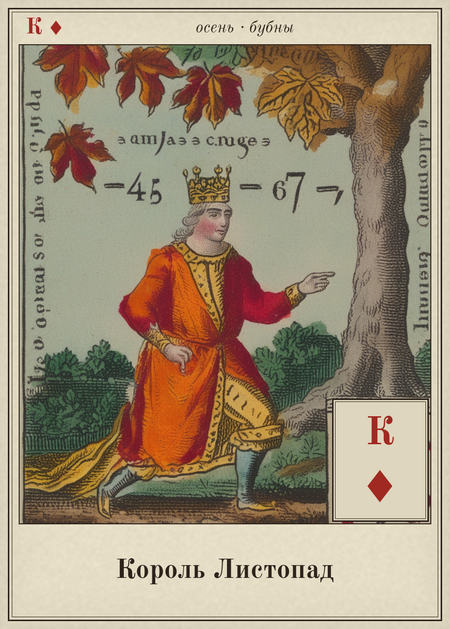
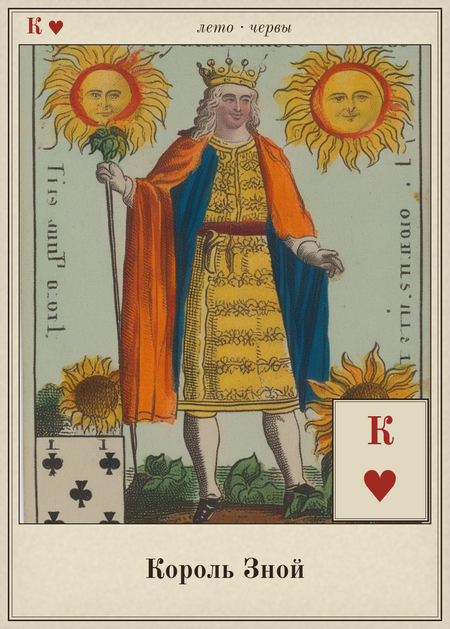
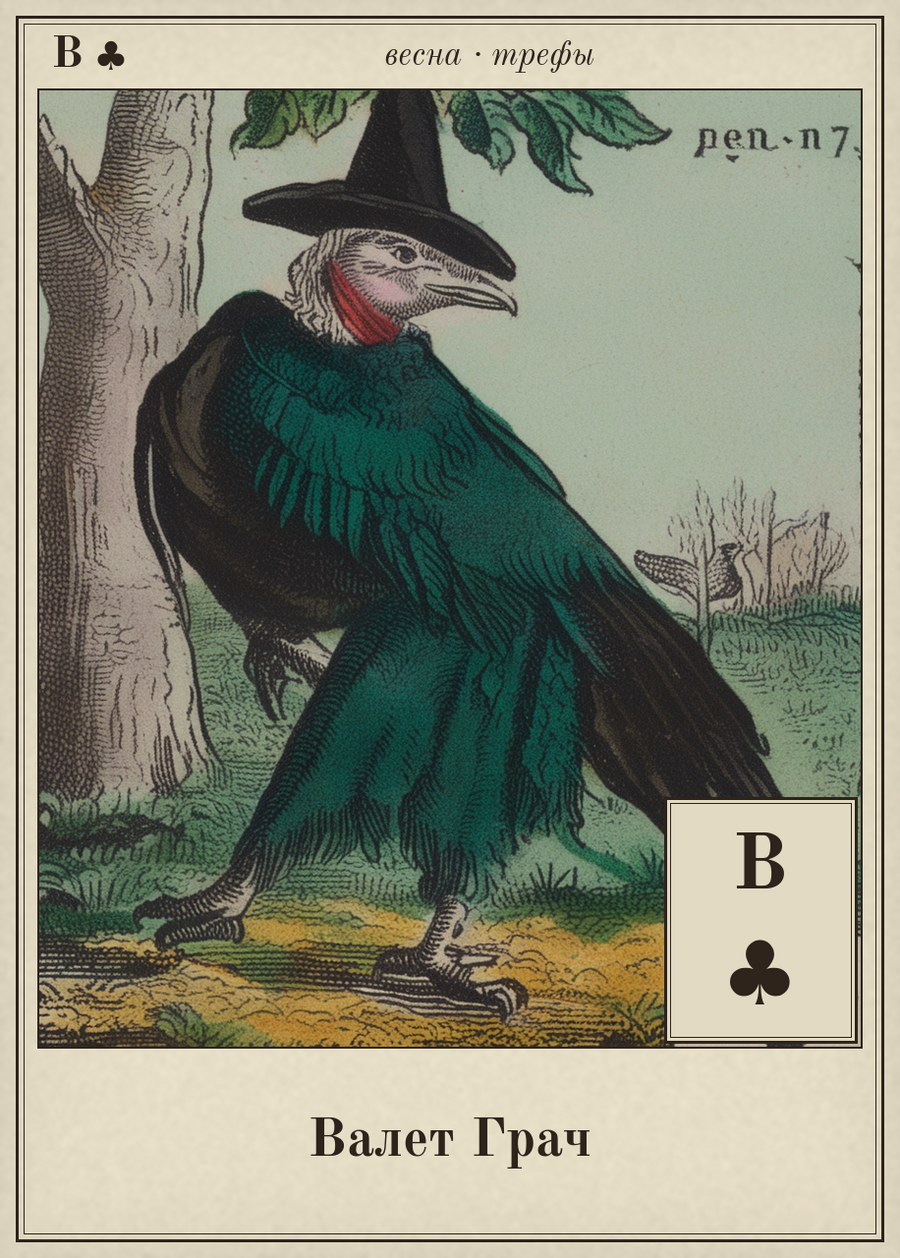
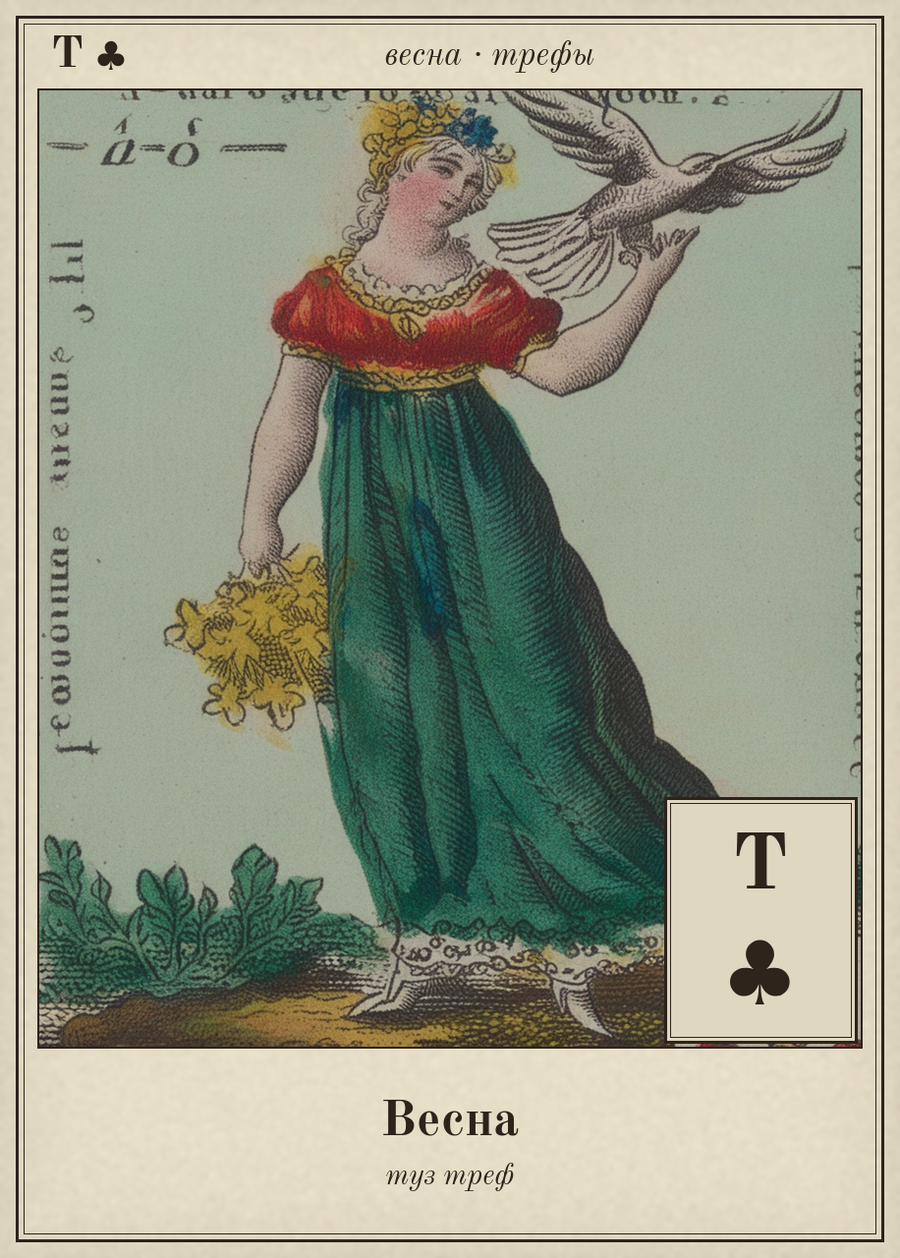
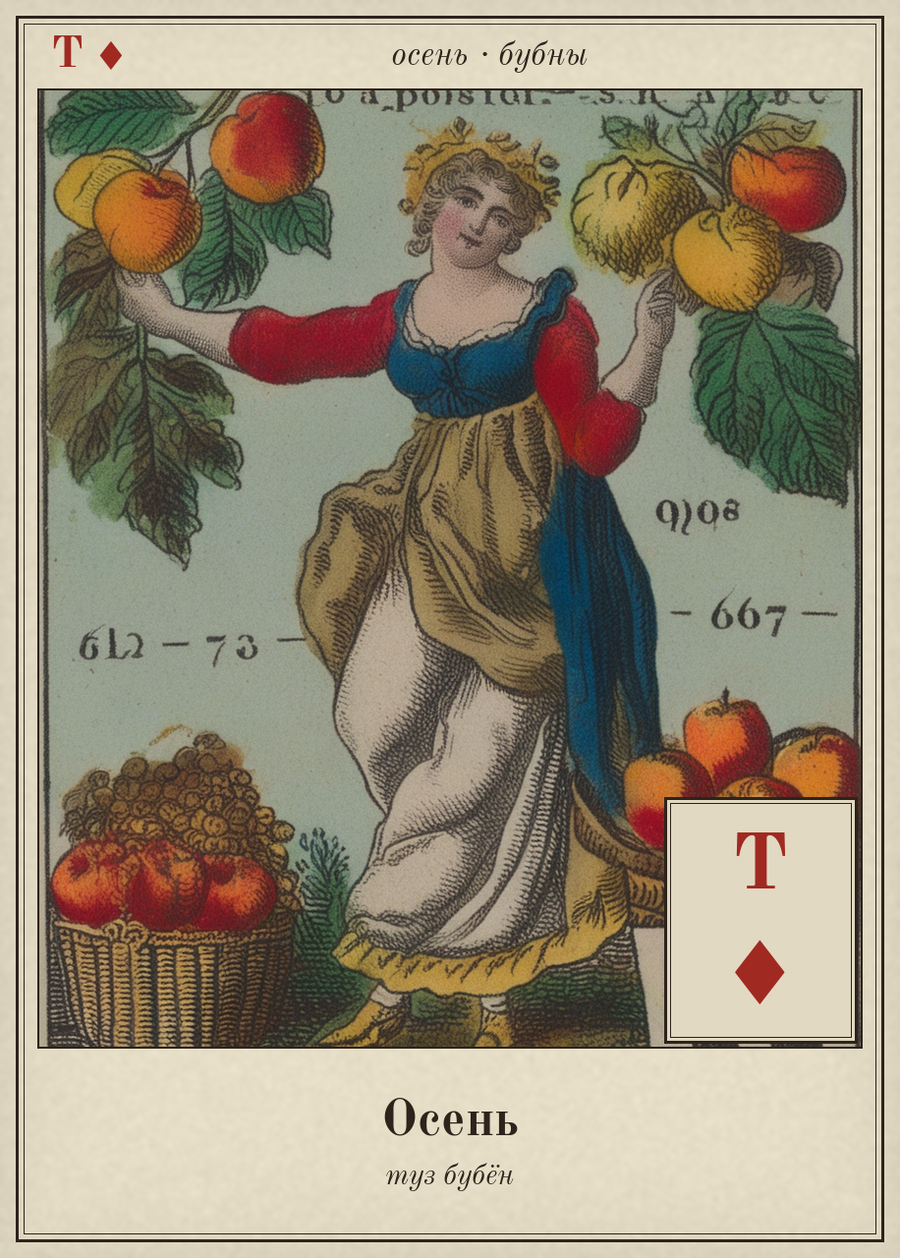
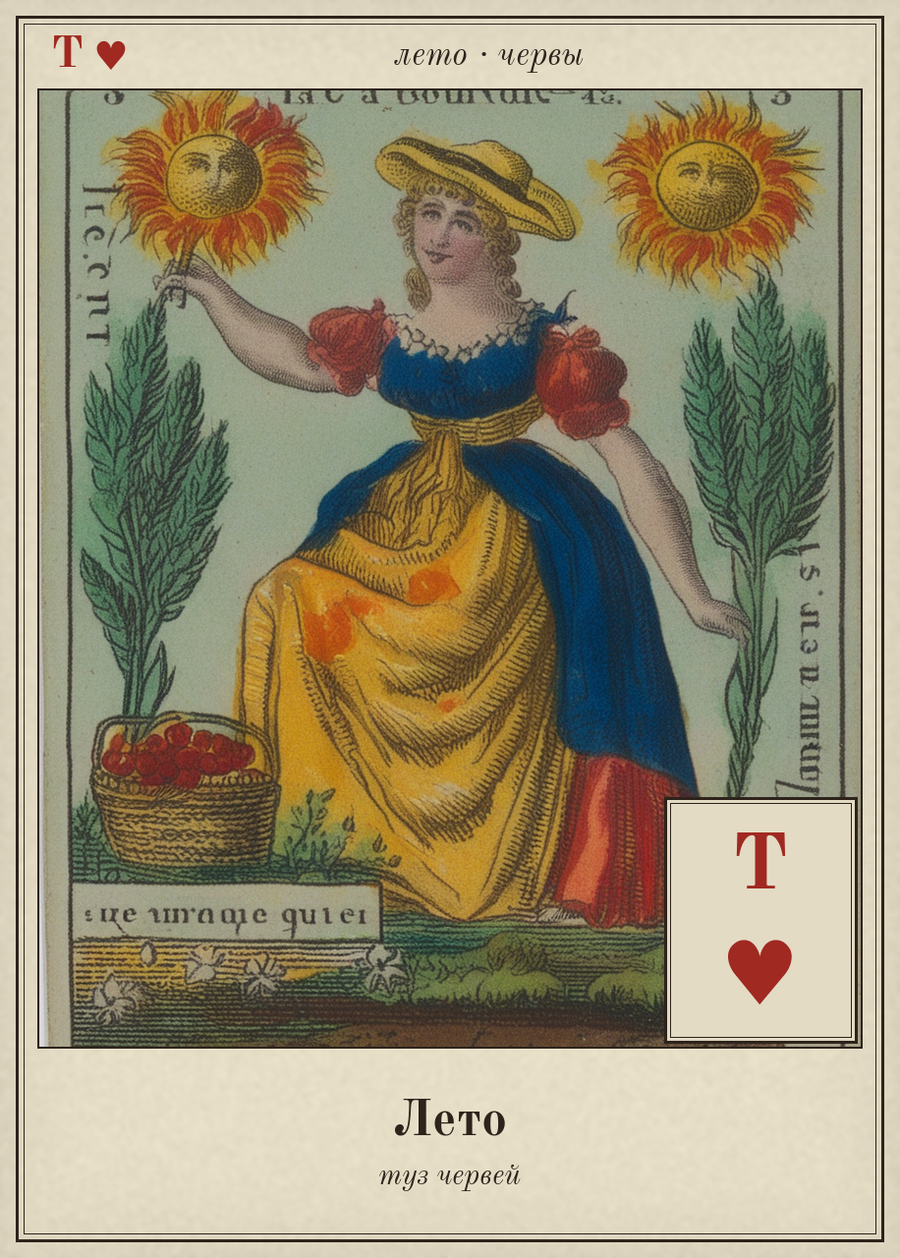
The prompt is structured the same way for all figures:«crdz, a hand-coloured etching on an antique French playing card,
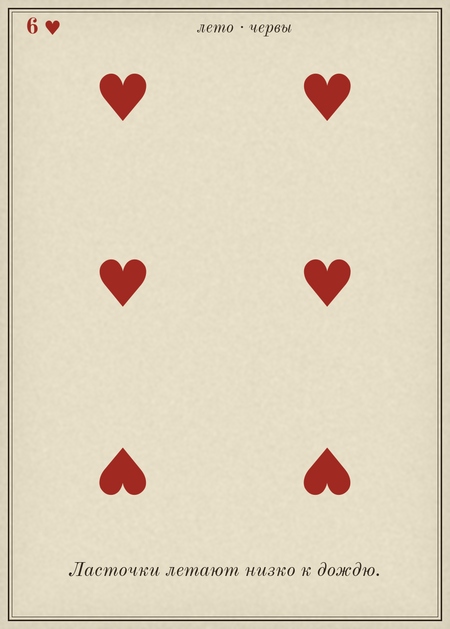
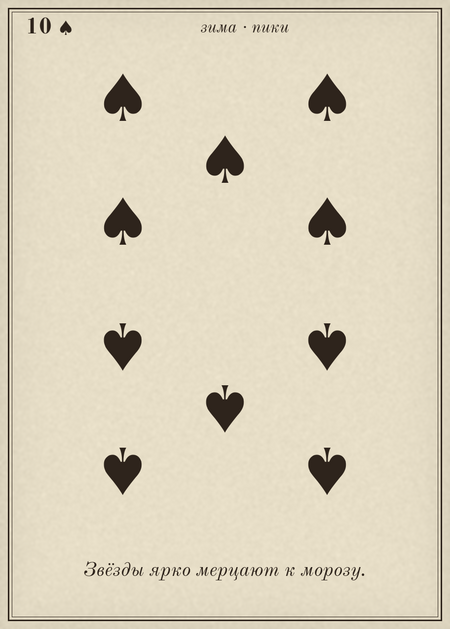
This is a standard 36-card deck. You can play games like «Fool,» «I Believe, I Don’t Believe,» or solitaire with it. The meteorologist acts as a joker. You can also play a game suggested by the deck itself:
“The Forecast.» For two or more players. The meteorologist is set aside, and the remaining cards are shuffled.
Every evening, one player draws a card without looking and places it face down.
The other players take turns predicting tomorrow’s weather: snow, rain, clear skies, or heat.
In the morning, the card is turned over. The suit indicates the season, and the figure or emblem suggests the weather. The King of Heat signifies hot weather, the Queen of Mist suggests rain, and «Thick smoke for frost» indicates frost.
The player whose forecast matches the card earns one point. The player whose forecast matches the actual weather outside earns a second point.
If both the card and the actual weather outside match, the player who drew the card takes the meteorologist, and their forecast for the following day counts as two points.
Comparison
The model was able to reproduce the style and structure of the deck quite in-depth, however:
— Suits. The model learned that card corners sometimes feature a suit border, but it doesn’t understand which suit is required: the King of Venom has trumps in the corner, while other figures have random hearts.
— Letters. The script along the edges resembles French calligraphy, but it is illegible—it’s simply the shape of the words. The actual Russian text is added by a script.
— Aces on clouds. I envisioned the aces floating on clouds, like Justice and Victory in the «Costumes» deck. Clouds only appeared for Winter. Out of the entire sample, there are only a few allegories compared to forty earthly costumes, and the model places almost all of them on the ground.
— Repeating costume. A blue cloak over a yellow or white dress, and a crown for the kings. This is the same costume from «Jeu d’Or, ” and the model applies it to half the figures. They differ mainly in the objects they hold and what is around them.
Code and Data
— notebooks/01_dataset.ipynb: map table, museum data loading, image map search, squares, captions, control sheets.
— notebooks/02_train.ipynb: training DoRA using the official diffusers script with one modification, loss function.
— notebooks/03_figures.ipynb: generating all figures, comparison with the untrained model, training stages, LoRA strength.
— tools/met_cards.py: searching for playing cards in the Metropolitan Museum’s public API.
— tools/make_deck.py: laying out the deck and files for printing.
— tools/fonts/: Old Standard TT font and its license (SIL Open Font License).
— data/selection.json: 50 sample cards: museum number, deck, date, technique, link, caption.
— data/sources.csv: source, license, and size of each dataset image.
— data/train_config.json: all training parameters.
— data/figures.json: eighteen figures and their prompts.
— data/log.json, data/chosen.json: prompts and parameters for all 108 variations and the final selection.
— lora/final/: DoRA weights (91 MB).
Sources
- The Metropolitan Museum of Art. Open Access and Collection API. https://metmuseum.github.io
- The Metropolitan Museum of Art. Playing cards «Jeu d’Or» and «Costumes des Peuples Étrangers», France, 18th century. Department of Drawings and Prints. https://www.metmuseum.org/art/collection
- Liu S.-Y. et al. DoRA: Weight-Decomposed Low-Rank Adaptation. 2024. arXiv: 2402.09353.
- Hu E. J. et al. LoRA: Low-Rank Adaptation of Large Language Models. 2021. arXiv: 2106.09685.
- Podell D. et al. SDXL: Improving Latent Diffusion Models for High-Resolution Image Synthesis. 2023. arXiv: 2307.01952.
- Hang T. et al. Efficient Diffusion Training via Min-SNR Weighting Strategy. 2023. arXiv: 2303.09556.
- Old Standard TT. The Old Standard Project Authors, SIL Open Font License 1.1. https://github.com/googlefonts/OldStandardTT