Research Concept
When we visit a museum, we rarely stop to consider why specific works are displayed there or who selected them. Usually, we perceive a museum as a place that stores and shows art. But in reality, how we perceive the art and the significance we attach to it are largely determined by the selection of works and their arrangement.
I became interested in the fact that some contemporary artists have begun to critique museums themselves. Moreover, they do this not only through texts or political statements but also through their artwork. They have rearranged the conventional display of objects, used archival photographs, created posters based on famous paintings, and even turned exhibition visitors into participants in their pieces.
My choice of topic was influenced by Hito Steyerl’s article, «The Politics of Art: Contemporary Art and the Transition to Post-Democracy» (2010). In it, the author suggests paying attention not only to what art communicates but also to how the art world itself is structured. After all, museums and galleries are also connected to money, power, and politics. I wanted to see how artists illustrate these connections using visual techniques.
Therefore, I decided to investigate how the meaning of a familiar image or object can be transformed when placed in a different context. For instance, a standard museum display case can tell a story about complex historical events. A famous painting can become a political poster if just a few details are altered.
For this study, I chose the works of Hans Haacke, Guerrilla Girls, and Fred Wilson. These artists use diverse methods of engaging with images, but they are united by a shared interest in how art institutions operate. Their work belongs to the practice of institutional critique, where the object of focus is not just the art itself, but the system in which it exists.
The primary principle guiding material selection was the potential for comparison.
I analyze pairs and groups of images. For instance, I might first present an original Engraving, followed by a poster by the Guerrilla Girls based on it. After that, I compare a standard museum exhibition of silver with a display by Fred Wilson. These examples illustrate how artists shift our perception of familiar forms.I have divided my research into four sections. The first is dedicated to the transformation of a known artistic image. The second examines how the arrangement of objects in a museum influences their meaning. The third section focuses on photographs and documents that are elevated to the status of artwork. In the final part, I investigate how the artist utilizes the museum space itself and engages the viewer in their work.In preparing this study, I consulted articles by Hito Steyerl, materials from art museums, and the archives of the artworks themselves. It was important to find information regarding the works' creation. This helps in understanding exactly what the artist intended to convey and why they chose a specific manner of presenting the material. My main focus is on composition, color, object placement, labeling, and how the images interact with one another.
My research question is: how do artists use familiar imagery and conventional museum display methods to critique the art system itself?
I believe that changing the context can completely alter our perception of a work. Sometimes, this doesn’t even require creating a new object. It is enough to change its environment, add text, or place it next to another item. In that case, the viewer begins to notice what they previously overlooked.
I am also interested in why this kind of critique arises specifically within museums. It seems that artists use the system’s inherent capacities to comment on its shortcomings. I want to understand how this contradiction manifests visually and which artistic techniques prove to be particularly expressive.
In this study, photography and imagery serve as the primary material, while text helps explain my observations. By comparing the works, I will attempt to demonstrate that sometimes it is not the object itself, but the way it is presented, that compels us to see an entirely different meaning.
How to alter the meaning of a famous painting?
To begin, I decided to compare two works separated by nearly 175 years. One is a famous 19th-century painting, and the other is a poster created based on it.
In Enger’s painting, we see a nude woman reclining on luxurious fabrics. Her body is depicted with flowing lines, and the composition itself conveys a sense of serenity. The woman turns toward the viewer and looks over her shoulder.The Guerrilla Girls maintain the recognizable pose and most of the figure, but they replace the woman’s head with a gorilla mask. The painterly background is replaced by a bright yellow field, and beside it, there is large black text displaying statistics. Comparison of Details The pose hardly changes; instead of idealized beauty, a frightening mask appears, and the soft tones of the painting are substituted with a stark yellow background. This introduces a question that shifts the image’s meaning.The poster presents the results of a count conducted by the Guerrilla Girls in 1989: fewer than 5% of the artists in the relevant sections of the Metropolitan Museum were women, even though 85% of the nude figures depicted were female. This is historical data from the group itself, not the museum’s current statistics.I believe the most compelling element here is the change in the viewer’s role. If Enger’s painting invites us to view the female figure as an artistic representation, the poster compels us to consider why women are so often present in art as depicted subjects rather than as creators.
How does the placement of objects change their meaning?
For this next comparison, I selected two museum exhibitions featuring silverwork. I was interested in exploring how similar objects can be presented in different ways and how their surrounding context influences perception.
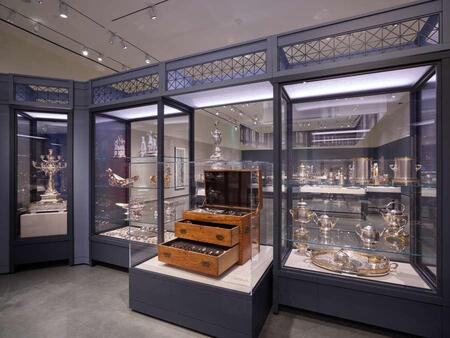
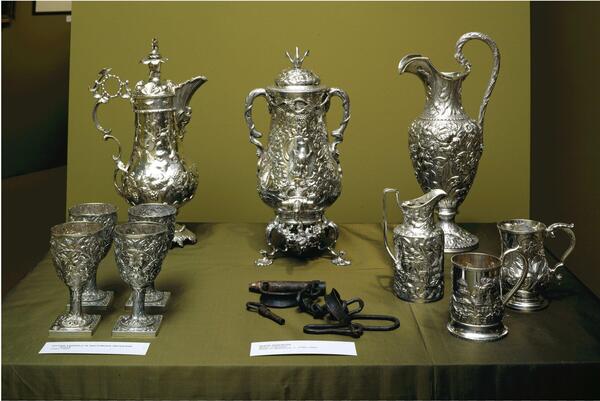
RISD Museum. Gorham Silver: Designing Brilliance 1850–1970, 2019 Fred Wilson. Metalwork, 1793–1880, part of the Mining the Museum project, 1992–1993
What does this mean?
In the first photograph, silver artifacts are neatly displayed in glass cases. They are well-lit, and space has been left between the pieces. In this kind of exhibition, the viewer’s attention is immediately drawn to the form, material, and craftsmanship.In the second photograph, we also see expensive silver tableware. However, next to it are iron shackles used to restrain enslaved people.This juxtaposition changes our perception. We are no longer simply looking at beautiful antique objects; we begin to contemplate how wealth and luxury can be linked to violence and inequality.The placement of the shackles is particularly striking. They lie directly in front of the silver vessels. The contrast between the gleaming decorative surfaces and the dark iron is clearly visible in the photograph.The artist barely alters the objects themselves. He simply connects things that we are not accustomed to seeing together.
My conclusion is that a museum exhibition itself has the power to influence the meaning of objects. By changing their placement, an artist can tell an entirely different story.
How to transform the spectator into a participant in the artwork?
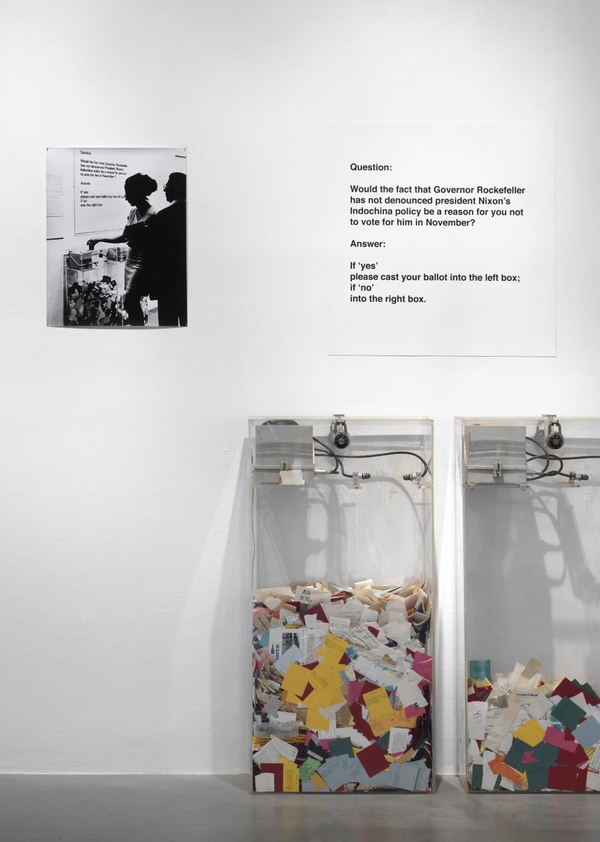
In the final section, I examined Hans Haacke. Here, the artist uses an unconventional voting technique.
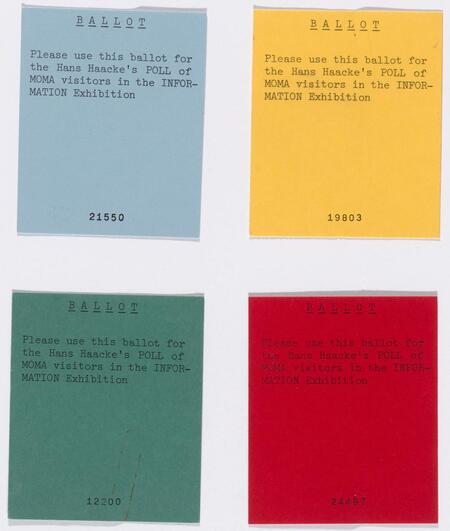
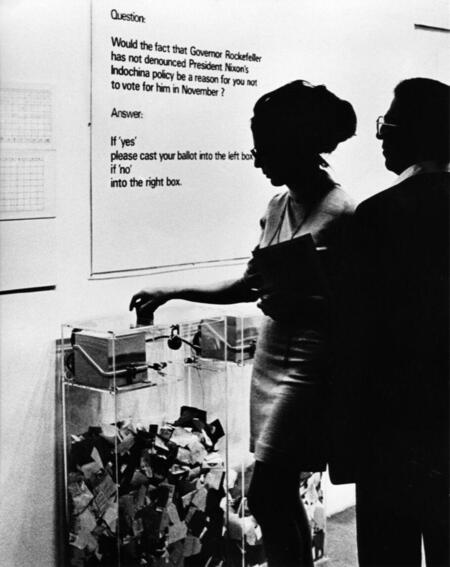
Hans Haacke. Bulletins for MoMA Poll, 1970 Hans Haacke. MoMA Poll, 1970. Documentary photography of viewers at the installation
In 1970, Haack installed two transparent display cases at MoMA and asked visitors to answer a political question. The question concerned Nelson Rockefeller, who was connected to the museum, and his stance on U.S. politics in Indochina.
What becomes art here?
The first photograph shows small, colored ballots. They look like ordinary voting slips.In the second, we see a visitor dropping a ballot into a clear box. At this moment, the viewer ceases to be a mere observer and becomes a participant in the work.
Hans Haacke. MoMA Poll, 1970. Re-exhibited at the New Museum, 2019. Photo: Dario Lasagni.
When viewed as a whole installation, it appears very simple: two boxes, text on the wall, and colored papers. However, the transparent walls allow viewers to see the accumulated responses of other people. As a result, the political opinion of the visitors takes on a tangible form. Individual ballots transform into noticeable masses of color. I find it particularly interesting that the artist does not provide a ready-made answer to the question. Instead, they create a situation in which visitors must express their own opinions. My conclusion is that museum space can become not only a place for exhibiting artworks but also a space for discussing political issues.
Conclusion
At the beginning of this research, I was interested in understanding how artists can critique museums using conventional methods of presenting art. After examining these works, I concluded that even subtle shifts can completely alter our perception of a piece. I find it compelling that for criticism, artists don’t always need to create something entirely new. Sometimes, simply changing the context, adding text, or suggesting an alternative way for the viewer to interact with familiar objects is sufficient. Thus, my hypothesis was confirmed: the method of presentation can change a work’s meaning and compel the viewer to notice what they hadn’t considered before.
Sources
Steyerl, H. Art Politics: Contemporary Art and the Transition to Post-Democracy. 2010. Russian translation in Spectate.The Metropolitan Museum of Art. Do Women Have To Be Naked To Get Into the Met. Museum. Museum Catalog.Guerrilla Girls. Naked Through the Ages. Artistic Collective Website.Maryland Center for History and Culture. Mining the Museum: Metalwork, 1793–1880.The Museum of Modern Art. Information Streams. History of the Information Exhibition, 1970. MoMA Archives.