«To be on the path is to be in a space where old rules no longer apply, but new ones have not yet been written.»
Concept
The concept of «liminality» was originally introduced by anthropologist Arnold van Gennep in his work Rites of Passage (1909). It referred to the obligatory intermediate phase (threshold) within ritual rites of passage, such as weddings, funerals, and births [1]. Later, Victor Turner, in The Ritual Process: Structure and Anti-structure (1969), expanded the concept of liminality to mean a state of transition where familiar social distinctions and status differences temporarily lose their stability. Turner also broadened the understanding of liminality, viewing it not only as an intermediary phase moving from one stable state to another, but also as a relatively autonomous state that can become permanent under certain social and cultural conditions [2].
In contemporary visual culture, the concept of liminality has acquired an additional dimension: everyday familiar spaces—empty hospital hallways, office buildings, hotels, playgrounds—are now described as liminal. Due to various reasons—particularly their unfamiliar emptiness—these spaces can evoke feelings of alienation, uncertainty, or anxiety in individuals [3].
In my view, not every familiar space that evokes anxiety due to its emptiness can be called liminal. In this study, I examine liminal space primarily as a transitional and in-between condition, focusing specifically on its visual structure and the techniques employed by auteur animation directors in their work. I am interested in how this feeling arises specifically within auteur animation, where space can not only accompany the action but also independently participate in developing the narrative. Episodes are particularly compelling where the protagonist’s usual movement or presence takes on the character of an indefinite transition. For example, a train might continue moving, yet the journey ceases to feel like a path toward a specific destination; a familiar room might retain its architecture but lose its sense of belonging or its customary connection to the outside world.
In auteur animation, such states can be expressed in various ways: the protagonist may become an observer of the surrounding world, become alienated from it, engage in opposition with it, or, conversely, be perceived as an extension of it. It is particularly interesting that the space is capable of developing the narrative even in the absence of overt action—through composition, light, color, shifts in scale, repetition of architectural elements, movement dynamics, or the passage of time.
The core research question is: by what visual and temporal mechanisms does auteur animation generate a sense of spatial in-betweenness, and what role does this state play in the narrative and the relationship between the character and the environment?
The central research question is how the author’s animation constructs a sense of spatial liminality through visual and temporal mechanisms, and what role this state plays in the narrative and the relationship between the character and the environment.
The research hypothesis posits that liminality in authorial animation does not arise from isolated visual techniques, but rather from how these techniques alter the perception of familiar space within the context of a specific scene. Emptiness, architectural repetition, framing, perspective, scale shifts, lighting, or temporal organization can evoke feelings of transition, anticipation, alienation, or disorientation, yet they do not possess inherent liminal meaning on their own. The same technique can elicit vastly different sensations depending on where the character is located, how they act, and how the space relates to the events unfolding.
It is hypothesized that this resulting state of uncertainty can become an independent dramatic device that influences the nature of the action and the development of the episode.
The primary research method is the visual analysis of spatial episodes within original animation, followed by a comparison of the identified artistic choices. The visual material was selected primarily from works in which a state of transition, uncertainty, or being «in between» finds spatial expression. I am interested in both films entirely structured around such a state, as well as individual episodes where this state becomes significant to the character’s position or the narrative development. In each episode, I first focus on the narrative context: what states the character finds themselves between, what the uncertainty of their position entails, and what role the surrounding environment plays in this. Subsequently, I investigate how this state is visually expressed through composition, scale, perspective, spatial boundaries, color, light, movement, and temporal organization. The material is organized into chapters based on which aspect of spatial in-betweenness the specific episode reveals.
Comparing frames allows us to see what artistic decisions different directors use to express similar states, and why the same visual technique in different works can take on a different meaning. The study also includes isolated examples where visual characteristics typical of liminal spaces are present, but the state of in-betweenness itself is not obvious. Examining these allows for a more precise determination of the conditions under which emptiness, architectural repetition, or unconventional organization of time acquires liminal significance.
Of particular interest is how the state of in-betweenness is expressed depending on the animation technique: the materiality of puppet space, the convention of drawn imagery, digital geometry, or collage texture. When analyzing movement, duration, and spatial transformation, individual frames are examined within the context of the corresponding animation episodes.
This research is directly connected to the development of my original animated film, «Freedom,» in which a character navigates an empty school environment. The classrooms, corridors, stairwells, gymnasium, and courtyard remain recognizable, yet they gradually lose their familiar spatial logic, connecting not through architectural means, but through an associative poetic principle. The practical outcome of this research will be a set of spatial and compositional solutions that can be utilized when working on my own animated film.
The Space of Indeterminate Transition
Not every path is liminal. A liminal reading arises when arrival does not resolve the hero’s previous state or when the meaning of the goal itself proves unstable.
Cat Soup: A Journey Between Life and Death
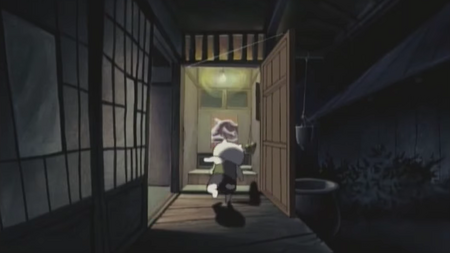
In «Cat Soup» (Tatsuo Sato, 2001), Nyatta attempts to recover the lost half of his sister’s soul. The animation begins and ends inside the house. A key dramatic feature of the cartoon is that the characters' journey is ultimately meaningless. Navigating the troubles does not transform the characters—upon returning home, they remain exactly as they were before leaving. Later, the house itself vanishes, underscoring the narrative’s triviality and artificiality. This story of a liminal passage is repeatedly emphasized throughout the animation through several visual elements related to the depiction of space and the characters' placement within it.
Roads That Go Nowhere
Uniform, hazy, almost faceless empty landscapes, with roads leading unidirectionally toward the horizon. The earth almost merges with the sky—there is no end to the journey.
2. The Eternal End of the Journey
In many shots, the characters are initially placed on the horizon line—they are almost always situated between worlds, which further emphasizes the futility of the journey.
3. A Journey Without End or Boundary
I specifically highlighted several frames where the characters travel across a static setting—where the horizon, between the earth and the sky, offers virtually no discernible color palette difference.
4. Path Staticity
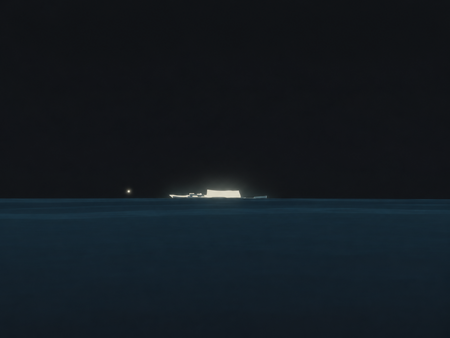
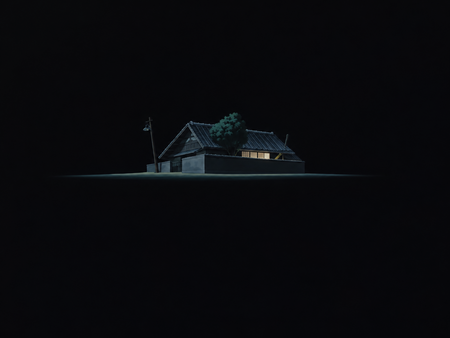
On the first slide, we see a boat upon which the cartoon characters navigate the ocean, seemingly frozen in darkness. Even though, formally, in relation to the plot, this is a journey, much like the previous shots showing the characters' paths on land, we feel that they are not actually going anywhere—the path leads nowhere.The second frame is compositionally similar to the first—it is a house, the starting and final point of the journey, suspended in darkness, which, in truth, has no meaning or connection to the surrounding reality.
5. Repeating shots of a path receding into the distance
Leading lines draw the protagonist further into the distance. The sheer length of the path in the frame is so elongated that we begin to anticipate a long journey—a journey with no end.
6. The highlighting of light on dark surfaces as a transitional state of estrangement
The contrast between light and dark is practically the only visual contrast we observe throughout the animated film. It begins when the protagonist senses something is wrong with his sister, and it also foreshadows the journey. However, this space is also liminal and anxious.
7. Distortion of normal space perspective