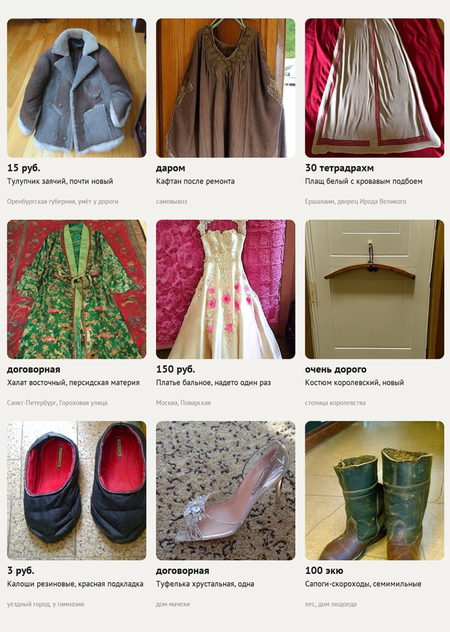
In Russian classics, clothing often functions as a narrative element. Gogol dedicated an entire novella to a single greatcoat—people save for it, sew it, wear it for one evening, and then lose it. Oblomov’s robe becomes almost a character in its own right. Raskolnikov understands that his hat could expose him. Chekhov’s Belikov hides from the world in rubber boots and covers. In these texts, an object speaks more about the owner than a portrait does.
Today, objects have another way to tell a story about their owner: a sales listing. A photo hanging on a hook by the door or on a blanket; the price; a couple of lines describing the condition: «worn by one owner, ” „worn once, ” „negotiable.“ The background, the lighting, and the phrasing easily paint a picture of both the apartment and the person selling it.
Technically, the project is structured as follows: 142 frames were selected from an open dataset of clothing photographs, LoRA was trained on them for Stable Diffusion 1.5 using the trigger nsl photo, and then twelve images were generated based on prompts compiled from book details. The listing cards were built using a script. From there, everything proceeds in order, divided into sections, similar to a product page: listings, buyer photos, specifications, reviews, and questions for the seller.
The project merges two genres. The reader is familiar with the characters from the books, but their belongings are presented as if they were being sold today: under domestic lighting, on the entryway floor, with an honest description of any flaws. The ad copy is drawn from the details within the works themselves: the collar of the greatcoat is described as «one could always mistake it for a sable, ” Oblomov’s dressing gown is listed as „without brushes, without velvet, without a waist, ” Raskolnikov’s hat is deemed too noticeable, and the fur coat from Capitana Dochka was valued by Savelyich at fifteen rubles.
Twelve cards organized into three sections on the board. The photographs were generated, and the announcement texts were written based on details from books; the cards were structured using the script tools/make_cards.py. Below each card is the source from which the item was taken.
Announcements
Twelve cards are presented across three board sections. The photographs were generated, and the announcement texts were drafted based on details from the books. The cards were assembled using the script tools/make_cards.py. Below each card is the source from which the item was taken.
Outerwear
N. V. Gogol, «The Overcoat, ” 1842: „…instead, they chose a cat—the finest one available at the shop, a cat that could always be mistaken for a marten.“
A. S. Pushkin, «The Captain’s Daughter,» 1836.
I. A. Krylov, «Trishkin’s Coat,» 1815: «On Trishkin’s elbows, the coat has worn through.»
M. A. Bulgakov, «The Master and Margarita, ” 1929–1940: „In a white cloak with a bloody trim, with a shuffling cavalry gait…“
Costumes and Dresses
N. V. Gogol, «Dead Souls,» 1842.
I. A. Goncharov, «Oblomov,» 1859: «…without brushes, without velvet, without a waist, quite roomy, so much so that Oblomov could wrap himself in it twice.»
L. N. Tolstoy, «War and Peace, ” 1867–1869: „…in white smoky dresses on pink silk covers, with roses in the corset.“
H. C. Andersen, «The Queen’s New Dress,» 1837.
Footwear and Hats
Fyodor Dostoevsky, «Crime and Punishment,» 1866: «…a high, round Zimmermann hat, but entirely worn out, completely reddish, full of holes and stains, with no brim and severely buckled to one side.»
Anton Chekhov, «The Man in a Suit,» 1898: «…even in very good weather, he went out in rubber boots with an umbrella and invariably in a warm padded coat.»
Perr, «Cinderella, or The Crystal Slipper,» 1697.
H. Perr, «The Boy with the Thumb, ” 1697.
Customer Photos. Where is the dataset from?
The model was trained on the open Clothing dataset, compiled by Alexey Grigoriev in 2020: 5,403 photographs of clothing across twenty categories. Approximately three thousand images were collected with the help of Tagias.com, while the remaining photos were submitted by 32 individuals via an open form. Each person photographed their own items in various home settings—on a bed, on the floor, or hanging on a door hook. The dataset is released into the public domain under the CC0 1.0 license and is permitted for any use, including model training: https://www.kaggle.com/datasets/agrigorev/clothing-dataset-full
24 frames from the training set
For this project, this is the ideal material: not a catalog, nor is it a high-fashion shoot, but specifically how people photograph items they intend to sell or give away. Different lighting, different phones, rugs, blankets, entryway tiles, parquet flooring.
Genre Filter
The three categories («Not sure, ” „Other, ” „Skip“) were immediately excluded. The model CLIP ViT-L/14 (OpenAI) evaluated the remaining 5,096 photographs by comparing each image against ten descriptions. The descriptions included four belonging to the desired genre („amateur photo of items on the floor, ” „on the bed, ” „on the door hanger, ” „used item for sale at home“) and six belonging to unrelated genres („person in clothes, ” „studio shoot on a white background, ” „dark blurry shot, ” „close-up of fabric, ” „pile of items, ” „mannequin“). The proportion of these four „correct“ descriptions constitutes the genre rating.
Almost the entire dataset was already domestic: only 167 images failed the 0.6 threshold, mostly studio shots of shoes and items held in hands. Another 57 frames were too small (less than 600 pixels on the shortest side), and 20% of the least sharp images were removed from each category. This leaves 3,890 photographs.