Lev at the Threshold: Plasticity and Function of the Zoomorphic Motif in Romanesque Sculpture and Fresco of the 12th–13th Centuries
Contents:
Concept, key question, hypothesis
Principle of material selection and principle of categorization
Chapter 1. The Wall: A Lion at the Threshold
Chapter 2. The Support: A Lion Under Load
Chapter 3. Small Forms: A Lion in the Knot
Chapter 4. Where the Scheme Fails
Conclusion
Bibliography and Image Sources
Concept
In a Romanesque church from the 12th to early 13th century, the image is clearly linked to the space: the stone and fresco do not merely, or even primarily, decorate the building; they perform a specific function—framing the entrance, supporting the weight of architectural elements, or filling a capital. Furthermore, the term «threshold» here refers not only to the exterior door of the church but also to any boundary within it—from the portal and entry into the nave to the nodes that separate the lay space from the cloister or choir.
The lion is the most frequent animal in Romanesque plastic art, making it an excellent subject to demonstrate how architecture influences form. Lions are usually interpreted through symbolism (a guardian at the threshold, the king of beasts, or perhaps the image of Christ or the devil), but this doesn’t always answer why one image receives various plastic treatments. At the doorway, the lion stands and gazes; beneath a column, it is compressed; on a pillar, it coils and attacks.
This theme allows one to view renowned monuments (such as those in Moussac, Verona, Modena, or Leone) not as isolated masterpieces, but as key points within a broader compositional logic, and to demonstrate lesser-known examples (from Sulillac, San Quirico d’Orcia, Foischy, or Chauvigny) as confirmation.
The Key Question
To what extent is the form of the Romanesque lion determined by its symbolic meaning or by the architectural function of the space?
Hypothesis
The animal’s form is determined by its placement. The stricter the frame and the more significant the element’s structural role, the more static and symmetrical the beast becomes (a guardian at the doorway, a lion-support). The more compact the architectural part (console, capital, column), the more tightly coiled and compressed its body is, and the more frequently the theme of devouring appears. The semantic component and symbolism explain why the lion is needed in the temple space, but not how it looks.
Material Selection Principle:
I selected sculpture and monumental painting from Western Europe spanning the 12th to early 13th centuries (Spain, Italy, France),
where the lion is the central subject and its placement within the architecture is clear. Two types of materials were used: canonical monuments
(Arlanz, León, Verona, Modena, Muassisac), which establish the standard, and lesser-known works (Suliac, San Quirico d’Orcia, Foixha,
Chovigny), which allow for testing that standard.
Principle of Categorization: The main principle of division is the image’s placement within the structure of the temple: 1) wall (lion at the threshold), 2) support (lion under architectural load), 3) minor forms (corbel, capital, column). The fourth chapter presents isolated instances where the scheme does not apply, yet these exceptions can, in a sense, also confirm the general hypothesis. In all chapters, the lions are compared using the same criteria: silhouette, posture, jaws and gaze, scale, and relationship to the frame.
Chapter 1. The Wall: A Lion at the Threshold
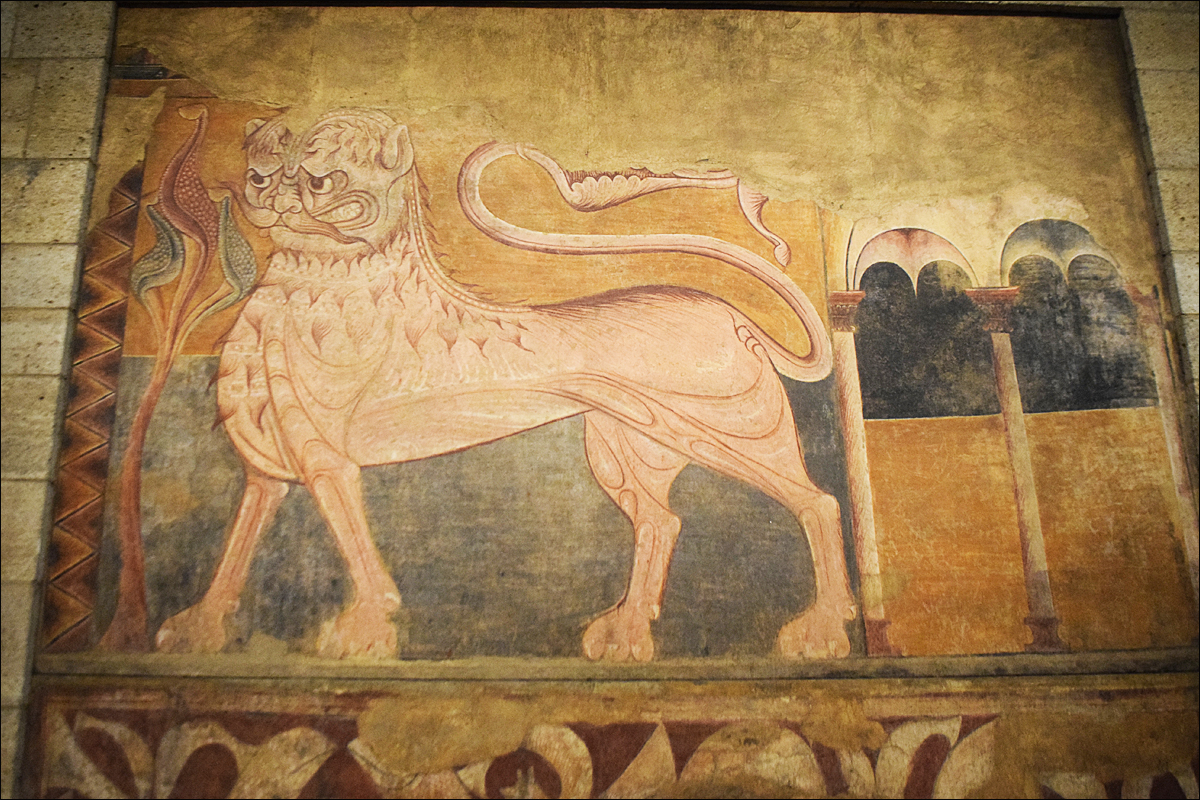
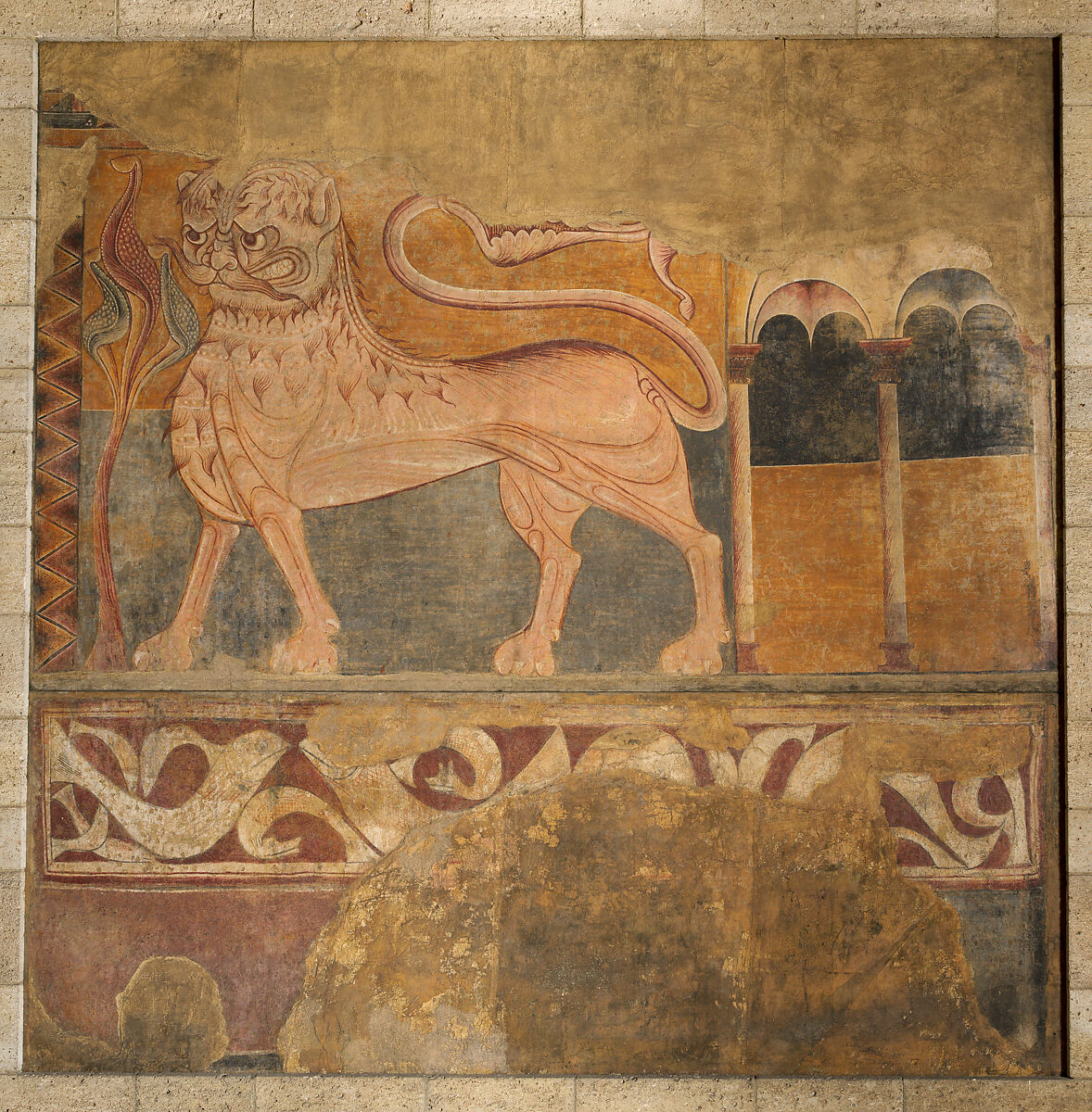
Unknown Master / Leo / after 1200. Fresco (transferred to canvas), Monastery of San Pedro de Arlanza, Castile–Leon. The Met Cloisters.
This lion is part of a pair of animals that framed the doorway on the upper floor of the chapter house of the Benedictine monastery of San Pedro de Arlanz (Castile–León, Spain; currently held in the Cloisters collection of the Metropolitan Museum of Art). The lions were placed symmetrically, facing each other, framing the threshold not of the main church, but of the enclosed monastic space. The fresco depicts tense musculature, a tousled mane, and a penetrating gaze. The primary compositional principle is pairing and symmetry: the animal is not moving; it is frozen in the active stance of a guard protecting the entrance.
Unknown Master / Lev / after 1200 / Fragment
The image of the guard becomes clearer when the snout is enlarged, especially the gaze and the snarl. According to museum researchers, the lion has a face almost like that of a stern, mustachioed man. Here, it is presented not as a leisurely «king of beasts, ” but as a vigilant sentinel: anthropomorphic eyes and bared teeth create the feeling that the animal is intently watching everyone who enters the door.
The «Lamb’s Gate» Portal (Puerta del Cordero), Basilica of San Isidoro, León (Spain)
The same principle of paired threshold guardianship, as seen in the fresco from San Pedro de Arlanzón, is evident in the stone relief on the southern portal of the «Gates of the Lamb» basilica of San Isidoro in León (Northern Spain). Two symmetrical lions are embedded in the wall plane on either side of the tympanum, directly above the entrance to the sanctuary. Although the material shifted from paint to stone, the function of the location remained the same—to mark the boundary of sacred space. Therefore, the beasts once again freeze in strict heraldic symmetry, asserting the inviolability of the entrance.
Conclusion: The lion guardian is positioned around the doorway—paired symmetry and a watchful gaze are more important here than dynamism. The static form of the beast is defined by the wall and the entrance threshold.
Chapter 2. Support: The Lion Under Load
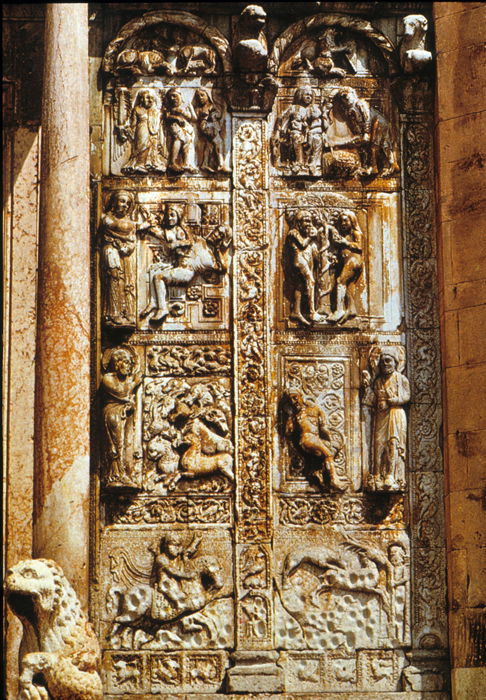
Nikolo Master (attribution) / West Portal of the Basilica di San Zeno, Verona / 1120–1178
On the western portal of the Basilica of San Zeno in Verona (Northern Italy), the lion no longer stands beside the door—it has been transformed into the base of the left column of the entrance portico (a lion-stilter, which is a sculptural representation of an animal serving as the base for a portal column). Its figure bears the vertical weight of the entire structure, while the griffin gripping a bird fulfills the same load-bearing role on the symmetrical right column. The lion ceases to be an independent image on the wall plane and becomes an integral part of the building’s architectural design.
Unknown master / Leo at the base of the column / late 12th century.
The lion’s body is literally pressed to the ground by the weight of the column. If you compare it to the guardian from the Arlansa Spanish monastery—where the animal’s figure is free from weight and full of internal tension—here it is the top load that defines the posture: its paws are spread wide, and its back is straightened beneath the base. Prey (presumably a lamb) is compressed between the lion’s front paws, but it is completely subservient to the horizontal plane of the pedestal.
Main portal of the Cathedral of Modena (Italy)
•Working official link: Official UNESCO World Heritage Site Portal
— Duomo di Modena and the Museum of Modena Cathedral (Musei del Duomo — the stilophor lions). High-quality photographs of the stilophor lions at the base of the portal columns are featured on both pages.
To ensure that the composition of the Basilica di San Zeno in Verona is not the random find of a single master, we turn to the portal of the cathedral in Modena (Emilia-Romagna, Italy). Here, the columns of the entrance porch also rest on the backs of powerful stone lions. The structural load dictates the same plasticity: the animals' paws press against the base slab, their necks are drawn into their shoulders, and their heads are oriented strictly along the entrance axis. Across Northern Italian cities, the same engineering challenge generates an identical form for the beast.
Unknown Master / Triumphal Arch of the Saint-Pierre Abbey Southern Portal, Muassak / c. 1115–1130
Unlike the examples in Verona and Modena, where the lion is laid flat beneath the column base, at the Abbey of Saint-Pierre in Muasson (Southern France), the animals are integrated into the very tympanum—the central vertical column that divides the wide entrance into two portals and supports the stone lintel of the portal. The narrow face of the column is filled with three pairs of male and female lions, crossed diagonally. The format of the support dictates a stretched, springing silhouette: the animals' paws and tails press against the boundaries of the relief and neighboring figures, creating a dense weave. The architectural element entirely subordinates itself to the anatomy of the predators—instead of an aggressive attack, we see a strict geometric rhythm, transforming the load-bearing column into ornament.
Unknown master / Lion and lioness on a chemise, Muassak / c. 1115–1130 / Fragment
In the close-up, the distinction between the maned male and the sleek female is clearly visible: the animals are presented strictly in pairs. However, their poses do not follow a narrative plot; rather, they adhere to the rhythm of the narrow, columnar space—the X-shaped diagonals of the bodies repeat three times from bottom to top. Here, the lion is no longer a guardian of the threshold or a hunter, but a living, constructive element that has become a relief.
Unknown Masters / Main Portal of the Collegiate Church of Santi-Cirico-e-Giulietta, San Cirico d’Orcia / 1186–1200
The Tuscan portal of the Santi Cirico e Giulietta collegiate church in San Quirico d’Orcia (Central Italy) repeats the formula found in Verona and Modena: the knotty columns of the portico rest on stylized lion bases, and the portal itself belongs to the Lombard tradition. The solution of using a «lion as a column base» proves to be a stable standard across various regions of Italy, rather than a localized quirk of a single master.