Scenography and costumes for a contemporary ballet production based on Shakespeare’s play, «A Midsummer Night’s Dream.»
The ballet «A Midsummer Night’s Dream» is like a «dream with a fever.» It is an absurdity that exists by its own rules—one that leaves the audience with a vivid impression, as if after waking up. It is the delirium of a sick mind.

Everything will unfold as it should. Humans do not command fate. There is a higher power that, by some unknowable means, resolves all matters—one to which we must place our trust. Just as we unconsciously find answers to our pressing questions in dreams, in life too, as soon as we let go, everything finds its own resolution.
Reality is illusory, shaped by perception, perspective, and irrational forces. There is no objective truth; what appears true is easily distorted. The world of the play is composed of several colliding and blending realms, leaving behind a sense of wonder and bewilderment.

Scenography
Everything that dreams has an origin. It does not arise out of nowhere. For the staging to feel like a dream, it must be placed within a context that is immediately recognizable to any viewer. Yet, since dreams are not reality, only suggestion remains.
falling asleep $\rightarrow$ sleep $\rightarrow$ waking up
Act I: Exposition, the palace in Athens (the main reception room of an old house)
Act II: Flight into the forest, the casting of spells, chaos and entanglement of feelings, the peak of nocturnal madness (false facade/veiling)
Act II: Dawn, the breaking of the spell, the couple’s reconciliation, and the grand celebration of three weddings (the interior of one apartment)
Act I
The entrance hall, where all the characters meet by chance. Everything that happens seems to exist in the space «between» events—it is a conflict, its genesis, but not yet its resolution, so the action is placed in a space that exists in the in-between.
Visually, the scene reflects a convoluted consciousness while simultaneously embodying the fragility and materiality of the real world.
Act II
There is an element of escape. In the original text, the characters secretly flee into the forest, but here the escape is into the street, where the houses are covered in false facades. The fabric motif resembles blankets and pillows that a person sees when waking up in the middle of the night and drifting back to sleep.
The second act scene serves as a metaphor for the consciousness shrouded in a veil.
During the scene with the fern flower, a red light turns on.
The actions of the second act are projected onto fabric to create a dreamlike sensation, where images blend and overlap.
Act III
In the third act, all conflicts are resolved, and the characters hold three weddings in quick succession. The action takes place in an old apartment. The projection serves as an homage to greeting cards, and the number of identical objects suggests a communal living arrangement where they multiply due to multiple occupants.
guests at weddings dressed as torso mannequins
Curtain
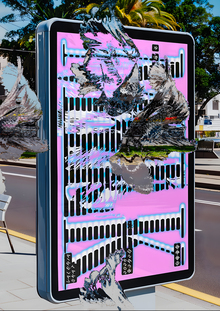
The curtain is an homage to the false facade; its design mimics the set pieces of the second act.