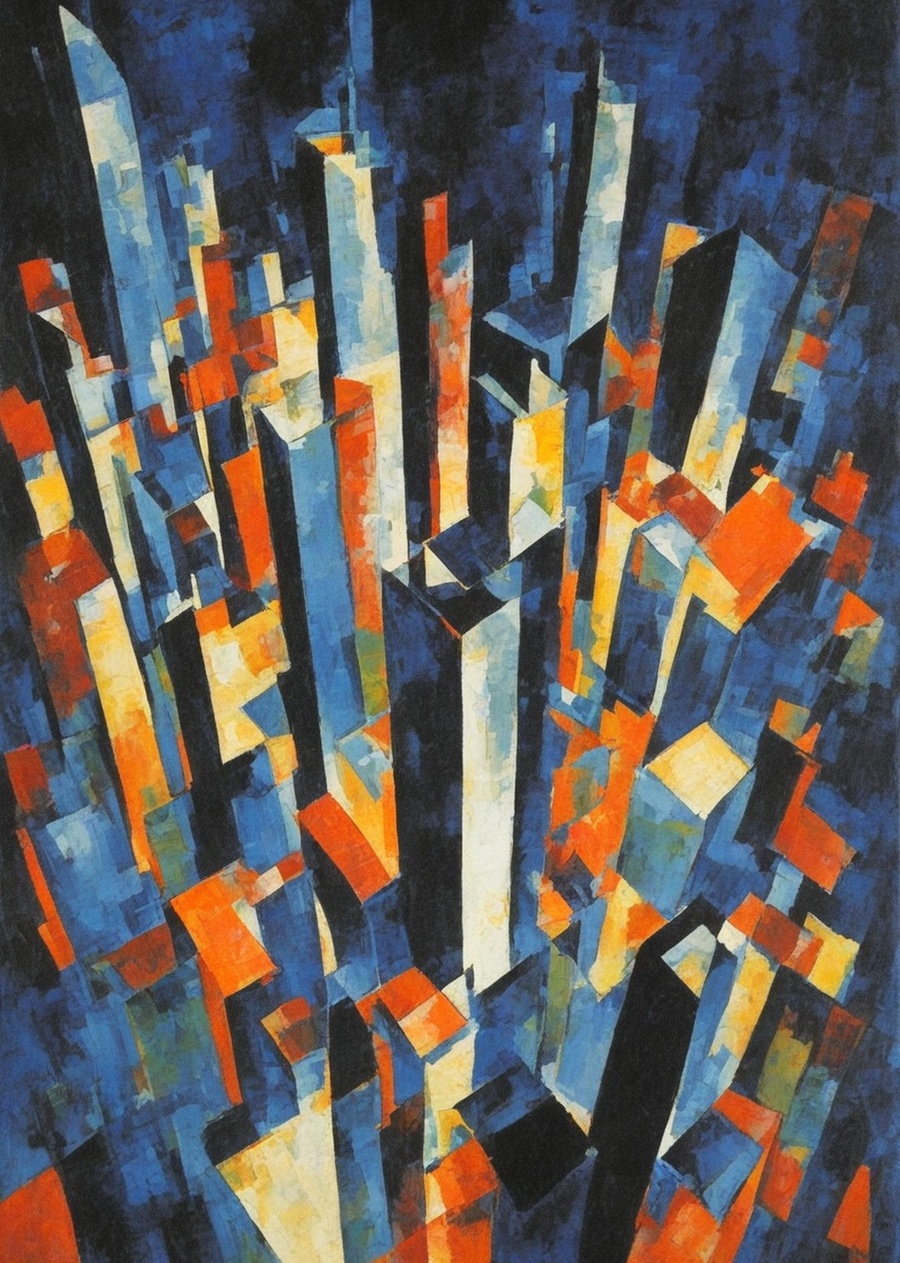
Suprematism of the 21st Century
A series of contemporary scenes generated using Stable Diffusion XL with a LoRA adapter trained on non-objective works by Malevich, Popova, Rozanova, and Liscitzky.
01 / Concept
What would our modern world look like if it were depicted by Suprematists?
In 1920, Casimir Malevich and his students formed the UNVIS group in Vitebsk—the «Proclaimers of New Art.» They believed that Suprematism was not just a painting style, but the language of the future: Suprematist squares and circles appeared on trams, billboards, fabrics, and grandstands, and El Lissitzky referred to his «Prouns» as a «transfer station from painting to architecture.»
The future they depicted has arrived, but it looks different. In this project, I have translated the visual language of Suprematism onto scenes of modern life: a person with a smartphone, a courier on an e-scooter, a co-working space, an airport, a wind farm, and a night cityscape. I chose Suprematism for its extremely clear language—flat colored shapes, diagonals, light backgrounds, and a limited palette—all of which an AI model can learn from a small dataset.
During the generation process, I discovered that the model approaches the subjects in vastly different ways. The courier on the scooter, the wind turbines, and the person with a smartphone remain recognizable, while the subway train, coffee cup, and crowd at a concert completely dissolve into non-objective geometry. The subject survives when it has its own clear silhouette—a wheel, a blade, the figure of a person—that can be constructed from flat shapes. The model, like the Suprematists themselves, considers everything else superfluous.
02 / Source Images
To train the model, I selected 87 works from four Russian avant-garde artists:
• Kazimir Malevich (1879–1935) — Suprematist compositions from 1915–1918, 29 works; • Lyubov Popova (1889–1924) — «pictorial architectonics» and «spatial-force constructions, ” 25 works; • Olga Rozanova (1886–1918) — non-objective compositions and „color painting, ” 16 works; • El Lissitzky (1890–1941) — „Prouns, ” 17 works.
From almost three hundred reproductions, I retained only non-objective geometric compositions. Figurative and Cubo-Futurist works, photographs of paintings in frames and exhibitions, black-and-white reproductions, duplicates, and nearly blank canvases, such as „White on White, ” were excluded. This selection maintains a unified visual language: flat colored shapes, diagonals, light backgrounds, and a palette of red, black, ochre, and blue.
The source for the reproductions is Wikimedia Commons. All four artists died more than 70 years ago, and their works are in the public domain; I only used files with a Public Domain status, excluding photographs of paintings taken by museum visitors under CC BY-SA licenses. A full list of the works with links is available in the project materials.
Below are six examples from the original selection. These show full reproductions; for learning purposes, I used square excerpts.
Kasimir Malevich. Suprematist Composition («Airplane Flying»). 1915
Kazimir Malevich. Pictorial realism of a footballer. Colorful masses in the fourth dimension. 1915
Lyubov Popova. Painterly Architecture. 1917
Lyubov Popova. Spatial-Force Composition. 1921
Olga Rozanova. Green Stripe (Color Painting). 1917
El Lissitzky. Proun 2C. 1920
03 / Training and Education
The model is trained on square images. For nearly square works, I cropped them to 1024×1024 pixels centered. For elongated works (aspect ratio greater than 1.3), I took two overlapping square fragments—one from each end—to prevent the composition from being lost, even though some parts inevitably fall outside the frame. Since five reproductions from Wikimedia Commons were unavailable, the training set included 82 pieces, resulting in a final selection of 118 square images.
Segments the model was trained on
For each image, the BLIP neural network automatically generated a caption describing the content («a painting of a red square and a black circle»), and I added the general tag suprematist painting in AVNGRD style. The word AVNGRD links the works in the collection under one identifier in the prompts. Everything mentioned in the caption is attributed by the model to the image content, and everything not mentioned—such as palette, texture, or composition characteristics—is attributed to the tag.
The training was conducted in Google Colab using a Tesla T4 GPU. I used Stable Diffusion XL Base 1.0 and the DreamBooth method with LoRA: a small adapter was trained for the UNet, while the core model and text encoders remained frozen. The prepared files were 1024 × 1024, but the training was executed at a 512 × 512 resolution—this allows SDXL to fit within the memory of the free GPU.
Program Parameters
The training progressed through 600 steps, with checkpoints saved every 200 steps. The steps themselves took about an hour, and with the model loading, the total time was 71 minutes. The first attempt stopped before training even began—Wikimedia Commons limits frequent requests, and downloading the dataset from Colab stretched over several hours. Therefore, I downloaded the reproductions in advance and uploaded them to Google Drive, from which the notebook accesses them.
04 / Final Series
For this series, I described ten contemporary themes and generated each one using two seed values—7 and 42—resulting in 20 images at 1024 × 1024. The prompt structure was consistent: the theme in English, followed by the marker «suprematist painting in AVNGRD style.» In the negative prompt, I excluded photography, blur, text, and captions. From these twenty variations, I selected six.
These pieces share a unifying aesthetic: flat shapes devoid of shadow or volume that hover against a warm, light background reminiscent of unprimed canvas, diagonal composition, and a palette featuring red, black, ochre, blue, and dark green. They differ in density and degree of objecthood: in some works, a few large forms are suspended in empty space, much like Malevich, while in others, the planes are fragmented and layered upon one another.
Person with a smartphone
The black human figure is composed of several rectangles: head, torso, and an bent arm. The smartphone itself is absent—instead, a cloud of red, blue, ochre, and green planes bursts upward and to the right of the person. This can easily be read as a stream of information from a screen, although it is more my interpretation: the model simply filled the space where a screen would have been in the photograph with Suprematist forms. There are almost no people in this selection, and the human has become a faceless silhouette—a form as flat as everything around it.
Courier
The narrative remains clearest: a courier in a helmet stands on an electric scooter, with the wheels and handlebars rendered as flat black shapes. The sensation of speed comes not from the figure itself, but from the background—red, blue, and ochre triangles and rectangles are scattering along the edges of the frame, twisted at various angles. If you look closely, the scooter has two handlebars: the model does not understand the object’s structure and constructs it from familiar parts.
Co-working
The co-working space is viewed from above: people seated on the light floor with laptops, and scattered among them are colored triangles and rhombuses. There are no walls or ceiling—the space is defined solely by the arrangement of the tables, and the top of the frame is closed off by large red, blue, and black planes. This is closer to Suprematist compositions, where figures float freely in white, rather than to Popova’s dense «architectonics.» The human figures are shown as black silhouettes; in some places, they merge with the chairs and tables.
Airport
A soaring airplane has transformed into a black cross: its long fuselage and the wing crossing it lie diagonally across the entire canvas, while another small plane hangs in the air to the left. This is the most «Malevichian» image in the series: the light background, the large green square, the red and ochre rectangles, and the diagonal are reminiscent of «Airplane Flies» from 1915, which was in the instructional selection. On this image, the boundary between style and imitation is clearly visible: the composition does not repeat any single work, yet it is very close to one of them.