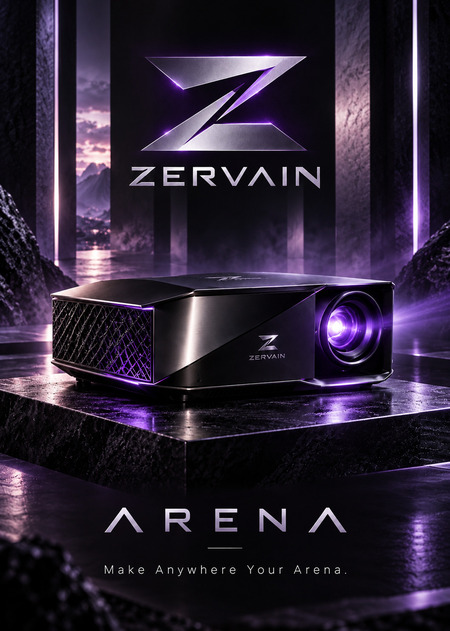
Description
ZERVAIN.A technological brand creating innovative devices for the gaming industry. The flagship product is ARENA, a portable gaming projector that transforms virtually any space into a full-fledged gaming arena. The brand merges advanced technology, high performance, and a premium, futuristic design, allowing gamers to enjoy a large-scale gaming experience without being tied to traditional screens or stationary gaming zones.
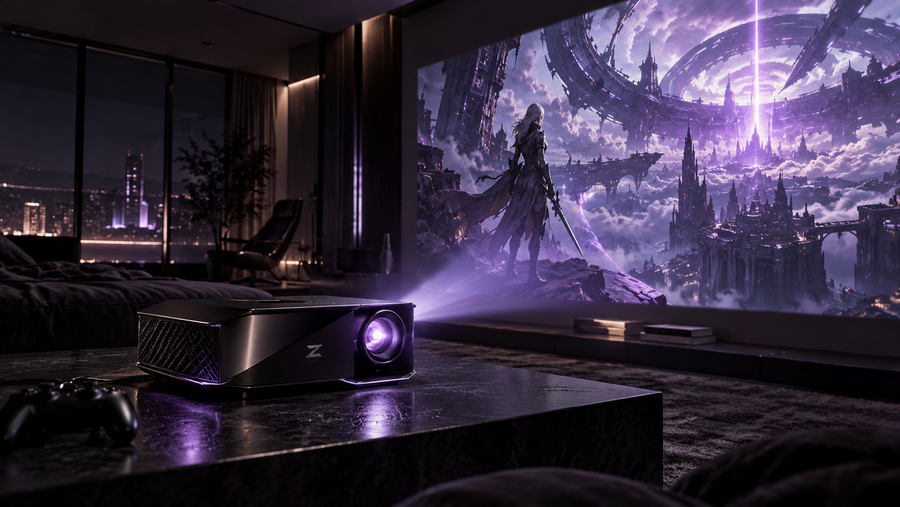
Each device is a fusion of cutting-edge technology and futuristic design, where engineering precision meets the aesthetics of a digital future, transforming any space into an arena of captivating gaming experiences.
Identity
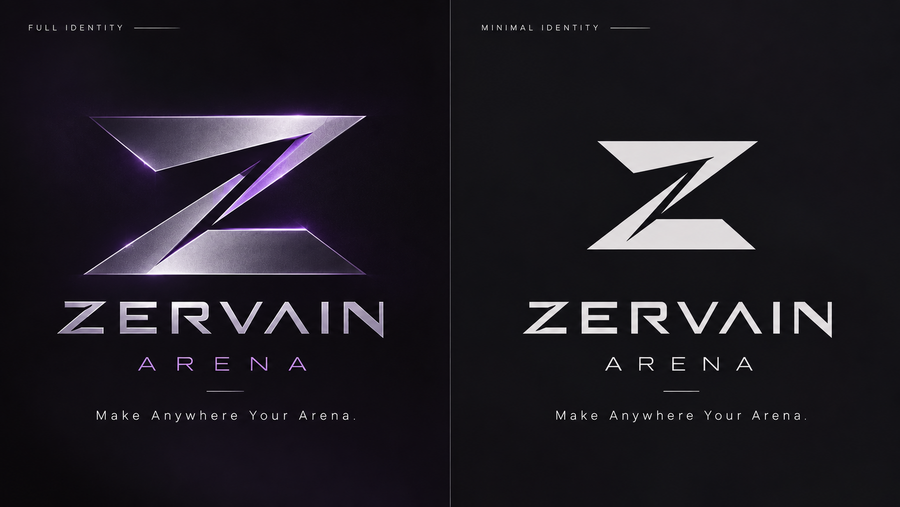
The ZERVAIN logo was created and refined using image generation in ChatGPT, based on prompts that reflect the brand’s futuristic aesthetic. The color palette was formed from graphite, silver, and amethyst hues, underscoring technological sophistication and premium quality. For typography, Michroma and Manrope fonts were chosen, blending geometric expressiveness with modern minimalism.
MAKE ANYWHERE YOUR ARENA.
Five scenarios. One device. Limitless possibilities for play.
Merch
Gamepad
Mousepad
Swappable Keycaps
Company Office
How I Created Images
WorkflowPhase 1. Concept DevelopmentInitially, I defined the startup’s direction—premium gaming electronics featuring a physical product.Through discussion with ChatGPT, I selected the name ZERVAIN, developed the concept for the ARENA portable gaming projector, and crafted the tagline: «Make Anywhere Your Arena.»Next, I established the brand’s visual identity: futuristic minimalism, a dark color palette, metallic surfaces, and amethyst accents.Tool: ChatGPT.Phase 2. Logo CreationTo develop the logo, I prepared a prompt to generate two variations of the brand mark on a single image: a full version and a minimalist version.The core of the logo was a geometric letter Z with sharp diagonal elements, referencing light rays and optical technologies.The initial full logo version lacked cohesion, so I used an additional prompt for refinement.This resulted in a clearer emblem that retained the metallic texture and purple light accents.Tool: ChatGPT Images.Method: Text-to-Image → Image Editing.Phase 3. Typography and Palette DevelopmentAfter approving the logo, I formed the visual identity system.Michroma was chosen for headings, and Manrope for body text.The color system comprised four shades: Obsidian Black, Ivory, Silver, and Amethyst.Based on these parameters, I generated a separate presentation sheet showcasing the fonts, color swatches, and their application.Tool: ChatGPT Images.Method: Text-to-Image, using the previous identity as a visual reference.
Phase 4. Visualization of the Core Product
The next phase involved creating the aesthetic for the ZERVAIN ARENA portable game projector.
I prepared a detailed prompt describing the device’s construction: a low, rectangular body, diagonal metal panels, a ventilation grille, and a circular lens with violet backlighting.
The first product key visual served as the primary visual benchmark for subsequent images.
Tool: ChatGPT Images.
Method: Text-to-Image.
Phase 5. Creation of Five Key Visuals
For the advertising campaign, I developed five distinct visual scenarios.
01 — The Next Generation. Studio product photography highlighting the device’s industrial design.
02 — Your Room. Your Arena. A home gaming room featuring a large-scale projection on the wall.
03 — Beyond the Screen. A demonstration of a racing game that emphasizes the dynamism and scale of the image.
04 — Play Together. A shared gaming session among three friends.
05 — Anywhere Is Your Arena. Using the portable projector on a skyscraper rooftop.
For each scene, I crafted a separate prompt, maintaining consistent requirements regarding the device’s design, lighting, and color palette.
Tool: ChatGPT Images.
Method: Text-to-Image with references and repeating constraints.
Phase 6. Merchandising Development
To expand the brand’s visual ecosystem, I designed three gaming accessories.
ZERVAIN PHANTOM — a limited-edition wireless gamepad.
ZERVAIN ARENA PAD — an XXL gaming mousepad featuring proprietary geometric graphics.
ZERVAIN NEXUS — a collectible keycap set for mechanical keyboards.
Each item was created using a separate prompt, detailing the materials, construction, signature elements, and studio photography conditions.
Tool: ChatGPT Images.
Method: Text-to-Image using brand identity images.
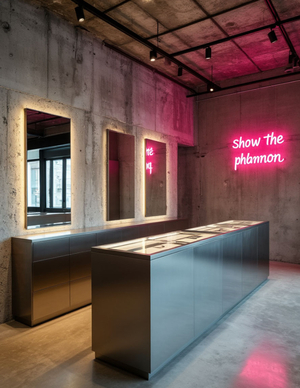
Stage 7. Spatial VisualizationTo demonstrate the application of the corporate identity in architecture, I created a concept for the ZERVAIN headquarters.The prompt described the reception area, engineers' workstations, a conference room, and the space for the ARENA projector display.Special attention was paid to integrating the logo, geometric forms, and corporate color palette into the interior design.Tool: ChatGPT Images.Method: Architectural AI visualization.Stage 8. Development of Advertising MediaI developed a concept for ZERVAIN ARENA outdoor advertising in the format of a citylight sign.This required creating a prompt that detailed the advertisement stand’s structure, logo placement, projector imagery, typography, and a nighttime urban setting.I also conceptualized the application of the identity on physical media: packaging, branded bags, business cards, documentation, and stickers.Tool: ChatGPT Images.Method: Generation of advertising mockups and branded objects.Stage 9. Cover DesignBased on the approved logo and the initial key visual, I developed a vertical project cover.The composition consisted of three main elements: the ZERVAIN logo, a large image of the projector, and the ARENA title with its slogan.The target cover format is 1140 × 1600 pixels, JPEG.Tool: ChatGPT Images.Method: Text-to-Image using existing visual references.ResultsThrough this work, I established a unified visual system for the ZERVAIN technology brand, encompassing identity design, physical product concepts, advertising key visuals, merchandise, architectural spaces, and promotional materials.The primary methodology involved combining structured text prompts, visual references, and iterative editing.This approach allowed for the sequential development of the brand while maintaining recognizable elements of the visual language across various image categories.