This project utilized assistance from ChatGPT 5.6 Luna
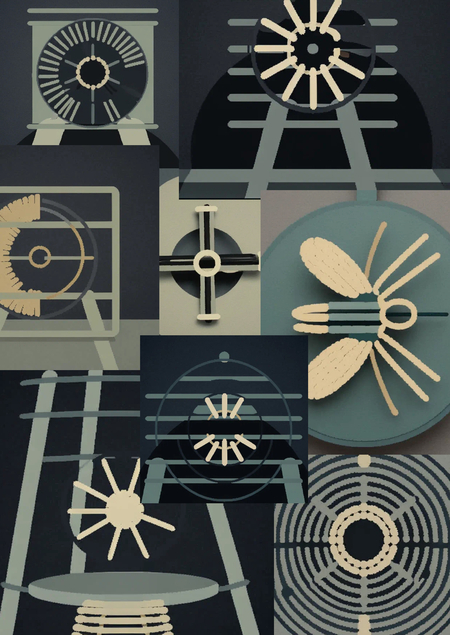
«Archive of Quiet Machines”—an exploration of a fictional museum collection: small biomechanical objects that look simultaneously like instruments, seeds, and relics of an unknown civilization.
The goal of this study is not to copy a specific object, but to internalize the visual language of the collection: the dark museum background, the frontal object composition, the muted palette of metal and ochre, the graphic casing, and the glowing central module.
The source images were created specifically for this academic project using a procedural script and are the original author’s material. External images and third-party works were not included in the dataset.
No. 1 Source Material

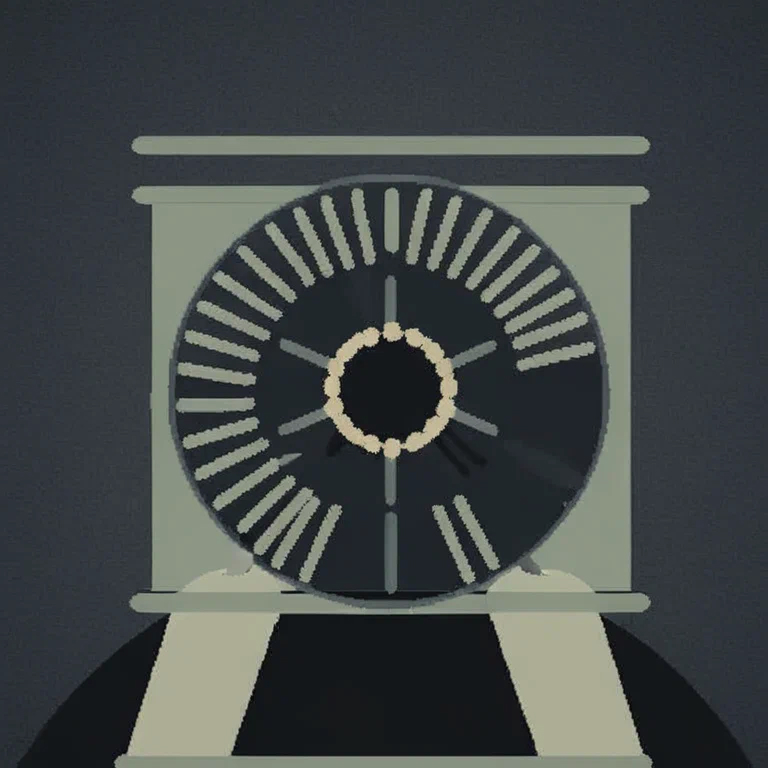
The dataset consists of 24 square images, sized 768×768 px. Variations were generated by altering the hull shape, antenna length, central module pattern, object placement, and background grain. Several examples can be found in outputs/dataset/.An example of one such image is shown on the left.
No. 2 Final Portfolio Series (Resulting Series)
The final series consists of eight images.
It reads like a catalog of finds: each object shares a common «genetic» trait—a symmetrical shell with a central core—yet differs in its internal symbol, the number of ribs, and its proportions.
1
2
3
4
5
6
7
8
No. 3 Visual Analysis
The series maintains consistency in background and scale: objects are placed within a conceptual museum space and photographed almost frontally. This helps present them as a unified archive rather than a collection of disparate illustrations. The overall palette is built around four groups: a charcoal-blue background, grayish-green metal, faded ochre, and a small light accent.
The differences manifest across three layers:
First, the silhouette changes: some objects are elongated vertically, while others appear heavier and rounder.
Second, the «character» of the core changes—be it an arc, a cross-axis, or a radial scheme.
Third, the technical detailing varies: the ribs of the shell, the antennas, and the supports.
Thanks to this, the model transfers not a single template, but a system of features.
The initial concept aligned perfectly with the result: instead of a literal character, a collection emerged where identity is defined by form and material. Further improvements made in the prepared pipeline include square cropping, uniform resolution, standardized descriptions, and the generation of several seed variations. For the final submission, it is recommended to select images free of artifacts and perform a light upscale if necessary.
No. 4 Learning Process
The notebook notebooks/sdxl_lora_archive.ipynb repeats the logic of the original example: installing Diffusers, loading SDXL, preparing images, DreamBooth LoRA training, saving the adapter, and generating a series using the unified trigger word quietmachine. The training is designed for Google Colab with a GPU. We recommend starting with 24 images, 800–1200 steps, a batch size of 1, gradient accumulation of 4, and a learning rate of 1e-4. The parameters should be adjusted according to the available VRAM.
Important: The images in this folder are an author-created procedural mock dataset to demonstrate the project structure. To claim that an SDXL LoRA has been genuinely trained, you must run the notebook and replace the preview section with the actual results from the run.
No. 5 Description of Generative Model Application
The project utilized the Stable Diffusion XL Base 1.0 model with a LoRA adaptation trained on a proprietary dataset.The generative model was employed to solidify the visual characteristics of the collection and to create new variations of objects based on textual descriptions. Additionally, ChatGPT was used to formulate the concept, structure the exposition, and prepare the notebook code. The procedural source images were created by the author’s script, not sourced from the web.
Links: original tutorial notebook [SDXL Base 1.0 on Hugging Face]https://huggingface.co/stabilityai/stable-diffusion-xl-base-1.0https://colab.research.google.com/github/shwars/ai-for-creatives/blob/main/6-DiffusionTraining/SDXL_DreamBooth_LoRA_Colab.ipynb
The final series was generated after training the SDXL LoRA on a proprietary dataset of 24 images. The keyword «quietmachine» was used to evoke the learned visual style.
The differences between the images were created by changing the textual descriptions of the form, the central core, the antennas, and the body material.
Number of images in the dataset: 24Image size: 768×768 pxNumber of training steps: 1200Model: Stable Diffusion XL Base 1.0Method: LoRANumber of final images: 8Number of generation steps: 30Guidance scale: 6.5