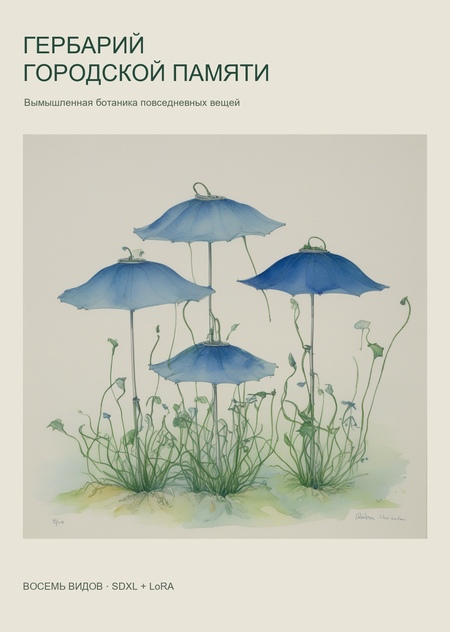
The Urban Memory Herbarium—a fictional botany of everyday objects.
The rhythm of city life is marked by its own set of repetitive gestures: turning a key, silencing an alarm, opening an umbrella, setting down a cup, waiting for the tram. These unnoticed actions coalesce to form the feeling of a familiar place.
In this imagined atlas, the key becomes a seed pod, the umbrella a flower cluster, and the streetlamp a drooping bud. Eight plants preserve the silhouettes of objects and the memories attached to them. All species and their names are fictional.
The visual foundation is botanical watercolor: a separate specimen on light paper, featuring a delicate outline, transparent color transitions, and attention to structure. The scientific format of the atlas prompts a re-examination of the ordinary object.
Visual Foundation and Dataset
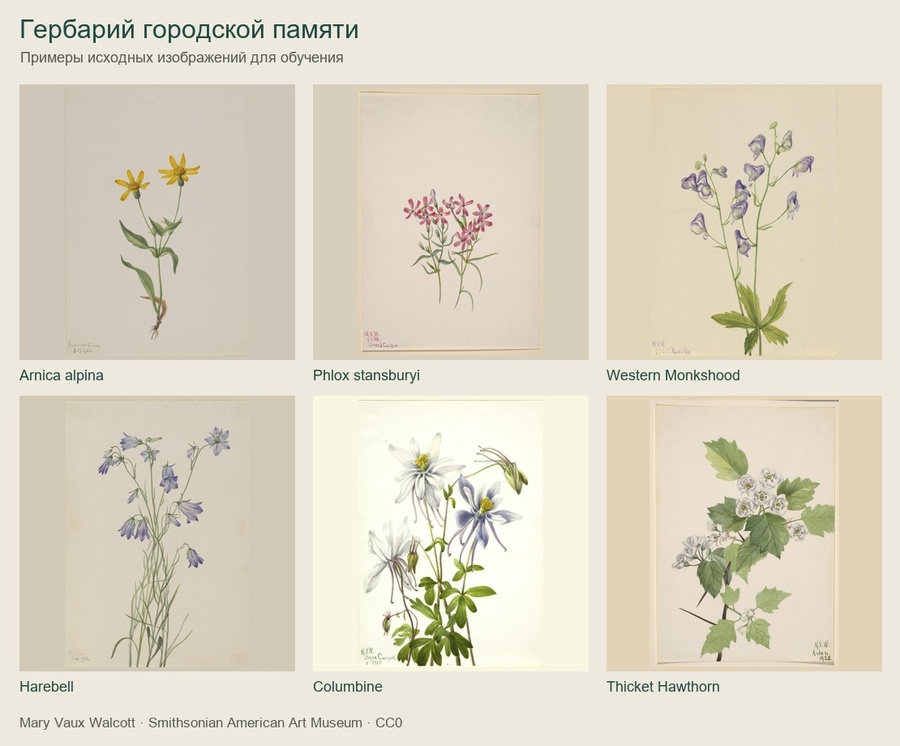
Mary Vaux Walcott. Smithsonian American Art Museum. CC0. The collection features Arnica alpina, Phlox stansburyi, Western Monkshood, Harebell, Columbine, and Thicket Hawthorn.
Forty museum illustrations were selected for training. Four additional images were set aside for visual comparison and excluded from the training set. Sources and licensing information are documented in the dataset registry.
Artist’s page: https://americanart.si.edu/artist/mary-vaux-walcott-5197 Open Access Terms: https://www.si.edu/openaccess/faq
The images have been converted to RGB and a square format of 1024×1024. The drawing is fitted proportionally without cropping the plant; the borders are filled with a color sampled from the edges of the paper. Captions describe the plant’s form and include the trigger «urbnherb watercolor style.» There are no urban elements in the training set—their geometry is defined by prompts during generation.
The collection preserves variations in paper tone, scale, and plant structure. The source material includes visible captions and sheet edges; these features are accounted for when validating generations. The museum works are not my illustrations; the original contribution to the project is the concept of a fictional atlas and the work with the generative model.
Model Training
Stable Diffusion XL Base 1.0 was fine-tuned using the DreamBooth LoRA method on 40 botanical illustrations. The UNet LoRA layers were trained; the text encoders remained frozen. The style trigger was «urbnherb watercolor style.»
The training was performed in Google Colab on a Tesla T4 with 14.6 GB of video memory. Parameters: 512×512, 800 optimization steps, learning rate 0.0001, rank 8, batch size 1, gradient accumulation 4, fp16, seed 42. The log shows completion of 800/800 steps; the training cycle counter was 1 hour, 32 minutes, and 6 seconds. The final weights were saved in pytorch_lora_weights.safetensors.
During launch, it was necessary to reconcile the Diffusers and Transformers dependencies, update TorchAO, and load the frozen components immediately in fp16 to reduce peak RAM consumption. The Diffusers script version 0.42.1 with this modification was used.
To assess the influence of the adapter, the base model and the LoRA model receive identical prompts and seeds. The contour, color, paper background, and readability of the urban object are compared. Similarity to the botanical illustration itself does not prove the effect of training; some of these characteristics already exist in the base SDXL.
Current run notebook: https://colab.research.google.com/drive/1wUj0XnFWORXaG8BEcY7khMsILwVPHVGQ Base model: https://huggingface.co/stabilityai/stable-diffusion-xl-base-1.0
What Changed in the Learning
The comparison on the left shows the base SDXL, and on the right—the same model with LoRA 0.7. In every row, the prompt, seed 2026, and generation parameters are identical. From top to bottom: keys, clock, umbrellas.
The LoRA emphasized the character of the botanical leaf: light paper, delicate stems, a restrained color palette, and distinct color washes. Simultaneously, the legibility of the objects decreased. In the first scene, both versions rendered seed pods instead of keys; in the row with the clock, the original model retained a large dial, while the LoRA transformed it into a faint circular frame. The umbrellas in both versions initially looked like blue flowers.
This comparison does not show an unqualified improvement. It revealed a conflict between style transfer and object geometry. For the final series, the LoRA strength was reduced to 0.45, and the prompts were refined: the rings and teeth of the keys, the alarm clock chimes, the domes of the umbrellas, the handle of the cup, the casings of the lanterns, the tram windows, and the details of the radio were explicitly described.
The Final Series
Eight imaginary species form a journey from a house key and a morning alarm to rain, evening tea, streetlights, a tram, a letter, and a distant radio signal. Below are selected images created by the trained model.
01. The House Key
The ring heads and serrated teeth maintain the key’s recognizability. Their metal shafts sit alongside delicate, winding shoots and leaves. The possibility of returning home becomes an image of growth and attachment to place. Instead of the three boxes from the initial concept, the model offered a whole range of keys—expanding the image into a collection of various doors.
02. Morning Sunflower
A large alarm clock occupies the central flower; light buds unfold beside it, and leaves wrap around the body from below. The object is recognizable by its circular dial, a pair of bells, and the top knob. The hands and numbers remain imprecise: the image conveys the obsession with time, not the mechanism of a working clock.
03. Rain Umbrella Canopy
Four blue domes rise above slender stems, resembling unusual flower heads. Radial seams and metal supports maintain the connection to the umbrellas; twisting tendrils link them to the plant. The varying heights create several small shelters—an image of personal space amidst the rain.
04. Evening Tea Leaves
A white, cup-shaped form unifies the open flower, the teacup, and the saucer. Yellow stamens are visible inside, and a green stem with two large leaves emerges from the bottom. Here, the everyday object dissolves into the botanical form more strongly than in the depiction of the teacup: the cup handle is subtly suggested. The image evokes the evening pause and the domestic ritual.
05. Twilight Lantern
Four amber lanterns hang from thin arches, reminiscent of both wire and stems. Green caps connect the metallic bodies to the foliage, and warm glows stand out against the light background. These familiar points of light are what allow the evening street to maintain the feeling of a lived-in place.
06. Tram Car Route Map
Three red wagons transform into miniature mobile gardens: greenery grows on the roofs and fills the windows. This variation diverges from the initial concept of rail-stems. After refining the brief, the tram became recognizable, but the plant and the vehicle connect primarily through sprouting and composite arrangement. The repetitive route is depicted as a place gradually imbued with memory.
07. The Unspoken Color Letter
Pink flowers are arranged on an open, light-colored envelope. The paper triangular flap and creases preserve the image of a letter, and the delicate stems seem to continue the lines of the paper. The model did not transform the petals themselves into envelopes; the connection became compositional. The letter becomes a space for words that have finally unfolded.
08. Distant Antenna
A pale radio receiver rises on several straight stalks; around it, round inflorescences unfold with delicate filaments. The speaker grille and the large tuning knob make the object recognizable. The inflorescences function as plant antennas. This final piece is dedicated to the attempt to hear a distant voice beyond the familiar route.
Visual Analysis and Selection
The series is unified by a delicate dark outline, green foliage, watercolor transitions, and the combination of an everyday object with a botanical form. The stylistic transfer is evident in the leaf veins and the uneven color washes. Meanwhile, the metallic details of the keys and the clockwork are denser and more graphic than the transparent stems.
The compositions vary. The keys form a vertical row; the clock is gathered around one large central point; the umbrellas and lanterns are distributed vertically. The teacup features an almost symmetrical single flower, while the tram features a heavy horizontal group of cars. The letter image uses an envelope as the plane of a herbarium sheet, and the radio serves as the upper accent of an elongated plant.
The degree of hybridization is uneven. The teacup with stamens and the umbrellas on stems bring the object closer to a plant organ. The keys and the radio retain their independent bodies and coexist with the shoots. In the tram image, the transport seems to be sprouting green rather than transforming into a plant. This represents the limit of the executed experiment, not the full realization of the original concept.
The background is not entirely consistent either: some leaves are light, and some are green. Pseudo-signatures remain visible in several images; the clock has inaccurate hands and markings, and in places, the stems are connected illogically. The negative prompt did not eliminate these artifacts. They were left visible and are not presented as authorial signatures.
A total of 18 variations of the series were generated for selection: two for each subject and two additional refinements. Six comparative images were created separately. The selection process utilized an AI assistant for object readability, form integrity, and conceptual connection; the student’s independent assessment remains necessary. For the tram image, seed 456 was chosen after refining the prompt; the letter image was kept with seed 42 because the additional variant lost the envelope.
The final images were generated at 1024×1024 with 30 steps, a guidance of 6, and a LoRA weight of 0.45. No inpainting, upscaling, or retouching was applied. The PNGs were saved as the original results, and JPEG copies were created without altering the composition for website upload.
Description of Generative Model Application
Stable Diffusion XL Base 1.0 (Stability AI) was utilized with a LoRA fine-tuned for this project. The objective of the fine-tuning was to transfer the visual characteristics of botanical watercolor; the goal of the generation was to create eight fictional plants inspired by urban elements. https://huggingface.co/stabilityai/stable-diffusion-xl-base-1.0
An auxiliary tool, Codex from OpenAI, model GPT-6, was employed. The assistant aided in concept development, searching for open-source material, preparing dataset captions, code and prompts, running and debugging the notebook, selecting options, image analysis, and drafting the website copy. A significant portion of the technical and editorial work was delegated to the AI; these actions are not presented as being performed solely by the student. https://openai.com/codex/
The training illustrations are works by Mary Vaux Walcott from the Smithsonian American Art Museum, published under Open Access with CC0 designation. They were not generated for this project and are not claimed as my own work. All plant names are fictional.
Project Materials
Training and Generation Notebook: https://colab.research.google.com/drive/1wUj0XnFWORXaG8BEcY7khMsILwVPHVGQ
Sources: https://americanart.si.edu/artist/mary-vaux-walcott-5197 Open Access Terms: https://www.si.edu/openaccess/faq
The parameters for each selected image and the execution details are saved in JSON files within the project package. The LoRA weights and checkpoints were created in the Colab environment. Please ensure the instructor has access to the notebook and verify the student’s final selection prior to submission.