Concept
This study examines the visual imagery and mechanics of power in the board game Root. The game is founded on a struggle for influence across a shared space among four factions, each possessing unique characteristics, actions, limitations, and ways to earn victory points [1]. The choice of this theme stems from the combination of captivating adventurous imagery and conflict built upon the struggle for territory, resources, and opportunities. This combination becomes integral to the game, allowing for the exploration of the visual form of power.
The theoretical foundation of this research draws upon the works of Eugen Fink and Johan Huizinga. Fink examines play and power within the phenomena of human existence, while also focusing on the duality of the game object and the position of the person taking on a role [2]. Huizinga links play to specific spatial and temporal boundaries within which its own order operates [3]. In this research, power is viewed through the ability to manage shared space and resources, and also in defining the conditions of others' actions and establishing relationships of dependency. This approach allows us to connect the structure of the forest with the participant’s position as they temporarily adopt the goals of one of the factions.
Power, in principle, is the relationship between people [2, p. 294].
Furthermore, the artistic form of the game is significant. Cole Wehrle stated that animalistic aesthetics should help participants feel more comfortable engaging in high-conflict play [4]. The illustrations are analyzed from the perspective of creating distance from the struggle for power through the fairy tale archetype, and they also help to present this struggle as an action within a constructed world.
The central research question is: how does the visual organization, mechanics, and rules of the tabletop game Root represent and allow the player to enact power relations within the game world?
The visual system of Root is viewed as an integrated environment where images denote roles, components signify the value of territory and resources, and player boards translate possibilities into a sequence of decisions. Through this interconnectedness, the struggle for influence becomes simultaneously depicted and enacted.
The foundational board game Root and its four factions—Marquise de Cat, Wyvern Dynasty, Forest Alliance, and Drifter—were selected for this study. This selection allows for a comparison of different foundations of influence within the overall game space and order. The research is based on the analysis of the board, player boards, cards, miniatures, tokens, as well as the illustrations accompanying the game and photographs of gameplay. Materials are selected based on their capacity to illustrate the connection between visual representation and action: faction affiliation, accumulation of commitments, resource utilization, control changes, and player interaction. This enables tracing the transition from the image of the forest to the concrete conditions of exercising power. Additionally, works that Kyle Ferry terms «artistic touchstones» are utilized to reveal the game’s origins.
The research is divided into five categories: 1. The Forest as a Play Space 2. Characters as Mechanisms of Power 3. Power Organized on the Board 4. Forest Fable: Image and Conflict 5. The Player Within the System of Power
The sections progress sequentially from the play space to the player themselves. The first examines the transformation of material objects into a forest world; the second compares ways of gaining influence with the limitations of each faction; the third reviews the graphical organization of actions on the game boards; the fourth analyzes the combination of adventurous imagery and military conflict; and the fifth explores player roles, cooperation, and power as methods of organizing the game world. This structure allows for a linkage between power and the conditions under which it is exercised.As textual sources, philosophical works by Fink and Heyting, scientific studies on gameplay, the materiality of board games, and participant interactions were selected. The works of Nguyen and Bogshot are used to analyze the connection between game objectives, actions, and the formation of meaning [5–6]. The official rules help verify the functions of the components and faction mechanics, while interviews with Verle and Ferrin allow for the correlation of visual solutions and intent. The sources are compared with visual material to analyze the provisions of the rules and the author’s intentions from the perspective of the concept of power.
Within the interactive space prevails a perfect order unique to it [3, p. 35].
The research hypothesis is that Root represents the concept of power through the interplay of rules, visual imagery, and the organization of player actions. The distinctions between factions are expressed in how they manage territory, resources, and support. The player boards and components make these methods visible and actionable. The narrative framing places the struggle for influence within a conditional inhabited world, where the decisions of one faction affect the standing of the others. The exercise of power within the game depends on the players jointly maintaining its order; the rules create the opportunities for power but also establish its limits.
The Forest as a Play Space
Components of the board game Root before starting the game
In the base version of the board game Root, four factions clash: the Marquise de Cat builds military and industrial presence; the Winged Dynasties strive to reclaim former dominance; the Woodland Alliance spreads sympathy and prepares for uprisings; and the Vagabond maneuvers between the factions for personal gain [1]. Their differences lie in their available actions and methods for scoring victory points. Thus, the forest can be viewed as a space where different ways of acquiring and maintaining influence collide.
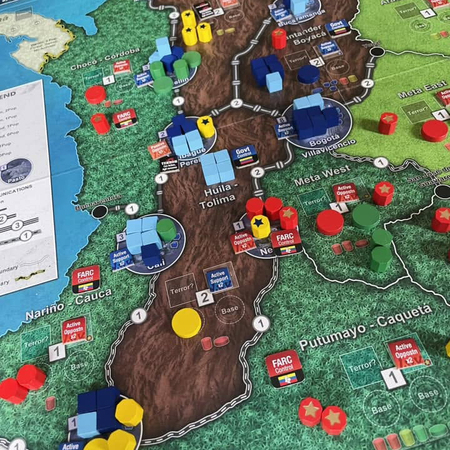
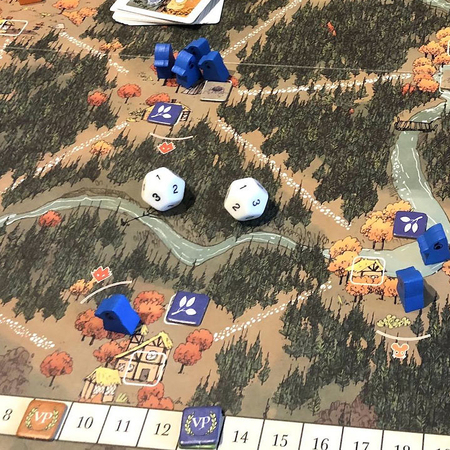
Left—the board game Andean Abyss, right—the board game Root
In Cole Wehrle’s development diary, early notes preceding Root are linked to plays in Andean Abyss, yet he cautions against equating them with the genesis of the project itself [7]. Later, he re-envisioned his work in light of an interest in asymmetry and the aesthetics of Leder Games; therefore, the origin of the game itself should be understood as a gradual convergence of several concepts and approaches.
A player is a person who plays, and simultaneously a person according to their in-game «role» [2, p. 360].
The player crafts the Better Burrow Bank card using two Marquee workshops on the rabbit suit field.
Marzy’s Toy Game Components
Hye-Jing describes play as an action bounded by time and space, within which a specific order operates [3]. Fink emphasizes the duality of the play object: it exists simultaneously in the real world and in the imaginary world of the game [2].In Root, this allows one to perceive the wooden figure as both a material object and a warrior, and the printed meadow not just as a sheet of cardboard, but as territory over which a battle is fought.
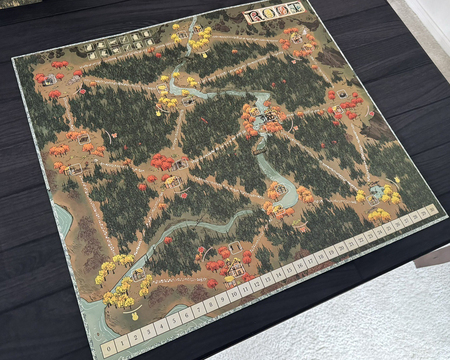
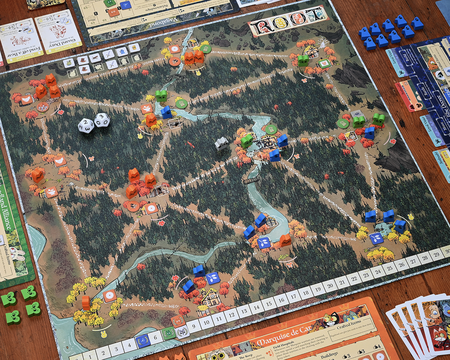
Left—an empty board game setup for Root; right—the board during gameplay.
Characters as Modes of Power
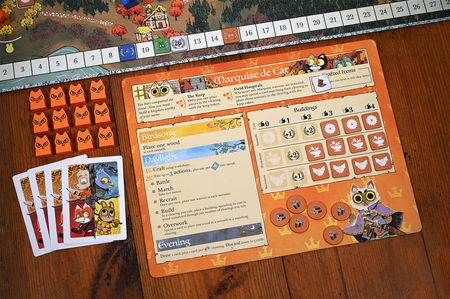
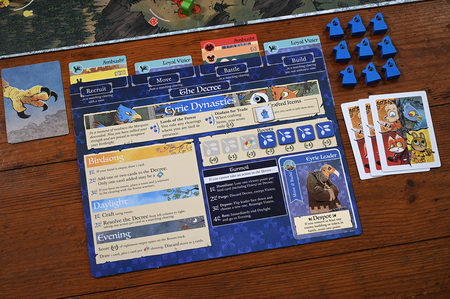
Left—Markiza de Cot’s tablet; right—Dynasties of the Winged Tablet.
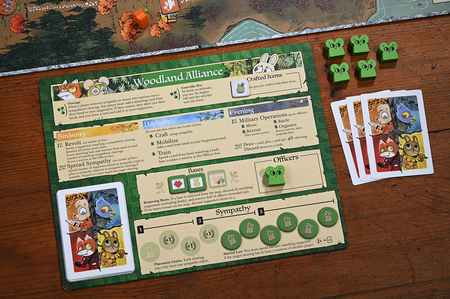
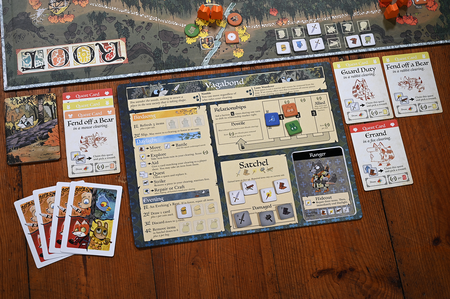
On the left is the Forest Union tablet, and on the right is the Wanderer tablet.
Root factions differ in their available actions, victory point acquisition methods, and restrictions [1]. Nguyen views the game rules and player objectives as a way to impose a specific behavioral paradigm on the participant [5]. In this sense, choosing a faction means adopting a particular logic of decision-making: the player must notice what opportunities and threats exist for that faction, so comparing factions helps explore how the drive for power influences player behavior and directs attention.
Warriors and Resources of the Marquesas of Cat
The Marquise earns victory points for building by using timber from the building site or from connected controlled clearings [1]. Therefore, the value of territory is determined by the presence of warriors and the incorporation of that territory into economic connections. Losing an intermediate clearing will make distant resources unavailable for construction. The Marquise’s dominance in such an organization can be viewed as constant upkeep of infrastructure vulnerable to rivals' interference.
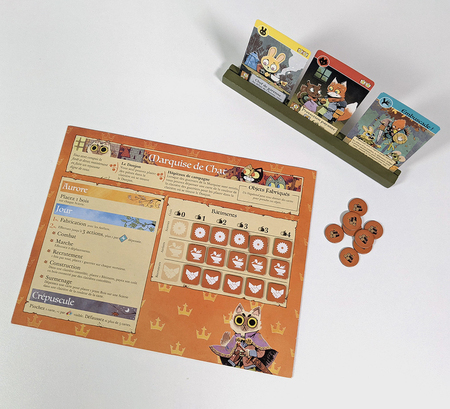
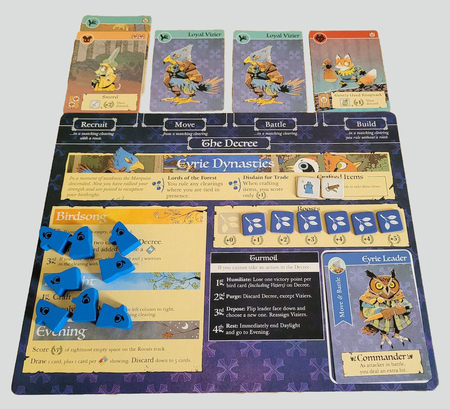
On the left—Markiza de Cot’s tablet, on the right—The Winged Dynasties tablet
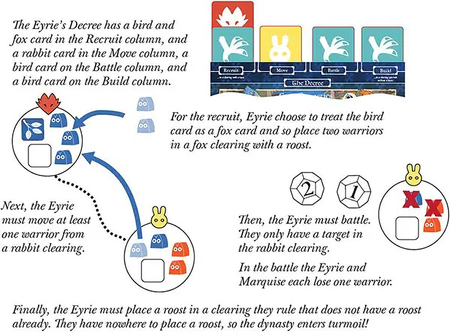
Winged dynasties annually enrich the Edict and are obligated to follow its prescribed actions. If they cannot complete all actions, unrest ensues and a change of leader occurs [1]. Verle views adherence to a pre-established plan as a way for the player to justify aggression by fulfilling obligations [4]. This creates a duality: the player forms the order themselves and then submits to it. The power within this faction can be seen as the ability to establish obligations by constantly confirming their feasibility.
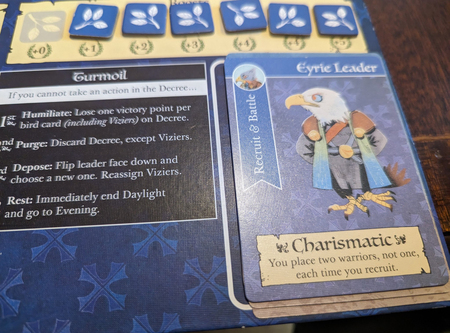
On the left — the leader of the Winged Dynasties; on the right — the master of the chaos.
Forest Union Game Components